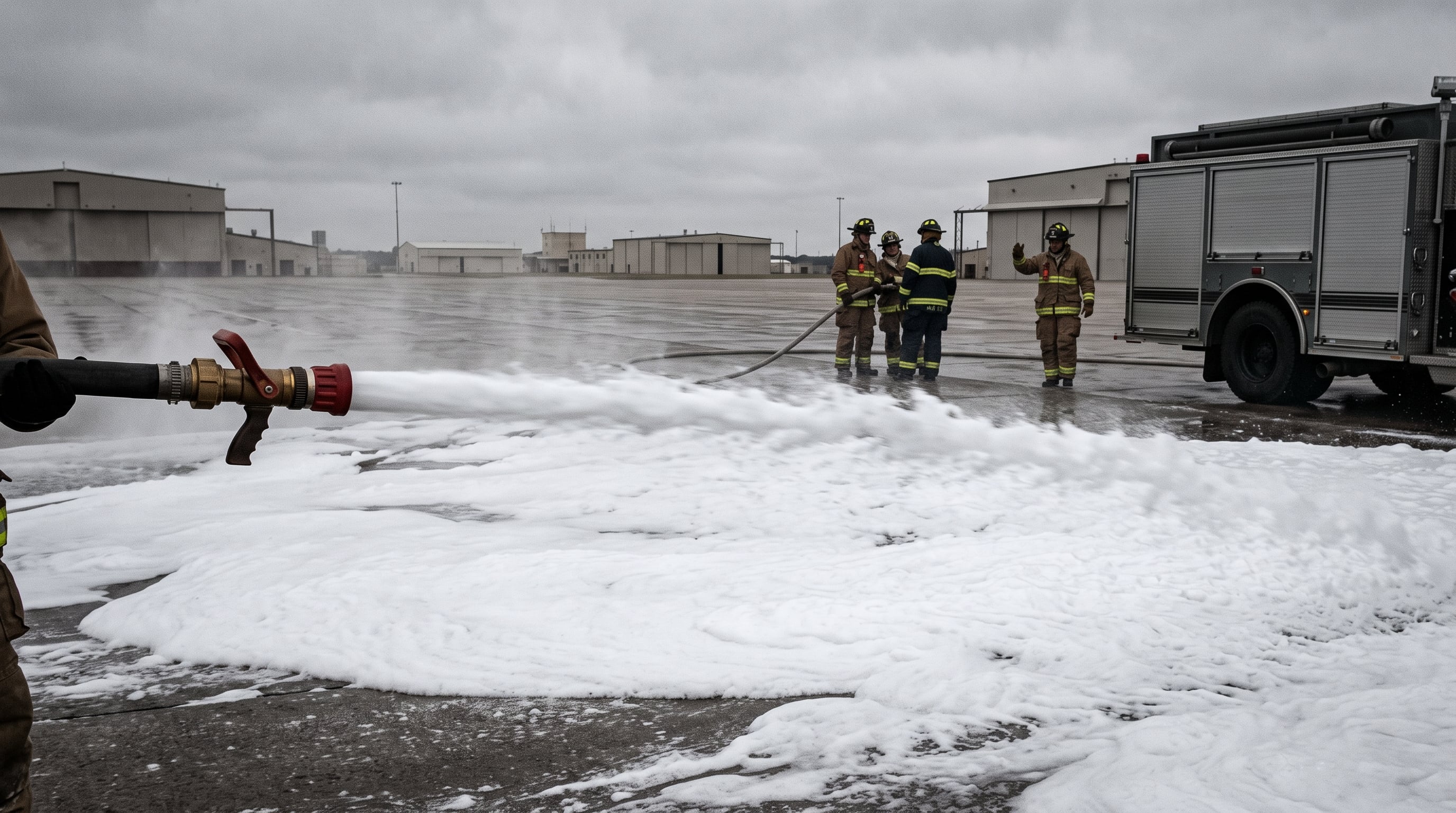
Aqueous film-forming foam was adopted by the Navy in the 1960s and became mandatory across the services for any facility handling fuel. It works by floating a fluorinated film across burning fuel and cutting off oxygen, and it works extraordinarily well — which is why it was sprayed at every crash rescue drill, every fire school evolution, every shipboard damage control exercise, and every accidental hangar system discharge for more than fifty years. Firefighters trained in it, stood in it, and washed their gear in it.
The chemistry that makes PFAS effective is the chemistry that makes it dangerous. The carbon-fluorine bond is the strongest in organic chemistry, so these compounds do not break down in the environment or in the body — hence forever chemicals. They accumulate in blood serum with a half-life measured in years, and firefighter blood studies routinely show serum PFAS several times higher than the general population. There is no VA presumption for PFAS today. That is a statement about the state of the regulation, not about the state of the science.
What you were actually breathing, drinking, or touching
No VA presumption exists for PFAS or AFFF as of today. These are facts-found claims — and the Department of Defense PFAS installation testing data is strong, public exposure evidence.
Where it was, when it was, and who was standing there
The exposure, in specifics
A claim is decided on specifics. Location, date range, and duty — in that combination — are what turn an assertion of exposure into a documented one.
Flight lines and crash rescue
Every military airfield ran AFFF crash and rescue training. Aircraft rescue firefighters discharged it repeatedly in live-burn pits, often with no respiratory protection and no barrier between the foam and their skin.
Hangars and fixed suppression systems
Hangar deluge systems held thousands of gallons of AFFF concentrate and discharged accidentally with some regularity. Anyone working in the hangar during or after a discharge was in it — not only the fire department.
Shipboard damage control
Navy damage control teams trained with AFFF in confined shipboard spaces with limited ventilation, which raises inhalation exposure well above what an open flight line produces.
Base drinking water
AFFF discharged into unlined training pits migrated into groundwater. Hundreds of installations have documented PFAS in or near the drinking water supply, which extends the exposed population far past the fire department to everyone who drank base water.
How you qualify
The routes available on this exposure
Work out which route your case is on before you gather a single document. Preparing the wrong evidence is the most common reason a truthful claim comes back denied.
Facts-found route
The direct route — and it is the only route right now
You must show the exposure, the diagnosis, and the nexus. The exposure is provable two ways: occupationally, through your job and unit — firefighter, crash rescue, damage control, hangar crew — or environmentally, through the Department of Defense PFAS testing results for your installation, which are published by installation and are unusually specific. Anyone telling you a PFAS claim cannot be filed is confusing “no presumption” with “no claim.”
Occupational proof: MOS or rating, unit assignment, fire school records, training logs.
Environmental proof: DoD PFAS installation testing results for your base and years.
A serum PFAS blood test, where available, is direct biological evidence of body burden.
The nexus opinion should cite the epidemiology on kidney cancer, testicular cancer, thyroid disease, and ulcerative colitis.
Secondary route
Conditions downstream of a granted PFAS claim
Thyroid disease produces fatigue, weight change, cardiac effects, and depression. Kidney disease produces hypertension and anemia. Ulcerative colitis produces malabsorption, anemia, and the surgical residuals that follow bowel resection. Each of these is separately ratable once the primary is granted.
Thyroid disease to cardiac and mental health effects.
Kidney disease to hypertension and anemia.
Ulcerative colitis to surgical residuals and nutritional deficiency.
Two different things — never combine them
A presumption and a TERA determination are not the same thing
These two get mixed together constantly — by veterans, by service officers, and sometimes in the decision letter itself. They are separate mechanisms that answer separate questions. One asks where and when you served. The other asks what you did while you were there. Treating either one as a substitute for the other is how a winnable claim gets prepared the wrong way and comes back denied.
Here is the fastest way to tell which lane you are standing in. A presumption almost always comes out of a deployment or an assignment to a place that has already been named — Vietnam, the Gulf, the Korean DMZ, the burn-pit countries, Camp Lejeune. Congress or VA drew a box around a region and a set of dates, and if your service falls inside that box and your diagnosis is on the list attached to it, you are in the presumptive lane and the law does the connecting for you. TERA is for everything else. If your exposure did not come from being sent to one of those named locations — if it came from the aircraft you turned wrenches on, the fuel you pumped, the foam you sprayed, the paint and solvent you stripped with, the engine room you stood watch in, the stateside installation where the work itself was the hazard — then no list is ever going to carry your claim. That is a TERA case, and it is proved with your duties.
Read both columns before you decide what to gather. If you are in the presumptive lane, the work is proving your service facts — orders, dates, locations. If you are in the TERA lane, the work is documenting what you actually did and then getting a medical opinion that ties it to the diagnosis. Those are two entirely different piles of paper, and preparing the wrong one costs months. And plenty of veterans are standing in both lanes at the same time — one condition that qualifies off a deployment, another that only ever gets connected through the work.
Set by law — where and when you served
A presumption
A presumption is written into statute and regulation. It has three moving parts and all three have to line up: a specific place, a specific date range, and a diagnosis that appears on the list attached to that place. When they do, VA presumes the exposure and presumes the connection — you never have to produce a medical opinion tying the disease to the service.
It is decided on service records, not on medical evidence.
Miss the location or the date window by anything at all and the presumption simply does not apply.
The condition list is closed — a diagnosis that is not on it is not presumptive, however strong the science behind it.
If you do qualify, it is the fastest route to a decision that exists.
Based on what you actually did
A TERA determination
TERA stands for Toxic Exposure Risk Activity. It is VA’s finding that your service involved an activity that put you at risk of a hazard, and it comes out of your duties, your assignments, and the work you actually performed — not out of a list of places and dates. It is not a presumption, and on its own it does not grant service connection.
What it does: it puts the exposure into the record, and under 38 U.S.C. § 1168 it generally obligates VA to obtain an exam and a medical opinion when there is a current disability and the file is otherwise short of proof.
What it does not do: it does not concede the medical link. VA can find TERA and still deny the claim for “no nexus.”
It is also used on the health care side, to establish eligibility to enroll and to get the toxic exposure screening.
It is frequently missing from the file, or built off your primary job code alone — which misses the duties that actually exposed you.
Keep them apart — four rules that decide claims
No presumption does not mean no claim. It means your claim is facts-found, and the link gets built with evidence instead of handed to you by regulation.
A TERA finding is not a presumption. It never removes the need for a nexus opinion — it is what forces VA to go get one.
You can be in both lanes at once. Presumptive on one condition and facts-found on another, inside the same application.
Serving somewhere with a documented hazard is not the same as qualifying for a presumption. The presumption needs the exact place, the exact dates, and a listed condition — all three.
The condition lists
What is on a list, and what is not
Read the label above each list carefully. A presumptive list and a health-care eligibility list are two different things, and confusing them costs veterans claims every single day.
Conditions with the strongest PFAS association in the literature
These are NOT VA presumptives. They are the diagnoses the epidemiology supports, and the ones a nexus opinion can be built around.
Kidney cancer
Testicular cancer
Thyroid disease, including hypothyroidism
Ulcerative colitis
Pregnancy-induced hypertension and preeclampsia
High cholesterol
Liver damage and elevated liver enzymes
Reduced vaccine response and immune effects
How to apply
The filing order, with the actual forms
Order matters. Filing in the wrong sequence is how veterans lose months of back pay on a claim that was always going to be granted.
1
VA Form 21-0966
Lock the effective date now
If a PFAS presumption is enacted later, an earlier effective date is worth years of retroactive pay. Filing early costs nothing and preserves everything.
2
Pull the DoD PFAS testing data for your installations
The Department of Defense publishes PFAS testing results by installation. Get the results for every base you served on and note the years the sampling covers.
3
VA Form 21-526EZ
File the claim and name AFFF explicitly
State the job, the installations, the years, and the foam by name. Vague exposure language produces vague development and a fast denial.
4
VA Form 21-4142
Release your private records
Kidney, thyroid, and gastrointestinal conditions are usually managed privately. Those records carry the diagnosis and the severity.
5
VA Form 21-22a
Appoint an accredited agent
PFAS claims are developed, not filed and forgotten. Talk to us first so the evidence is built before the decision rather than after it.
Evidence to gather
What belongs in the file before you file
DD-214 and personnel records showing a firefighting, crash rescue, damage control, or flight line assignment.
Fire school and recurring training records documenting live-burn AFFF evolutions.
Department of Defense PFAS installation testing results for every base you served on.
Serum PFAS blood testing where you can obtain it — it is body-burden evidence, not inference.
Buddy statements describing foam discharges, hangar system activations, and the absence of protective equipment.
Complete treatment records for the claimed condition, including pathology.
A nexus opinion from a physician who engages the PFAS literature by name.
What you will be told, and the answer
The shortcuts to expect
““PFAS is not on any VA presumptive list.””
True and beside the point. Direct service connection under 38 CFR 3.303 does not require a presumption — it requires evidence. Every presumption in the system began as a series of won direct claims.
““PFAS is in everyone’s blood, so service did not cause it.””
Background exposure is not military exposure. Occupational firefighter serum studies show levels several times higher than the general population. The question is not whether you had any — it is whether service raised it, and the data says it did.
““There is no record you handled foam.””
Your rating or MOS, your unit, and the installation PFAS testing record together establish the exposure. Contemporaneous handling logs were never kept for a substance nobody considered hazardous at the time, and their absence cannot be held against you.
Why representation changes the odds
Register with us on your pfas & firefighting foam (afff) claim
Tell an accredited agent what happened and we will review your situation first, then tell you honestly whether we can help. One form, one click, and a real person reads it.
Filing now preserves an effective date that becomes extremely valuable if a presumption is enacted later. Waiting is the single most expensive decision in this exposure.
Most PFAS denials are exposure denials, and the DoD installation testing data answers them directly — if it is actually in the file.
The nexus opinion has to name the compound and the study base. We tell the physician what the opinion has to address.
Firefighters usually have several exposures stacked — foam, fuel, combustion products, asbestos. Claiming them together is stronger than claiming them one at a time.
VA-Accredited Claims Agent #45147
Albert Thombs
An accredited agent personally reviews every request — we’ll reach out within 48 hours.
Registering opens the secure sign-up form of the advocate who is next to take a new file, in a new tab. If you would rather have someone look at your situation before you decide anything, ask for the free case review instead.
Office hours: Mon–Fri, 11am–6pm Pacific
Keep building the case
The era, the job, and the medical evidence that go with this exposure
Direct service connection: 38 CFR 3.303. Benefit of the doubt: 38 CFR 3.102. Exposure documentation: Department of Defense PFAS installation testing results. General information for education, not legal or medical advice.
Both options are free · No obligation
Two ways to work with us — both free
Talking to a VA-accredited claims agent costs nothing either way. Pick the one that fits: get answers to your questions, or register to hire us to take on your claim.
Free information — just ask
You can ask Albert, our AI claims assistant, anything about exposure, evidence, or the claims process — he answers instantly. If you would rather have a direct, personal answer, send your question below and an accredited agent will come back to you. No cost, no obligation.
Or send your question
Ready to hire us? Register with us
For veterans who have decided they want us on their claim. Registering is free too, and it takes the registration form plus a signed VA Form 21-22a.
Until VA Form 21-22a is signed we cannot accept your claim, access your VA file, or do any work on your behalf. That is federal law, not firm policy.
What happens after you register
You register. This simply starts the conversation — you are not our client yet, and you owe us nothing.
You sign and return VA Form 21-22a. It appoints us as your accredited representative and gives us access to your VA file.
Once we have your signed 21-22a and access to your case, we verify everything is in order.
We review your case in full and conduct your interview with an accredited agent.
Only then do YOU decide whether to move forward with us. If you choose not to, we will not proceed on your behalf — no pressure, no obligation.