
Veterans Crisis LineDial 988 then Press 1 — or text 838255· Free & confidential, 24/7
Toxic Exposure Evidence Center shieldToxic ExposureEvidence Center
When the answer was no

There are four ways to fight a VA decision. These are their real names.

A denial letter is a decision, not a verdict. There are exactly four lanes out of it — a Supplemental Claim, a Higher-Level Review, the Board of Veterans Appeals, and the Court of Appeals for Veterans Claims — and each one carries its own form, its own deadline, and its own rule about whether you are even allowed to send in evidence. Get the lane right and you keep your effective date. Get it wrong and you usually just lose time. Here is all four, laid out.

A veteran at his kitchen table with an opened VA decision letter in front of him

Read this first

Most veterans quit right here, because nobody ever named the options

The letter arrives, it is several pages of numbered paragraphs, and somewhere in the middle it says the evidence does not show the condition is related to service. Most people read that as the end of the claim. It is not. It is the point where the system finally tells you what it thinks is missing — and where you get to choose, deliberately, which of four different doors you walk back through.

The four lanes are not four flavors of the same thing. They split on one question: can new evidence come in, or not? Two of them are built for evidence. Two of them are built for legal error on a record that has already closed. Sending the right thing into the wrong lane is the mistake that costs veterans years.

The letter says what they decided, not why they were wrong

A decision letter gives you the outcome and a short list of what VA looked at. The reason your claim actually failed is usually one line buried in the reasons-for-decision section — no evidence of exposure, no nexus opinion, the condition is not presumptive for that place. Find that line first. It decides which lane you belong in.


One year. That is the clock on the letter.

For decisions dated on or after February 19, 2019, three of the four lanes run on the same deadline: one year from the date on the decision notice. The clock does not care that you were in treatment, that you moved, or that you never opened the envelope. Put the date on a calendar the day the letter arrives.

Staying inside the year protects your effective date

The effective date decides how far back your benefits reach. Keep challenging inside the one-year window and the original date stays alive. Let the year lapse and file fresh later and you can win the exact same condition with a much later start date. Any figure anyone gives you for that difference is an estimate — confirm it on VA.gov.

The wrong lane usually costs time, not the claim

Pick wrong and you generally lose months, not the case — except when the year runs out while you are sitting in the wrong place. The most common and most expensive mistake is mailing new evidence into a lane that is legally forbidden from looking at it. Read the evidence rule on each lane below before you mail anything.

The four lanes

Supplemental Claim, Higher-Level Review, the Board, and the Court

Read all four before you pick one. The line to look for in each is the evidence rule — it decides whether the lane can help you at all. Then look at who decides, because sending a legal argument back to the same office that just made the error is how veterans end up in year three of a claim that should have taken one round.

A veteran and his wife at a dining table assembling new evidence for a supplemental claim, including base records, buddy statements and a physician letter

Lane 1 of 4

Supplemental Claim

VA Form 20-0995

This is the lane for something VA has not seen. It replaced the old new-and-material standard with a lower one: the evidence has to be new — not already in the file — and relevant, meaning it tends to prove or disprove something at issue. That is a far easier bar than most veterans assume.

Deadline
Any time — inside one year to protect your effective date
New evidence
New and relevant evidence is required
Who decides
Your VA regional office
  • The duty to assist applies here. Identify a record and VA is obligated to try to get it — service records, unit records, a VA treatment file.
  • It is decided back at the regional office level, not by a judge, which is why it is usually the fastest real fix.
  • You can file it any time, even years later. Filing inside the year is what keeps the earlier effective date alive.
  • A change in law counts. If your condition became presumptive after your denial, that is a basis for this lane.

Use this lane when

The exposure chain was never documented. No nexus opinion was ever obtained. Base, unit or duty records were never pulled. A diagnosis came in after the decision. The law changed.

Do not use it when

Do not use it when the file is already complete and the mistake is legal. Handing VA the same record a second time invites the same answer.

A senior VA reviewer at a desk with a headset re-reading the same claim file with no new evidence added

Lane 2 of 4

Higher-Level Review

VA Form 20-0996

This lane says: you already had everything you needed and you got it wrong. A more senior reviewer takes the claim de novo — a genuinely fresh look, not bound by the first decision — but only on the exact record that already existed.

Deadline
Within one year of the decision
New evidence
No new evidence — the record is closed
Who decides
A senior VA reviewer, deciding fresh
  • No new evidence may be submitted or considered. Mail evidence into this lane and it does not get looked at. This is the single most expensive mistake in the whole appeal system.
  • You may request one informal conference — a phone call where you or your representative point straight at the error. Use it. It is the only point in the process where someone has to listen to you name the mistake.
  • The reviewer can find a duty-to-assist error and send the claim back for the development that should have happened the first time.
  • You cannot ask for a Higher-Level Review of a Higher-Level Review decision. From there the road runs to the Board.

Use this lane when

A TERA memo or a conceded exposure is already in the file and the decision never addressed it. The examiner opinion never answered the question that was asked. A presumption applied and was not applied. The wrong rating criteria were used on a complete record.

Do not use it when

Do not use it if what you actually have is new evidence. It will sit in the file unread while the year burns.

An empty formal federal hearing room with a raised bench and a witness table, of the kind used for veterans appeals hearings

Lane 3 of 4

Board of Veterans Appeals (BVA)

VA Form 10182

This lane takes the claim out of the regional office and puts it in front of a Veterans Law Judge. On the form you choose one of three dockets, and that choice is the whole strategy — it controls whether you can submit evidence, whether you get to speak, and how long you wait.

Deadline
Within one year of the decision
New evidence
Depends entirely on the docket you choose
Who decides
A Veterans Law Judge
  • Direct Review — no new evidence, no hearing. The judge decides on the record as it stands. Fastest of the three.
  • Evidence Submission — you may submit new evidence within 90 days of filing, and there is no hearing.
  • Hearing — you appear before the judge and you get 90 days after the hearing to submit evidence. Slowest of the three.
  • The judge can grant, deny, or remand. A remand sends it back with instructions — frustrating, but often what wins the claim two steps later. Board decisions in other veterans cases are nonprecedential, so a favorable outcome elsewhere is persuasive, not binding.

Use this lane when

The regional office made the same error again after a Higher-Level Review or a Supplemental Claim. The dispute is legal and you want it in front of a judge instead of the office that already told you no.

Do not use it when

Do not choose the Direct Review docket if you are still holding evidence you intend to submit. You will have closed that door on yourself.

The entrance of a modest federal courthouse building of the kind that hears appeals of veterans benefits decisions

Lane 4 of 4

Court of Appeals for Veterans Claims (CAVC)

Notice of Appeal filed with the court

This is the lane almost nobody explains, and the reason is simple: it is not a VA office at all. The Court of Appeals for Veterans Claims is a federal court, independent of the VA, and it reviews a Board decision for legal error.

Deadline
120 days from the date the Board mailed its decision
New evidence
None — the record closed at the Board
Who decides
A federal court outside the VA
  • The deadline is a Notice of Appeal within 120 days of the date the Board mailed its decision. That one is hard. Miss it and the court cannot hear you at all.
  • No new evidence. The record closed at the Board. The court decides whether the law was applied correctly to what was already there.
  • The court can affirm, reverse, or remand. A remand back to the Board is by far the most common outcome.
  • From the court, a further appeal runs to the U.S. Court of Appeals for the Federal Circuit.

Use this lane when

The Board applied the wrong law, ignored evidence that was squarely in front of it, or failed to give reasons you can follow. The fight has stopped being about facts and become about law.

Do not use it when

Do not treat it as another bite at the evidence. If what you are missing is a record or an opinion, that belongs in a Supplemental Claim, not in a federal court.

Match the denial to the lane

What your letter said, and where that actually belongs

These are the sentences that turn up over and over in toxic-exposure denials. Find the one closest to yours. This is a starting point, not a substitute for somebody reading your file — the same sentence can point two different directions depending on what is already in the record.

The decision said

Your condition is not on the presumptive list for that location.

The lane

Supplemental Claim

Why

Presumption is one road, not the only road. Direct service connection is still open — build the exposure record and get an opinion that ties the disease to it.

The decision said

There is no evidence you were exposed to a hazard.

The lane

Supplemental Claim

Why

This is a records problem, and records are exactly what this lane is for — base histories, unit records, the duty you actually pulled, and buddy statements.

The decision said

A TERA memo is in your file and the decision never mentions it.

The lane

Higher-Level Review

Why

Nothing new is needed. The error is sitting on the record you already have, which is precisely what a senior reviewer is there to catch.

The decision said

The examiner said any connection would be speculative.

The lane

Either one — read the opinion first

Why

Higher-Level Review if the opinion is inadequate on its face and never answered the question asked. Supplemental Claim if what you truly need is a better opinion.

The decision said

Your condition became presumptive after your denial.

The lane

Supplemental Claim

Why

A change in law is a recognized basis in this lane. The PACT Act moved a great many conditions after the denials had already been mailed.

The decision said

The presumption plainly applied to you and the decision ignored it.

The lane

Higher-Level Review

Why

The dates, the place and the diagnosis are already in the file. Do not rebuild what is already proven — put it in front of a reviewer who can correct the law.

The decision said

The regional office repeated the same error after your Higher-Level Review.

The lane

Board of Veterans Appeals (BVA)

Why

You have given that office two chances. A Veterans Law Judge is not bound by what they concluded, and can remand with instructions they have to follow.

The decision said

The Board applied the wrong law to your exposure case.

The lane

Court of Appeals for Veterans Claims (CAVC)

Why

Legal error at the Board is the entire job of that court. 120 days from the mailing date — this is the one deadline with no cushion in it.

A veteran and an advocate reading through a stack of service and treatment records

Both options are free · No obligation

Not sure where you stand? Let us look at it.

Tell us what happened and what the VA said. An accredited agent reads it and tells you honestly what he sees — no cost, no obligation. When you are ready to have us fight it, register and we start.

An accredited agent personally reviews every request — we’ll reach out within 48 hours. Or call 702-992-4883.

The dates that bite

Four numbers worth writing on the envelope

Every one of these runs from a date printed on a document, not from when you found out, felt well enough, or finally got somebody to help. Check each one against your own letter — the date on your paperwork is the only one that governs your case.

One year

Supplemental Claim, Higher-Level Review, Board

Measured from the date on the decision notice, not the day you opened it. Each new decision starts a new one-year clock.

90 days

The Board evidence window

On the Evidence Submission docket, 90 days from filing. On the Hearing docket, 90 days after the hearing. On Direct Review there is no window at all.

120 days

Notice of Appeal to the CAVC

From the date the Board mailed its decision. This is a federal court deadline and it does not bend.

Any time

A Supplemental Claim after the year is gone

The door does not lock. The effective date moves, which is why filing late and filing on time are not the same win.

The honest part

Where the four lanes stop working, and who can stand where

Nobody is served by a page that pretends every case drops neatly into one of four boxes. Four situations sit outside them — and one of those is about the limits of an accredited agent, this one included.

If your decision predates February 19, 2019

Older decisions that were never moved into the current system run on the legacy appeal process — a Notice of Disagreement, a Statement of the Case, and a Form 9 to the Board. If those are the words on your paperwork, you are in the old system, and the four lanes above do not map cleanly onto it. Have somebody read the letter before you file anything.

If the year is already gone

You have two options and neither is a fifth lane. File a Supplemental Claim and accept a later effective date, or, on a final decision, raise a clear and unmistakable error — a narrow argument that the decision was undebatably wrong on the law or the facts in front of it at the time. Narrow is the operative word.

Where an accredited agent can stand, and where he cannot

VA accreditation covers representation inside the VA — the regional office, a Higher-Level Review, and the Board. It does not reach the Court of Appeals for Veterans Claims; that court admits its own practitioners under its own rules. Anybody who tells you otherwise is selling you something. If your case belongs in that court you should be told so plainly and pointed toward counsel who practices there.

Confirm the form and the date before you mail it

Form numbers and processes do change. Confirm every date and form number on this page on VA.gov, or with the VA at 800-827-1000, before you rely on it. This page is general education from an accredited agent. It is not legal advice, and this is not the VA.

If you want even more depth on one lane

Everything you need to choose a lane is on this page. If you want a longer walkthrough of a single lane, Albert built a separate free site that takes each one apart — same author, same accreditation, nothing to buy.

Open the appeal-options walkthrough

Bring us the letter

Have somebody read the denial before you pick a lane

The lane is chosen off two things: the exact reason they gave you, and what is already sitting in your file. Send the decision letter and tell us where you served and what you handled. Albert Thombs is a VA-accredited claims agent, #45147, and the review costs you nothing. If the year on your letter is close to running out, say that in the first line. General information, not legal advice. We are not the VA.

702-992-4883

One more time, because it is the thing that costs the most: do not mail new evidence into a Higher-Level Review. If you are holding a new opinion, a new diagnosis, or records the VA has never seen, the lane you want is a Supplemental Claim.

Straight from the VA

The VA explaining its own appeal lanes

Four official videos on decision reviews: Higher-Level Review, supplemental claims, and the three Board dockets. Useful because the VA is describing the rules it is bound by — hold it to them.

Claim for VA Disability Denied? | Higher-Level Review | Supplemental Claim | BVA Appeal | theSITREP

The three decision-review lanes after a denial, described by the VA.

Source: U.S. Department of Veterans Affairs

Receive an Unfair Rating for VA Disability? VA Higher Level Review & Supplemental Claim | theSITREP

When to ask for a Higher-Level Review and when to file a supplemental claim instead.

Source: U.S. Department of Veterans Affairs

VA Board of Veterans Appeals | 3 Options for Appealing VA Disability | Win Your Appeal | theSITREP

The three Board dockets, and what choosing each one costs you in time.

Source: U.S. Department of Veterans Affairs

Glad You Asked: Higher Level Review

A short, plain explanation of what a Higher-Level Review reviewer can and cannot do.

Source: U.S. Department of Veterans Affairs

These videos are published by the U.S. Department of Veterans Affairs and are embedded here unedited. They are the agency’s own explanation of its rules, not ours, and they are not legal or medical advice. If what the VA said on camera does not match what your decision letter says, that gap is worth a conversation.

Send us the denial

The date on the letter, the reason they gave, where you served and what you were around. That is enough to tell you which lane fits.

An accredited agent personally reviews every request — we’ll reach out within 48 hours.

Both options are free · No obligation

Two ways to work with us — both free

Talking to a VA-accredited claims agent costs nothing either way. Pick the one that fits: get answers to your questions, or register to hire us to take on your claim.

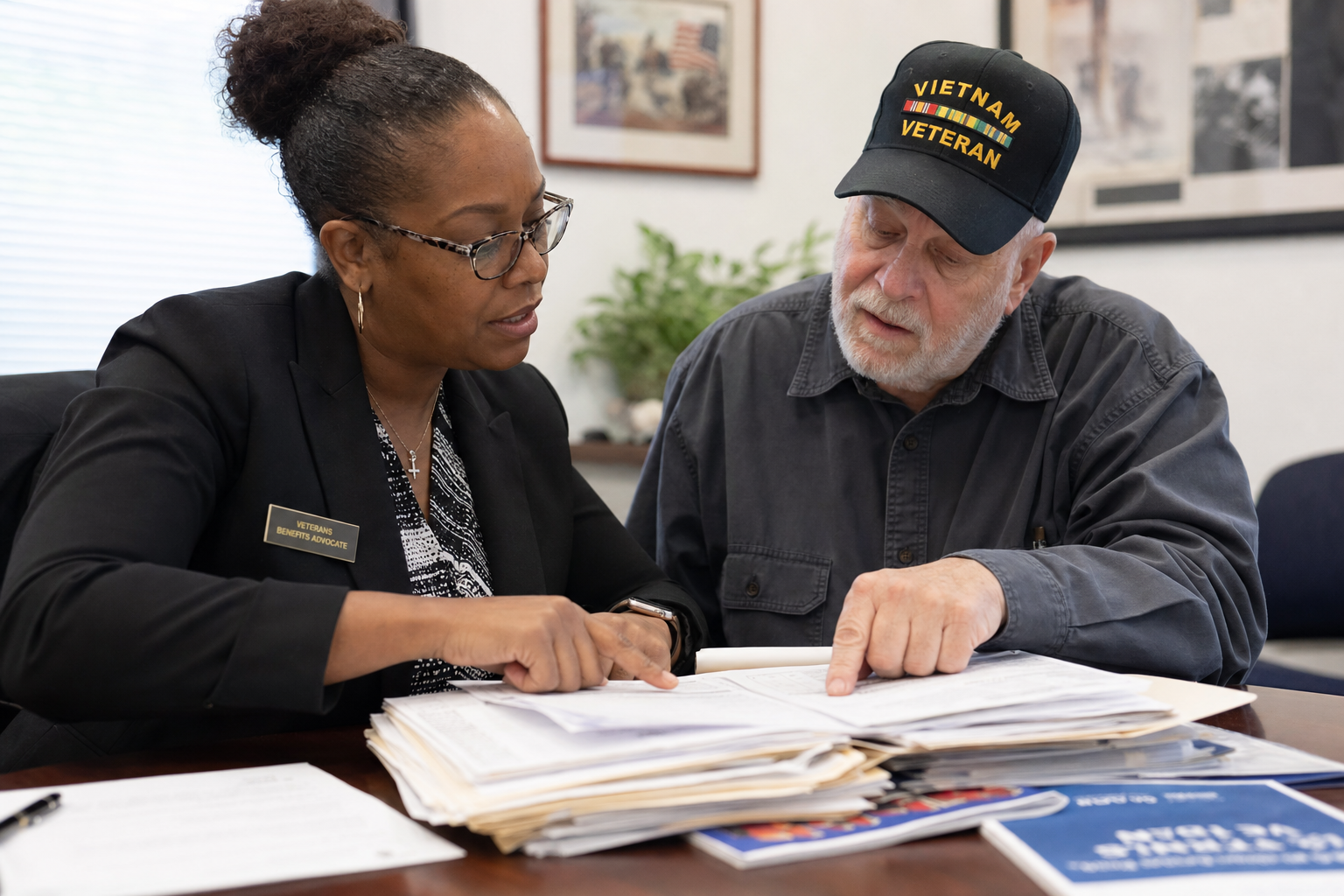
A VA-accredited claims agent talking across a desk with an older veteran in a ball cap, coffee mugs between them, nothing being signed

Free information — just ask

You can ask Albert, our AI claims assistant, anything about exposure, evidence, or the claims process — he answers instantly. If you would rather have a direct, personal answer, send your question below and an accredited agent will come back to you. No cost, no obligation.

Or send your question
A veteran and his wife at a conference table with an accredited representative pointing to the paperwork in front of them

Ready to hire us? Register with us

For veterans who have decided they want us on their claim. Registering is free too, and it takes the registration form plus a signed VA Form 21-22a.

Until VA Form 21-22a is signed we cannot accept your claim, access your VA file, or do any work on your behalf. That is federal law, not firm policy.

What happens after you register

  • You register. This simply starts the conversation — you are not our client yet, and you owe us nothing.
  • You sign and return VA Form 21-22a. It appoints us as your accredited representative and gives us access to your VA file.
  • Once we have your signed 21-22a and access to your case, we verify everything is in order.
  • We review your case in full and conduct your interview with an accredited agent.
  • Only then do YOU decide whether to move forward with us. If you choose not to, we will not proceed on your behalf — no pressure, no obligation.
Call us: 702-992-4883

An accredited agent personally reviews every request — we’ll reach out within 48 hours.