
One page. Hand it to your doctor.
Fill this in at your kitchen table, print it, and put it in the hand of the clinician at the start of the visit. It puts your unit, every place you served, every job you actually did, what you were around, and what has changed since — on one page, in the order a doctor can use.

Most exposure histories die in the waiting room. A veteran rehearses it in the car, gets fifteen minutes with a clinician who is already behind, and walks out with a note that says shortness of breath, follow up as needed and not one word about the burn pit, the parts washer, the shipyard, or the water. Nothing in that record connects the service to the symptom, so nothing in that record can be used later — by a specialist, by a VA examiner, or by anyone reading the file five years from now.
This sheet fixes that in the only way that reliably works: you hand it over on paper. A clinician who is handed a single organised page reads it, and what they read tends to end up in the note. You are not asking them to diagnose your service, complete a form, or agree with you. You are asking them to write down where you were, what you were around, and what has changed — and then to treat you like any other patient with those facts in front of them. Everything you type below stays in your own browser on this device; nothing is sent to us, and there is no account to make.
This is a communication tool, not a claim
Nothing here is filed with anyone. It does not open a claim, it does not preserve an effective date, and it is not a VA document. It is your own account, written down, so a clinician has something to work from and your record finally says what happened to you.
Warning signs, never diagnoses
Describe what changed. Do not name a condition, and do not let this page name one for you. A clinician decides what is going on with you. If something is severe, sudden, or getting worse quickly, that is an urgent care or emergency question today — not a paperwork question.
What the sheet puts in front of them
Six things a clinician can use, on one page, in the right order.
The order is not decorative. Service facts first, hazard second, functional loss third, request last — because that is the order a clinical note is written in, and a page that matches the note is a page that gets copied into it.

01
Your unit, every location, every job
The single most common reason an exposure never makes it into a record is that the veteran named the base and stopped. Exposure is proven by unit, by every location including the temporary duty nobody cut orders for, and by every job actually performed — not by the code printed on a personnel record. The sheet has a row for all four, on purpose.
02
The hazard in plain language
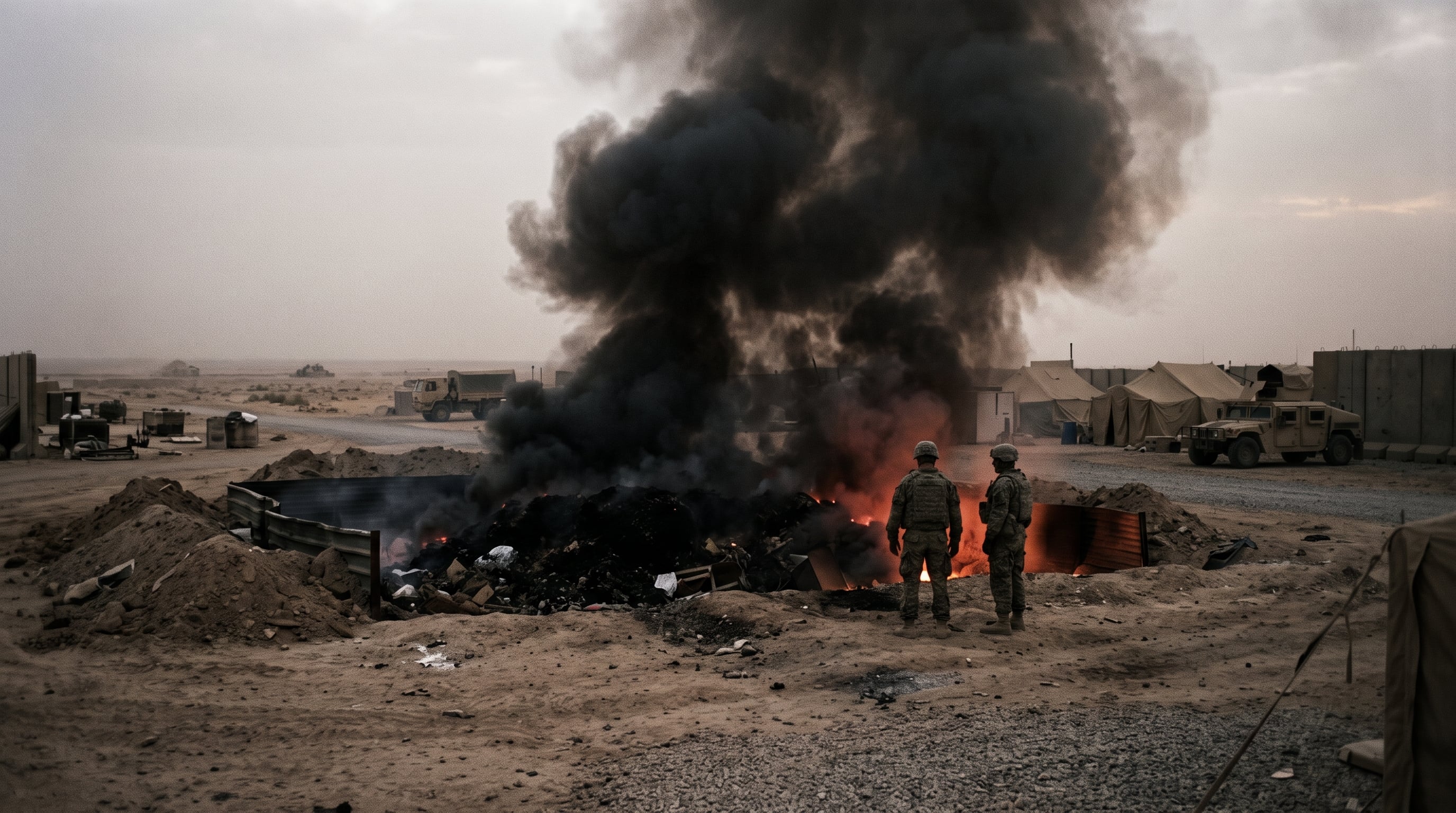
A clinician does not need the chemical name. They need to know that you slept two hundred metres downwind of a pit that burned everything the base threw away, or that you spent four years in a shop with a parts washer and no ventilation. The sheet gives you the wording, so you are not searching for it in the room.

03
What changed, not what you think it is
Walking in and naming a condition invites a clinician to rule out that one condition and move on. Describing the change — what you cannot do now that you could do three years ago, how often, and since when — makes them look. Warning signs are not diagnoses, and deciding what is going on is the clinician's job, not yours and not ours.

04
A request they can act on today
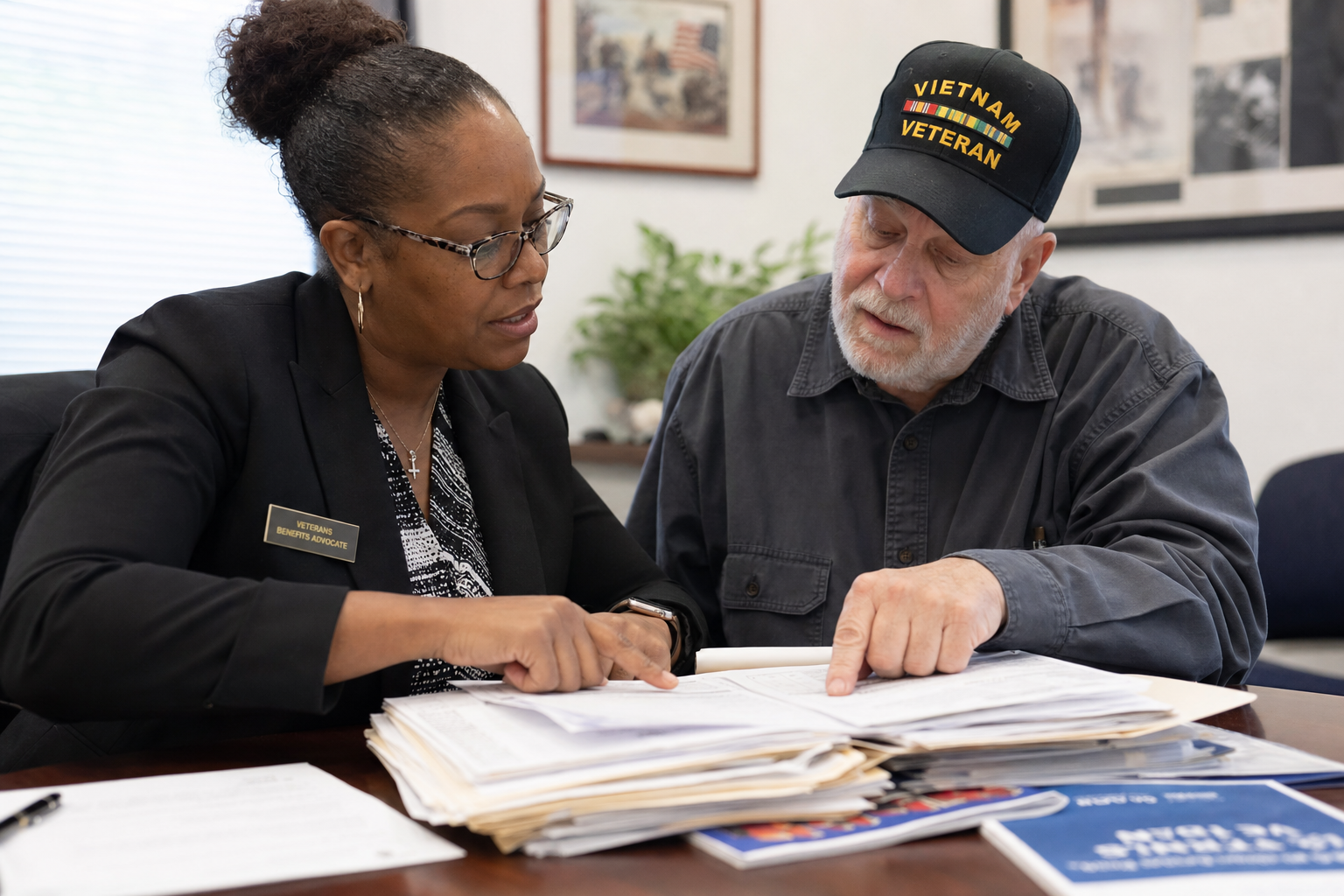
An appointment with a request attached produces an order, a referral, or a note. An appointment without one produces a follow-up. The sheet ends with the specific asks: put the exposure history in my record, run my toxic exposure screening, order testing, refer me, and write down whether you think it could be related.
05
A dated copy for your own file
Print two. One stays with the clinician, one stays with you. A dated summary in your own words, handed over on a known date, is contemporaneous evidence of what you reported and when you reported it — and that matters later, whether or not you ever file anything.
06
Something you can hand to a C&P examiner
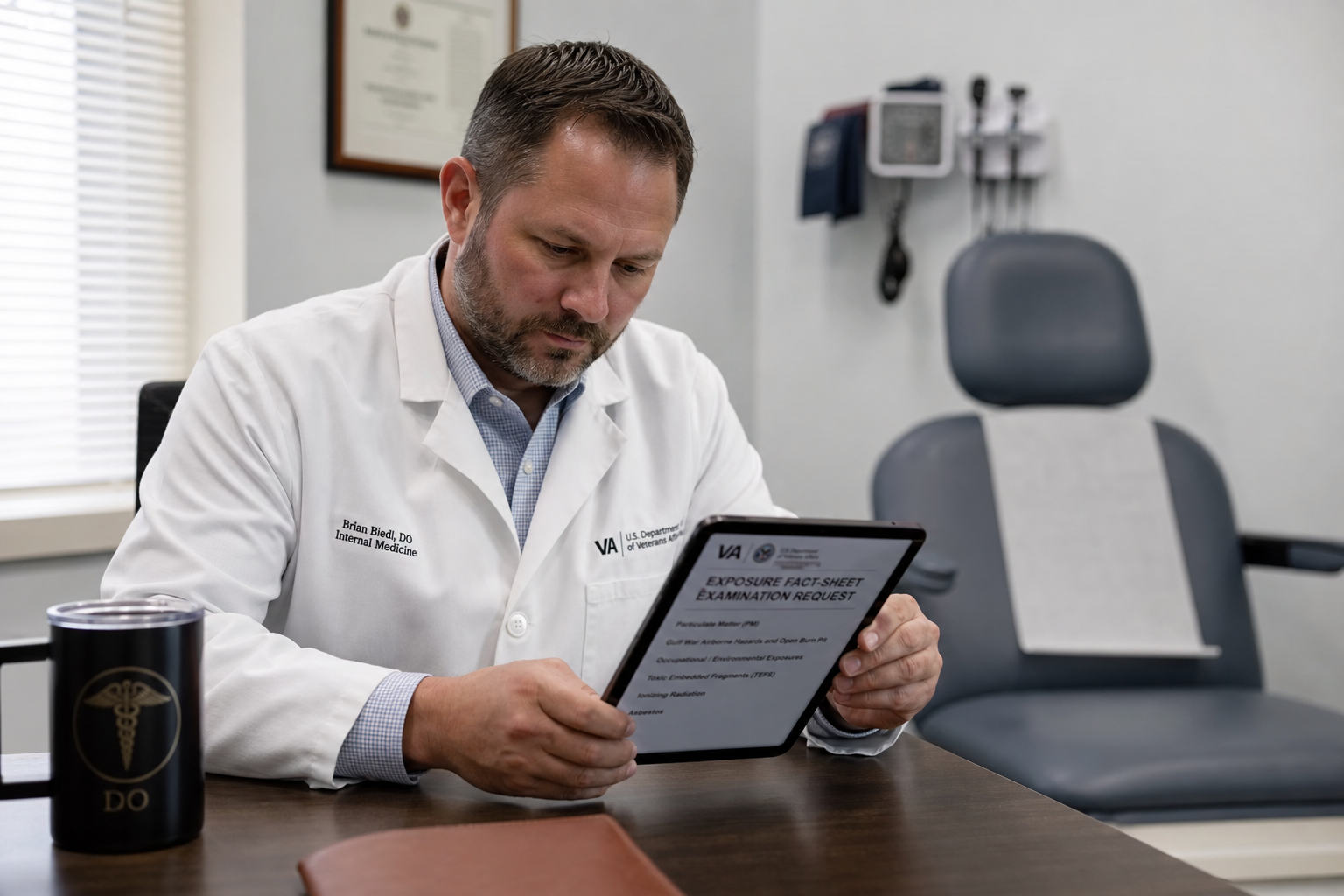
A compensation and pension examiner often has twenty minutes and a file they read that morning. Handing them one page that states unit, location, job, hazard, and functional loss is the difference between an exam that reflects your service and an exam that reflects whatever fit in the margin.
Build your sheet
Fill this in once. Print it. Hand it across the desk.
Everything you type stays in this browser on this device. Nothing is sent anywhere, and there is no account to make. Close the tab and come back later — your work will still be here.
Printing gives you the sheet only — the website around it does not print.
This is what prints
Military Environmental Exposure Summary
Prepared by the veteran for the treating clinician. This is the veteran's own account of service, exposure, and symptoms. It is not a diagnosis and it is not a VA record.
| Veteran | — | Branch | — |
|---|---|---|---|
| Years of service | — | Prepared | — |
To the clinician
I am asking that the military environmental exposure history below be entered into my medical record at this visit, and that you note whether any of it could be related to what I am reporting. I am not asking you to complete a disability form.
1. Where I served and what I did there
Fill in the form above and this section will build itself.
2. What I was around
Nothing ticked yet.
3. What has changed, in my own words
Nothing written down yet.
4. Care I have already had for this
None reported.
5. What I am asking for today
- 1. Document my military environmental exposure history in my medical record today.
- 2. Complete my VA toxic exposure screening, or tell me who at this facility does it.
- 3. Order the testing you think is appropriate for these exposures and these symptoms.
- 4. Refer me to the right specialty if this is outside primary care.
- 5. Write in your note whether you think any of this could be related to the exposures above.
This summary is the veteran's own account. It is not a diagnosis, not a medical opinion, and not a VA determination. Prepared with the free exposure summary builder at veterantoxicexposure.com.
Using it in the room
Print two copies. Hand one over in the first minute.
Do not wait to be asked, and do not save it for the end. Give it to the clinician while they are still opening your chart and say one sentence out loud with it: I want my military exposure history documented in my record today. That sentence, plus the page in their hand, is the whole job. Keep the second copy, dated, in your own file.
No printer? Save it as a PDF.
The print button opens your device's print dialog. Choose Save as PDF as the destination instead of a printer, then email it to yourself or send it through your patient portal message before the visit. A clinician who reads it the night before walks in already knowing.
Getting the appointment in the first place
If you do not have a doctor yet, or you have been told the exposure screening is not available, that is a solved problem — the numbers to call, the exact words to say to scheduling, and the environmental health coordinator at your own medical centre are all on the appointment page.
How to get seen and what to sayStraight from the VA
The VA on statements and presumptions
What the VA expects a buddy statement to say, and what “presumptive” actually means — both in the agency’s own words.
"Buddy Statement" for VA Disability Service-Connection | Statement in Support of a Claim | theSITREP
What the VA expects a lay statement to actually say.
Source: U.S. Department of Veterans Affairs
Presumptive Condition & Service-Connection | Filing for VA Disability | theSITREP
The VA on what “presumptive” means — and what it does not cover.
Source: U.S. Department of Veterans Affairs
These videos are published by the U.S. Department of Veterans Affairs and are embedded here unedited. They are the agency’s own explanation of its rules, not ours, and they are not legal or medical advice. If what the VA said on camera does not match what your decision letter says, that gap is worth a conversation.
Turn this page into an appointment
How to get seen about this
Reading a symptom list changes nothing on its own. A dated note in your medical record does — for your health first, and years later for a claim. Below is every route to an appointment, the phrase that gets your exposure history written down, and the numbers to dial. Nothing on this page is a diagnosis, and none of it replaces your doctor.
Some things do not wait for a scheduler
Chest pain or pressure lasting more than a few minutes, or chest pain with sweating, nausea, or pain spreading to the jaw or arm
Sudden trouble breathing, or breathlessness while sitting still
Face droop, weakness or numbness on one side, slurred speech, or sudden confusion
Coughing up or vomiting blood, or bleeding that will not stop
A first seizure, or fainting you cannot explain
Call 911 or go to the nearest emergency room. Do not wait to reach a VA facility first, and do not drive yourself. Tell VA as soon as you can afterward — VA asks to be notified within 72 hours of emergency care received in the community — and keep every discharge paper and bill.
Call your VA medical center
Fastest- Calling your own VA facility is the quickest way to get an appointment. VA Health Connect gives you round-the-clock phone access to a scheduler, a nurse, and in many regions a provider.
- Do not know your facility's number? Call MyVA411 at 800-698-2411, any hour, and ask to be connected to your VA medical center's scheduling line.
- Say you are an established patient if you already have a primary care provider, and ask for the next available appointment with that provider.
- If nothing is available soon, ask to be added to the cancellation list and ask whether a nurse can advise in the meantime.
Call VET-HOME — VA's exposure team
Exposure-specific- 833-633-8846, Monday to Friday, 9:00 a.m. to 7:30 p.m. ET. VET-HOME stands for Veterans Exposure Team — Health Outcomes Military Exposures, and it exists for exactly this conversation.
- Say: I want a military environmental exposure assessment. The intake center schedules you with a clinician specially trained in military environmental exposures — by telehealth, so it does not matter how far you live from a medical center. Any veteran enrolled in VA health care, anywhere in the United States or its territories, can use it.
- The clinician documents your exposure history, answers exposure-related questions, and recommends follow-up. If labs, imaging, breathing tests, or a specialty consult are needed, they say so. Afterward VA mails you a letter with your results, what they mean, and the recommendations.
- Two limits, so you are not surprised: VET-HOME clinicians do not prescribe medication and do not complete disability claim forms. What they produce is a dated VA record of your exposure history — which is the piece most claims are missing.
- They also handle the environmental health registry evaluations, and those do not require VA health-care enrollment. If you would rather be seen in person, ask for the environmental health coordinator at your own facility instead — the list is further down this site's Talk To Your Doctor page.
Schedule online or message your care team
- Sign in on VA.gov to schedule or request many appointments yourself. What you can book online depends on your facility and the type of care.
- You can also send your care team a secure message through My HealtheVet. Use it for non-urgent things — replies typically take up to three business days.
- Secure messaging is not for anything urgent. If you need an answer today, call instead.
- Locked out or cannot find the option? The My HealtheVet help desk is 877-327-0022.
Not enrolled in VA health care yet
- Call the VA Health Benefits Hotline at 877-222-8387, Monday to Friday, 8:00 a.m. to 8:00 p.m. ET, and say you want to enroll in VA health care.
- Enrollment is what unlocks VA primary care and the toxic exposure screening. Under the PACT Act many veterans who were turned away years ago are now eligible, so do not assume an old answer still applies.
- Enrolling does not mean giving up your own doctor. Plenty of veterans keep a civilian provider and use VA alongside it.
- Enrolling in health care is separate from filing a disability claim. One does not require the other.
You see a civilian or private doctor
- Ask the front desk for the next available appointment and tell them why: a symptom that has lasted weeks, plus chemical and airborne exposure during military service.
- Bring this page, or write the exposures and years on one sheet of paper. Hand it over and ask for it to be scanned into your chart.
- A community provider can order tests, refer you, and write your exposure history down — all of which helps. What they cannot do is VA's toxic exposure screening, which only happens inside VA's own record system.
- Ask for a copy of the visit note and every result. Those copies are yours, and they are what a claim is eventually built from.
If you are in crisis right now
24/7- Dial 988 and press 1, or text 838255. The Veterans Crisis Line is staffed around the clock.
- You do not need to be enrolled in VA health care, and you do not need a service-connected rating, to use it.
- You can also start a confidential chat from VA's crisis line website, or ask any VA staff member to walk you to someone.
Ask for your toxic exposure screening
The PACT Act requires VA to offer this to every veteran enrolled in VA health care. It takes about five to ten minutes, and it is the cheapest way to get your exposure history into VA's own record in VA's own words.
What it is
A short set of questions asking whether you believe you were exposed to open burn pits and other airborne hazards, Agent Orange, radiation, Gulf War-related hazards, or contaminated water at Camp Lejeune.
Who can get it
Every veteran enrolled in VA health care. If you are not enrolled yet, enrollment comes first — call 877-222-8387.
How often
An initial screening, then at least once every five years. If you answer that you do not know whether you were exposed, VA schedules you again a year later.
How to get one
It is often done during a primary care or specialty visit — but you can ask for it sooner. Ask your primary care team directly, or ask your facility for its Toxic Exposure Screening Navigator by name.
What it is not
It is not an exam for any specific illness, and it is not part of the disability claims process. It is optional, and declining it does not affect your health care or your benefits.
Why bother
It creates a dated VA record that you raised military exposure. Years later, that entry is evidence that the concern predated the diagnosis.
A civilian or community provider cannot perform this screening — it lives inside VA's own health record. If you only see a private doctor, that is a reason to enroll in VA health care as well.
The burn pit registry: you are probably already in it
Since August 1, 2024, VA and the Defense Department enroll eligible veterans and service members in the Airborne Hazards and Open Burn Pit Registry automatically, from deployment records. For most people there is nothing to sign up for.
Automatic enrollment covers service between August 2, 1990 and August 31, 2021 in the listed operations and locations — Desert Shield, Desert Storm, Iraqi Freedom, Enduring Freedom and New Dawn, the Southwest Asia theater, Egypt, Afghanistan, Djibouti, Jordan, Lebanon, Syria, Uzbekistan, Yemen, and the associated airspace and waters.
You do not need to have been knowingly exposed, and you do not need any current health problem, to be included.
If you enrolled yourself before the redesign, your enrollment carried over. There is nothing to redo.
To check your status, contact the Environmental Health Coordinator at your VA facility.
The registry holds deployment and demographic data only. No medical information is stored in it.
Participation is optional and you can opt out. Being in the registry is not required to file a claim, and it does not affect your eligibility for care or benefits either way.
Being in the registry is not evidence of exposure on its own, and it is not a claim. Treat it as a research tool, and do not let anyone tell you a claim depends on it.
What to take with you
- A one-page list of the chemicals and hazards you worked around, with the years and the base or ship
- Your job title and MOS or rating, written the way the military wrote it
- The symptoms that brought you in, and roughly when each one started
- Any breathing tests, blood work, or imaging you already have, including from civilian doctors
- A short list of what you want out of the visit — usually: document the exposure, order these tests, refer me
- Someone who has watched the change in you, if memory or breathing is the concern
Write the job you actually did and the places you served at the top of that sheet, in the words the military used for it.
Before you leave, and afterward
- Ask for a copy of the visit note before you leave, and actually read it.
- Check that your exposure history is in the note. If it is missing, say so and ask for it to be added — politely, but ask.
- Get a copy of every test result, including the numbers, not just the word normal.
- Keep your own folder. Paper you hold is worth more than paper you assume exists somewhere.
- If a symptom persists after a normal test, go back. A normal result rules out some things, not everything.
The numbers, in one place
VET-HOME — VA's exposure team
833-633-8846
Monday to Friday, 9:00 a.m. to 7:30 p.m. ET
The number to call about a military environmental exposure specifically. VET-HOME books a free telehealth evaluation with a clinician trained in military exposures, and that clinician writes your exposure history into your VA record. Say you want a military environmental exposure assessment.
MyVA411 — VA main line
800-698-2411
24 hours a day, 7 days a week
The one number to call if you do not know who to call. Ask to be put through to your VA medical center's scheduling line, or press 0 for a person.
VA Health Benefits Hotline
877-222-8387
Monday to Friday, 8:00 a.m. to 8:00 p.m. ET
Enrolling in VA health care, health-care eligibility, VA medical bills, and community care billing.
Veterans Crisis Line
988, then press 1
24 hours a day, 7 days a week
Any crisis, and you do not need to be enrolled in VA health care to use it. You can also text 838255.
My HealtheVet help desk
877-327-0022
Monday to Friday
Trouble signing in, secure messaging, or online scheduling.
VA Benefits Hotline
800-827-1000
Monday to Friday, 8:00 a.m. to 9:00 p.m. ET
Claims, ratings, and back pay — the benefits side rather than the medical side.
TTY
711
Relay service
If you are deaf or hard of hearing.
These are VA's own published lines. If a number ever gives you a runaround, MyVA411 at 800-698-2411 will transfer you — it is staffed every hour of every day.

Both options are free · No obligation
Not sure where you stand? Let us look at it.
Tell us what happened and what the VA said. An accredited agent reads it and tells you honestly what he sees — no cost, no obligation. When you are ready to have us fight it, register and we start.
An accredited agent personally reviews every request — we’ll reach out within 48 hours. Or call 702-992-4883.