
Barr v. Nicholson
Once VA undertakes to provide an examination, it must ensure the examination is adequate.
The problem is not that an opinion is unfavorable. The problem is when it ignores accurate service facts, combined exposures, favorable science, lay history, or the actual legal and medical question.
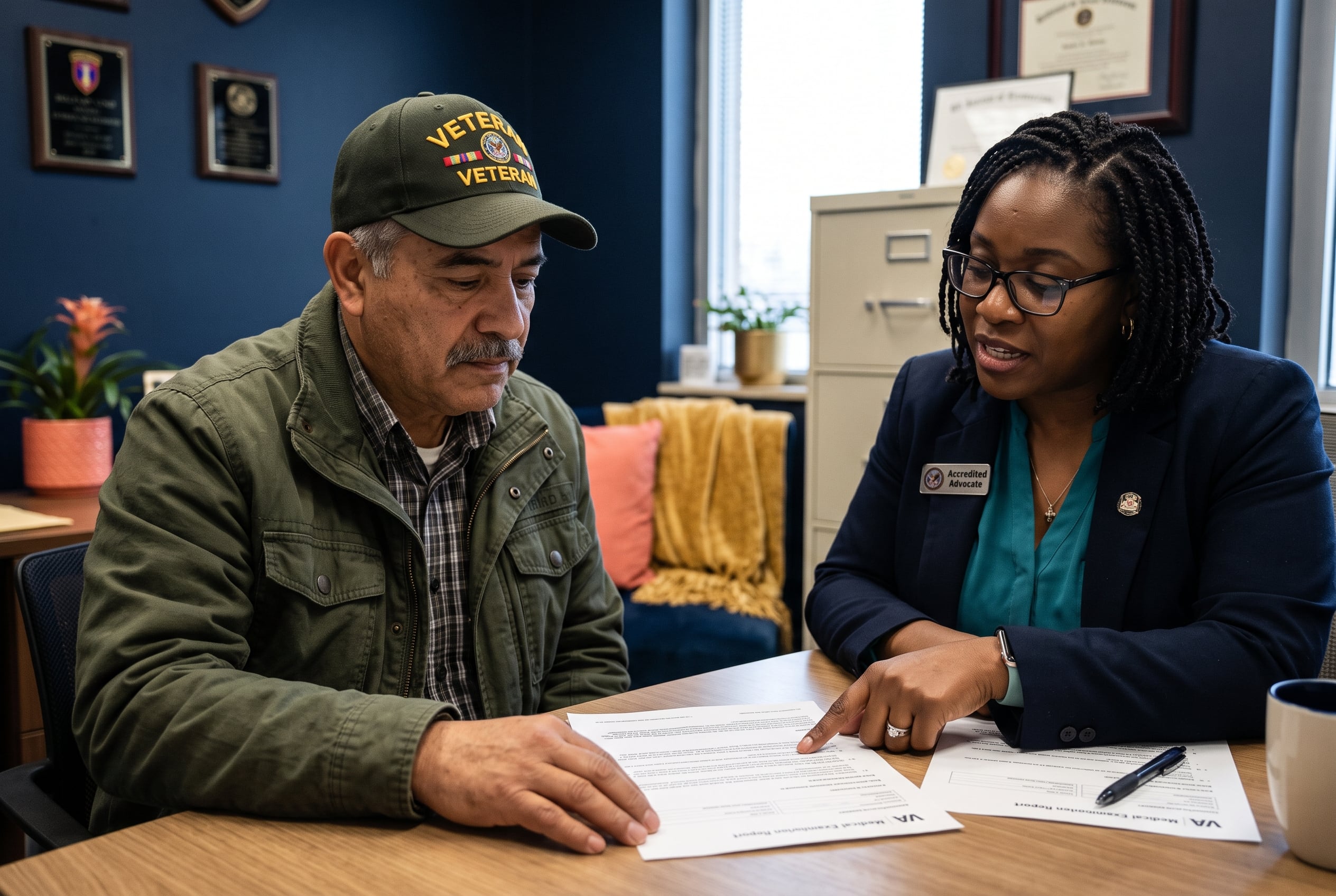
OIG documented systemwide VHA screening training-monitoring problems, and GAO documented contractor-exam oversight concerns. Those findings justify scrutiny. They do not prove that every contractor, a particular examiner, or a named regional office produced an inadequate opinion.
Once VA undertakes to provide an examination, it must ensure the examination is adequate.
Probative opinions contain clear conclusions, supporting data, and a reasoned medical explanation connecting them.
The opinion must provide analysis an adjudicator can consider and weigh against contrary evidence.
A speculative conclusion cannot be an unexplained substitute for medical analysis.
Veterans law does not require scientific consensus before favorable medical evidence can support a claim.
The duty-to-assist examination trigger is distinct from the ultimate weight of a completed opinion.

Use when new and relevant evidence is needed: corrected records, unit history, detailed exposure statement, specialist report, or independent opinion.
May fit an existing-record legal or factual error, such as a missed presumption or an opinion that did not answer the requested question.

Dockets differ for direct review, evidence submission, or a hearing. Other Board decisions are nonprecedential.
The same handful of sentences appear on denial letters over and over. None of them are the end of the road. Here is what each one really means and the legal footing you use to push back.

A flat, categorical statement with no reasoning attached — the examiner never engages with the actual chemistry or with a secondary theory.
Carbon monoxide, solvents, organophosphates, jet fuel and burn-pit smoke are all documented neurological irritants, and headache is one of the most reported Gulf War symptoms. Migraine also connects secondarily to service-connected TBI, tinnitus, neck injury, sinusitis and PTSD — you do not need a direct toxic pathway if a service-connected condition is driving the headaches.
Secondary service connection — 38 C.F.R. § 3.310

Used to shift the cause off of service. But if it was not noted on your entrance exam, the law presumes you entered sound.
Unless a condition was recorded at entry, the presumption of soundness applies and VA must prove by clear and unmistakable evidence both that it pre-existed AND that service did not aggravate it. And service connection is still available if your service worsened a genuinely pre-existing condition beyond its natural progression.
Presumption of soundness & aggravation — 38 C.F.R. § 3.304(b), § 3.306

A negative dressed up as science. “No studies” is not the same as studies showing no link, and the courts have said so.
A medical opinion has to be supported by a reasoned analysis — a bare conclusion carries no weight. The absence of a formal presumption or a large study does not defeat a claim; direct service connection can be proven on the individual facts, and the benefit of the doubt belongs to the veteran when the evidence is in relative balance.
Reasoned-opinion & benefit-of-doubt — Nieves-Rodriguez; Wise v. Shinseki; 38 C.F.R. § 3.102

The single most abused denial. Missing records are treated as your problem — when the law makes them the VA’s.
When records are lost, destroyed, or unavailable, VA is held to a HEIGHTENED duty to assist: it must run an exhaustive, documented search, tell you in writing, and invite alternative evidence such as buddy and lay statements. VA cannot lawfully deny a claim solely because a record it was responsible for is missing — that is a duty-to-assist error and a direct ground for appeal.
Heightened duty to assist — 38 U.S.C. § 5103A; 38 C.F.R. § 3.159; O’Hare & Moore v. Derwinski
Once a condition is service-connected, VA assigns a percentage from a fixed schedule. Knowing the exact rung you meet is how you catch a rating that was set too low. These criteria are quoted from the current rating schedule — verify each at the source.
38 C.F.R. § 4.124a
Very frequent, completely prostrating and prolonged attacks productive of severe economic inadaptability.
Characteristic prostrating attacks averaging once a month over the last several months.
Characteristic prostrating attacks averaging one in two months over the last several months.
Less frequent attacks.
“Prostrating” means an attack that forces you to stop and lie down. It does not require total unemployment — VA must weigh nausea, light sensitivity and dizziness too, even if the record never uses the word “prostrating.”
38 C.F.R. § 4.97
FEV-1 less than 40%, or FEV-1/FVC less than 40%, or more than one attack per week with respiratory failure, or daily high-dose systemic corticosteroids.
FEV-1 of 40–55%, or at least monthly physician visits for exacerbations, or three or more courses of systemic corticosteroids per year.
FEV-1 of 56–70%, or daily inhalational or oral bronchodilator, or inhalational anti-inflammatory medication.
FEV-1 of 71–80%, or intermittent inhalational or oral bronchodilator therapy.
Rated on lung-function (FEV-1) numbers OR on the treatment you actually require — whichever gives the higher rating. Keep your pulmonary function tests and your medication list.
38 C.F.R. § 4.97
Chronic respiratory failure with carbon dioxide retention or cor pulmonale, or requires a tracheostomy.
Requires the use of a breathing assistance device such as a CPAP machine.
Persistent daytime hypersomnolence (excessive daytime sleepiness).
Documented sleep-disordered breathing that is asymptomatic.
A prescribed CPAP or BiPAP that you actually require is the 50% rung. Sleep apnea frequently connects secondarily to service-connected sinusitis, rhinitis and PTSD.
38 C.F.R. § 4.104
Diastolic pressure predominantly 130 or more.
Diastolic pressure predominantly 120 or more.
Diastolic pressure predominantly 110 or more, or systolic predominantly 200 or more.
Diastolic predominantly 100 or more, or systolic predominantly 160 or more, or a history requiring continuous medication.
The 10% rung includes a history of diastolic pressure predominantly 100 or more that now requires continuous medication to control — so being medicated can itself be compensable.
Rating criteria change over time and some conditions are rated by analogy. These summaries are for orientation, not a promise of any specific percentage — always confirm the current schedule and how it applies to your exam.
When your claim is wrongly denied, the fault is often on the VA’s side of the desk — not yours. These are findings from the VA Office of Inspector General’s own published audits of how toxic-exposure and PACT Act claims are decided.
of sampled denied claims processed incorrectly
45%VA OIG review of PACT Act presumptive denials found nearly half were mishandled before the denial was issued.
involved unnecessary “overdevelopment”
36%Staff ordered exams and evidence VA did not need for conditions that were already presumptive — delay dressed up as diligence.
The same audit documented roughly $1.4 million in wasted work over six months, about 870 claims flagged with potential impact errors, and one veteran wrongly denied about $47,000 in benefits — because staff failed to seek clarification on an incomplete, contradictory exam.
of re-reviewed burn-pit denials still had errors
31%A July 2025 follow-up found roughly a third of previously denied burn-pit exposure claims were still processed incorrectly.
of respiratory (asthma / COPD) claims mishandled
25%Airway conditions closely tied to airborne hazards were among the most frequently mishandled.
of identified errors could financially harm the veteran
90%More than nine in ten of the documented processing errors worked against the veteran, not the government.
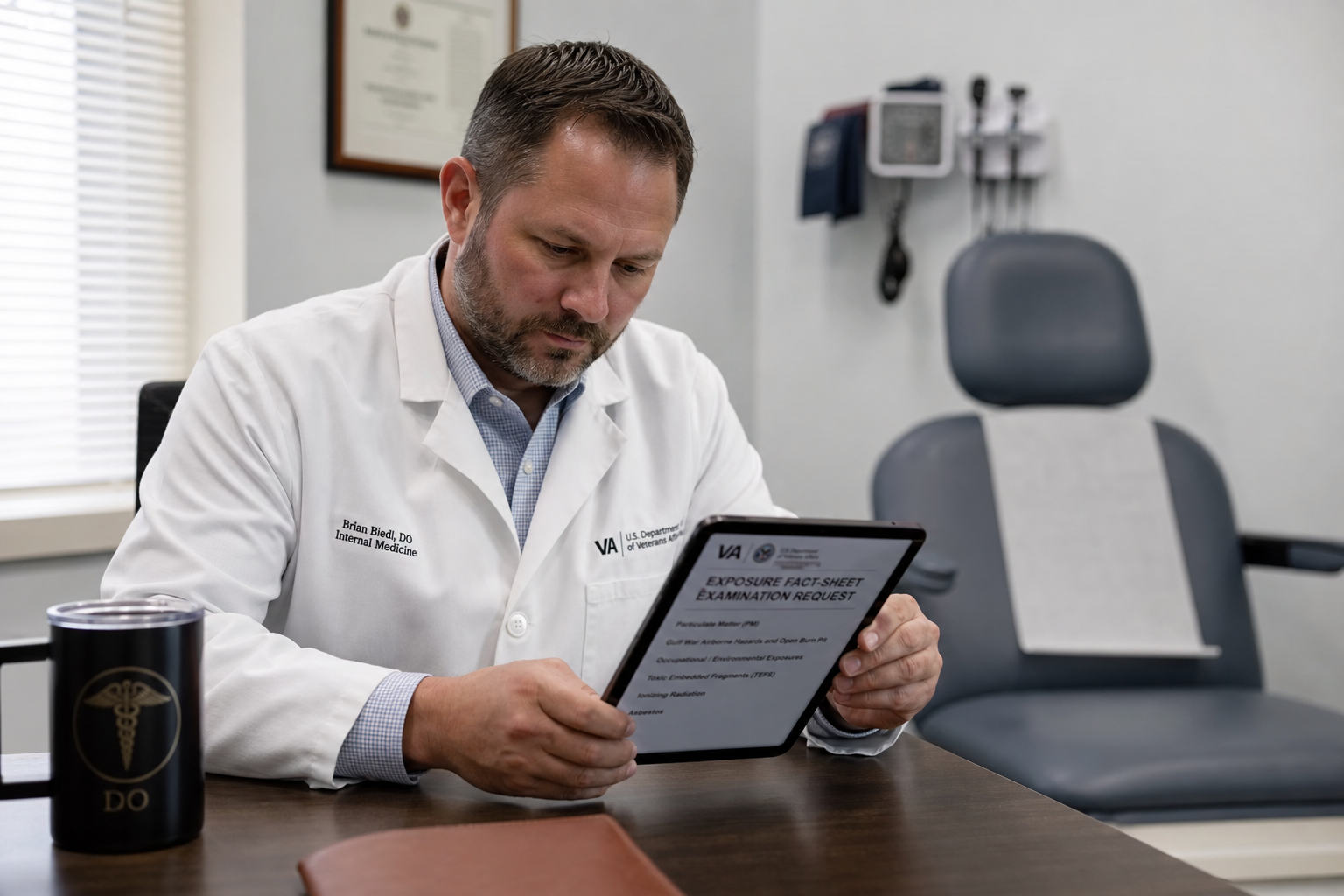
The 2022 review found VBA prematurely denied most burn-pit claims, failed to order the exams its own rules required, and sent examiners into evaluations without the exposure fact sheets they needed to decide correctly.
If your denial reads like one of these patterns, it is not the last word — it is a documented, appealable processing error.
If your letter used one of these lines, an accredited advocate can read the decision, name the error, and build the evidence to answer it. Registering costs nothing. Fees are recovery only: 20% of past-due benefits, never hourly, nothing on a first-time claim, under 38 C.F.R. § 14.636.
VA-accredited claims agent #45147
Straight from the VA
When the agency tells you on camera what sinks a claim, that is a checklist. Two official videos: the mistakes it sees most, and what a complete filing looks like.
3 Common Mistakes Some Veterans Make When Submitting a VA Disability Claim | theSITREP
The VA naming the mistakes it sees most often on incoming claims.
Source: U.S. Department of Veterans Affairs
Filing a Claim for VA Service-Connection? | Fully Developed Claim | VA Disability | theSITREP
Handing the VA a complete package instead of letting it build the file for you.
Source: U.S. Department of Veterans Affairs
These videos are published by the U.S. Department of Veterans Affairs and are embedded here unedited. They are the agency’s own explanation of its rules, not ours, and they are not legal or medical advice. If what the VA said on camera does not match what your decision letter says, that gap is worth a conversation.
Both options are free · No obligation
Talking to a VA-accredited claims agent costs nothing either way. Pick the one that fits: get answers to your questions, or register to hire us to take on your claim.

Free information — just ask
You can ask Albert, our AI claims assistant, anything about exposure, evidence, or the claims process — he answers instantly. If you would rather have a direct, personal answer, send your question below and an accredited agent will come back to you. No cost, no obligation.

Ready to hire us? Register with us
For veterans who have decided they want us on their claim. Registering is free too, and it takes the registration form plus a signed VA Form 21-22a.
Until VA Form 21-22a is signed we cannot accept your claim, access your VA file, or do any work on your behalf. That is federal law, not firm policy.
What happens after you register
An accredited agent personally reviews every request — we’ll reach out within 48 hours.