
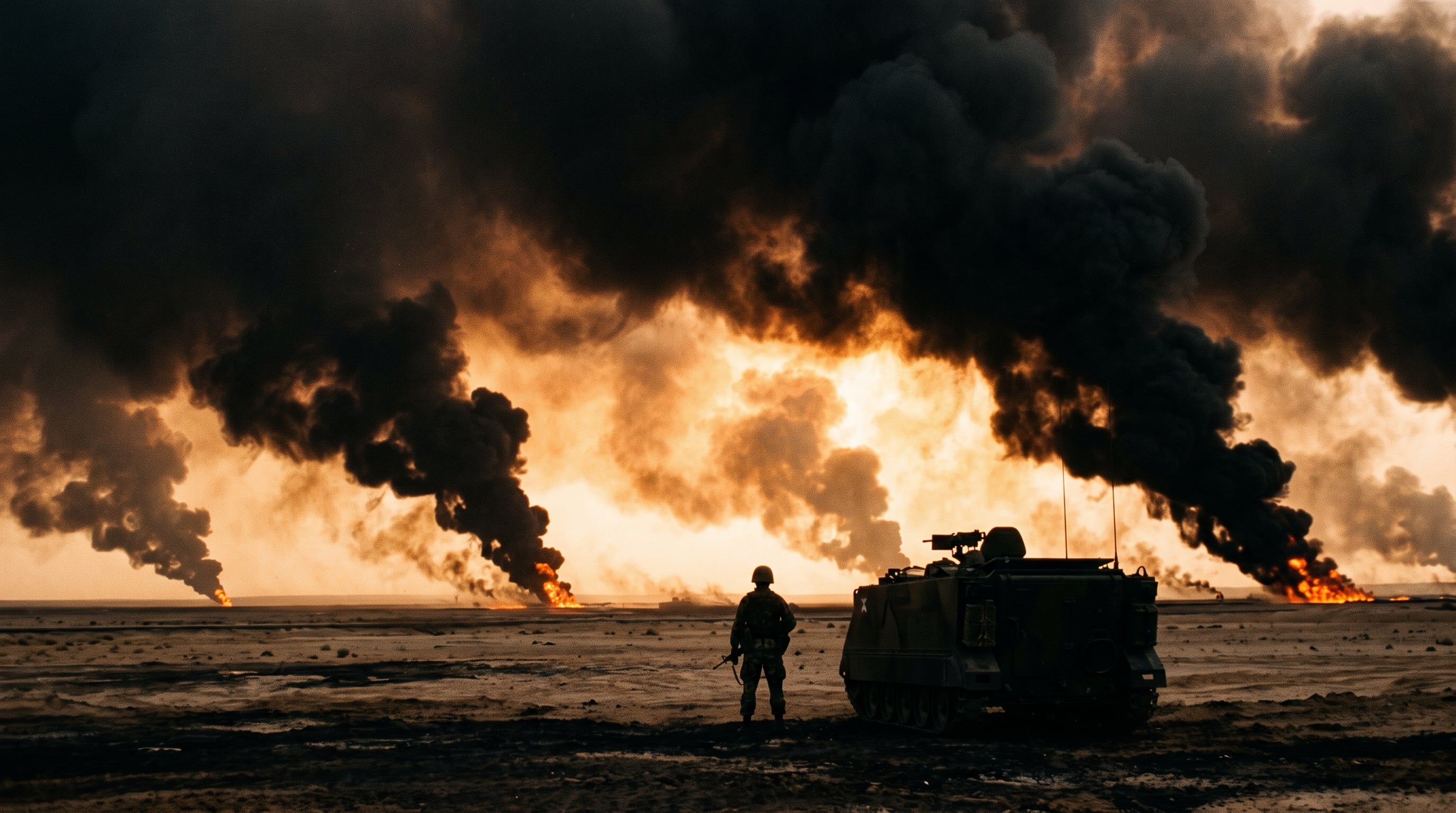
Oil-well fire smoke
EPA-led monitoring found high particulate levels while sulfur dioxide and hydrogen sulfide were generally insignificant during monitored periods. Plume location, duration, and symptoms remain veteran-specific.
The Gulf War was a multi-exposure environment: more than 600 burning oil wells, pesticides, pyridostigmine bromide pills, Khamisiyah nerve-agent concerns, depleted uranium, sand, fuels, exhaust, vaccines, and environmental stressors.

EPA-led monitoring found high particulate levels while sulfur dioxide and hydrogen sulfide were generally insignificant during monitored periods. Plume location, duration, and symptoms remain veteran-specific.

Sarin and cyclosarin concerns require unit-location evidence, modeled hazard dates, alarms or protective posture, and consideration of other cholinesterase-inhibiting exposures.

Individual records can be incomplete. Statements should identify issue and use of pills, application methods, frequency, and acute neurologic, skin, respiratory, or gastrointestinal symptoms.

Persistent fatigue, pain, cognitive difficulty, headache, GI symptoms, sleep disturbance, dizziness, and respiratory complaints may fit an undiagnosed illness or medically unexplained chronic multisymptom illness pathway.
VA’s briefing for veterans of the 1991 Gulf War, including the undiagnosed and medically unexplained illnesses that still get denied for the wrong reason. It tells you what VA offers. It does not tell you how to document the six months of chronicity that decides most of these claims, which is why so many are denied on a technicality rather than on the medicine.
Source: U.S. Department of Veterans Affairs, official channel
On paper the 1991 Gulf War veteran holds the most generous rule in the entire compensation system. Under 38 CFR § 3.317, a qualifying chronic disability arising from an undiagnosed illness or a medically unexplained chronic multisymptom illness is presumed service-connected with no nexus opinion required at all. In practice, denial rates in this population stay high, and the reason is procedural rather than medical. An examiner gives the symptoms a conventional label — this is not undiagnosed, it is irritable bowel syndrome — and the rater then treats § 3.317 as inapplicable and denies direct service connection for want of a nexus. The claim is defeated by being answered under the wrong regulation.
The evidence problem compounds it. Pyridostigmine bromide tablets were handed out by the blister pack and almost never charted in an individual health record. Pesticide application was constant and unrecorded. The Khamisiyah plume modeling has been revised more than once, and unit locations were reconstructed from records years after the fact. “I was there and I am sick” loses. What wins is a file that documents each symptom domain separately — fatigue, pain, gastrointestinal, neurologic, skin, respiratory — with the date of onset, persistence of six months or more, the effect on work, and the name of the regulation it wants applied.
Two veterans of the same conflict rarely carry the same claim, and veterans of different conflicts often carry the same one. The first panel is what belongs to this era alone. The second is the layer this era shares with the rest of the site — and it is the layer that reopens old denials.
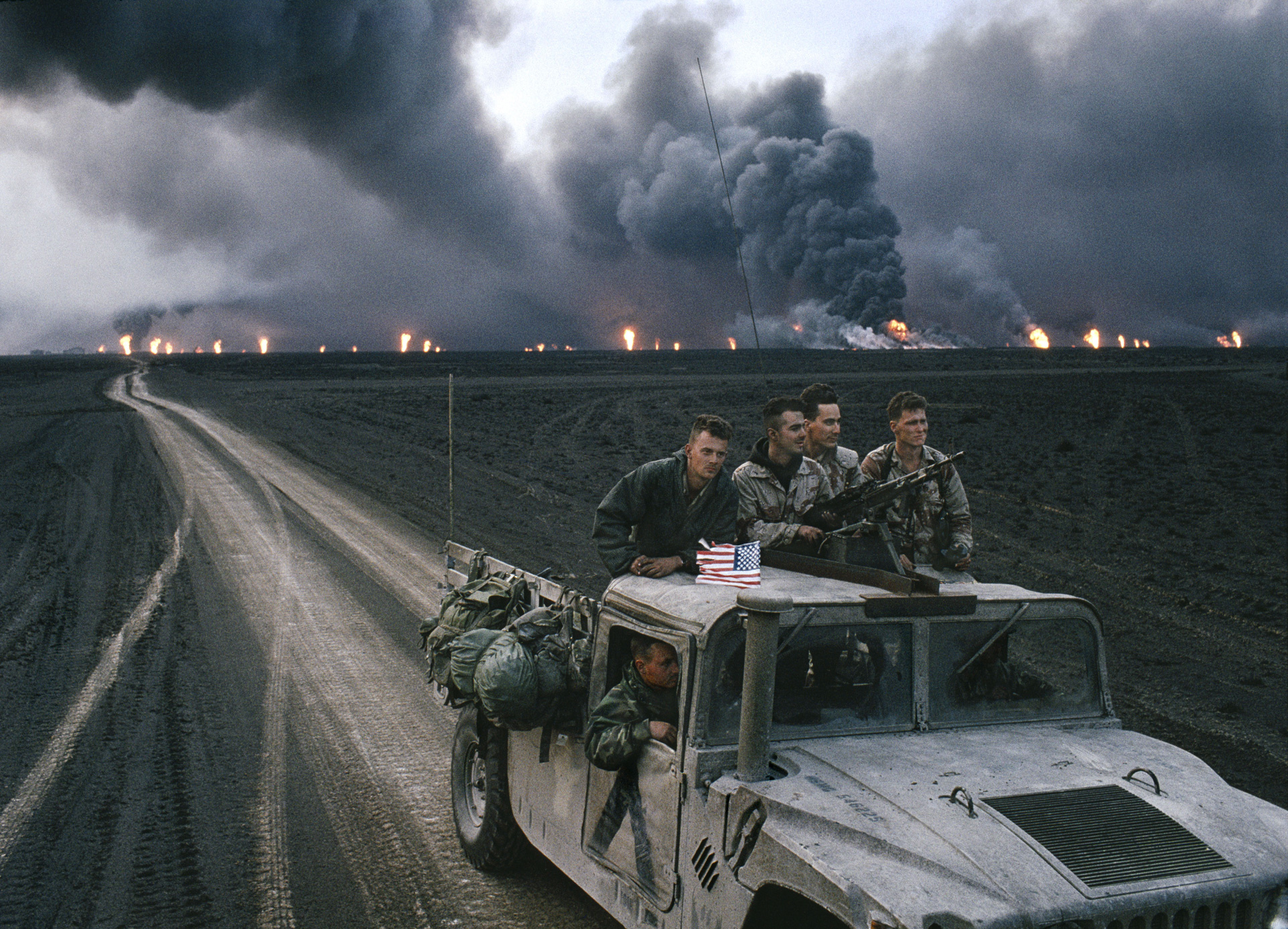
Six months of deployment in an environment that has no parallel in any other era, and one regulation written for this population alone.

Desert Shield and Desert Storm veterans are routinely told the burn pit laws are for the younger generation. That is wrong, and it costs claims.
This era has two separate presumptive authorities and most veterans only know about one. They do not overlap, they do not cancel each other, and a denial under one says nothing at all about the other. Read both lists before you decide what to file.

For qualifying Southwest Asia service, these are presumed service-connected without any medical opinion connecting them to service. The disability must be chronic — six months or more — and at least 10 percent disabling.

Covered service starts August 2, 1990 for Bahrain, Iraq, Kuwait, Oman, Qatar, Saudi Arabia, Somalia, and the United Arab Emirates, plus the airspace above. These 23 conditions are presumed service-connected with no exposure proof and no nexus:

These are not on either list. They are granted when the exposure, the diagnosis, and the opinion are in the file — or when they grew out of something already service-connected.
38 CFR § 3.317 and the PACT Act are separate authorities with separate requirements. A denial under one is not a decision about the other, and both can be pleaded in the same claim. One caution on timing: § 3.317 sets a presumptive period for when the disability must have become manifest, and that period has been extended repeatedly by regulation. Check the current period before you assume you are outside it.
These three codes carry most of the rating weight in this era, and all three are rated on frequency and function rather than on any laboratory finding. That cuts both ways: there is no test that can contradict you, and no test that can speak for you either. A symptom diary and a provider who charts it are the evidence.
38 CFR § 4.88b
Debilitating fatigue, cognitive impairments, or a combination of other signs and symptoms which are nearly constant and so severe as to restrict routine daily activities almost completely, and which may occasionally preclude self-care.
Symptoms which are nearly constant and restrict routine daily activities to less than 50 percent of the pre-illness level, or which wax and wane resulting in periods of incapacitation of at least six weeks total per year.
Symptoms which are nearly constant and restrict routine daily activities to 50 to 75 percent of the pre-illness level, or which wax and wane resulting in periods of incapacitation of at least four but less than six weeks total per year.
Symptoms which are nearly constant and restrict routine daily activities by less than 25 percent of the pre-illness level, or which wax and wane resulting in periods of incapacitation of at least two but less than four weeks total per year.
Debilitating fatigue, cognitive impairments, or a combination of other signs and symptoms that wax and wane but result in periods of incapacitation of at least one but less than two weeks total per year, or the symptoms are controlled by continuous medication.
There is no 30 percent and no 50 percent tier under this code — the schedule jumps from 20 to 40 to 60 to 100. Note 1 defines an incapacitating episode as a period of acute signs and symptoms severe enough to require bed rest and treatment by a physician. Bed rest you decided on yourself does not count; bed rest a physician ordered does. That single sentence decides most of these ratings.
38 CFR § 4.71a
Symptoms that are constant, or nearly so, and refractory to therapy.
Symptoms that are episodic, with exacerbations often precipitated by environmental or emotional stress or by overexertion, but that are present more than one-third of the time.
Symptoms that require continuous medication for control.
The schedule defines widespread pain for this code as pain in both the left and right sides of the body, that is both above and below the waist, and that affects both the axial skeleton and the extremities. Forty percent is the ceiling here, which is why fibromyalgia is so often paired with separately rated conditions — and why a file that stops at fibromyalgia alone is usually under-rated.
38 CFR § 4.124a
Very frequent completely prostrating and prolonged attacks productive of severe economic inadaptability.
Characteristic prostrating attacks occurring on an average of once a month over the last several months.
Characteristic prostrating attacks averaging one in two months over the last several months.
Less frequent attacks.
Prostrating means the attack stops you — you lie down in the dark and you cannot function. If your headaches are charted as “headache, given medication” with no description of what you had to stop doing, you will be rated at zero or 10 percent no matter how often they come. A dated log showing each attack, its duration, and what work you missed is worth more here than any imaging study.
When a condition has no diagnostic code of its own, 38 CFR § 4.20 allows VA to rate it by analogy to a closely related code. That choice can change the ceiling on your rating entirely — an undiagnosed multisymptom illness rated by analogy to fibromyalgia is capped at 40 percent, while the same picture rated under chronic fatigue syndrome can reach 100 percent. Which analogy VA picked is worth checking on every Gulf War decision.
Combine your ratingsThree separate doors, and in this era it is common to qualify through more than one at the same time. Naming all of them in a single claim is not greedy; it is how you keep the rater from answering the wrong question.
Active military service in the Southwest Asia theater of operations on or after August 2, 1990. No exposure proof required, no nexus opinion required. The disability must be chronic — six months or more — and at least 10 percent disabling.
What the file needs

The same service on or after August 2, 1990 in the listed countries brings you inside the 23-condition burn pit and particulate matter list. Many veterans in this era were denied for asthma, sinusitis, rhinitis, or cancer years before this list existed, and never refiled.
What the file needs

For everything the two lists do not cover: parkinsonism, neuropathy, cognitive impairment, sleep apnea, and the mental health conditions that follow years of unexplained illness. This is where the accredited work usually happens.
What the file needs
Order matters more than speed. Every step below is free, and the first one protects money you have not been awarded yet.
An Intent to File locks your effective date for one year. Everything you are later awarded is paid back to the date VA received that form, not the date you finished gathering evidence. It takes minutes and costs nothing.
One form can carry many conditions, but each one has to be named. "Breathing problems" is not a claim; asthma, chronic sinusitis, and chronic rhinitis are three claims with three sets of criteria, and each is rated on its own before the ratings are combined.
The Individual Longitudinal Exposure Record compiles what the government already knows about where you served and what was there. For exposure that is not on a presumptive list, ask for a Toxic Exposure Risk Activity determination under 38 U.S.C. § 1168 — that determination is what turns an unlisted exposure into a developed one.
Form 21-22a appoints an accredited agent or attorney; form 21-22 appoints a veterans service organization. Representation is never required. No one may lawfully charge you a fee to prepare or file an original claim.
A Supplemental Claim (20-0995) is for new and relevant evidence. Higher-Level Review (20-0996) is for a decision that got the existing evidence wrong and allows no new evidence. A Board appeal (10182) is for the law itself. Choosing the wrong lane can cost a year and, in the worst case, an effective date.
One line to remember when you write your claim: name the regulation. A claim that says “please consider 38 CFR § 3.317 and, in the alternative, direct service connection” is far harder to answer with a single conventional diagnosis than a claim that just lists symptoms. Filing is free, and no one may lawfully charge a fee to prepare or file an original claim.

This era has more health-surveillance programs attached to it than any other, and most veterans are enrolled in one without knowing it and missing the other two. All three are free, and none of them is a claim.
For the Gulf War Registry exam and to check whether you are already in the burn pit registry, contact the Environmental Health Coordinator at your VA medical center, or call MyVA411 at 800-698-2411, available 24 hours a day, seven days a week. For the Depleted Uranium Follow-up Program, ask your VA provider for the referral to the Baltimore VA Medical Center program.
There is no presumption of service connection for depleted uranium, and being listed in any registry is not evidence that you were exposed. The registries document your health; the claim is what pays. File both.
Registry exams and exposure evaluations start with a clinician. Our doctor page has the words to use at the appointment, the direct phone number and VA email of the exposure coordinator at your own VA medical center, and every VA registry you can sign up for.

Gulf War illness and its multisystem symptoms can be disabling enough to reach a permanent and total rating — which opens health care and education doors for the whole household. If a service-connected Gulf War condition contributes to death, survivors have a DIC pathway that is frequently overlooked.
Both options are free · No obligation
Talking to a VA-accredited claims agent costs nothing either way. Pick the one that fits: get answers to your questions, or register to hire us to take on your claim.

Free information — just ask
You can ask Albert, our AI claims assistant, anything about exposure, evidence, or the claims process — he answers instantly. If you would rather have a direct, personal answer, send your question below and an accredited agent will come back to you. No cost, no obligation.

Ready to hire us? Register with us
For veterans who have decided they want us on their claim. Registering is free too, and it takes the registration form plus a signed VA Form 21-22a.
Until VA Form 21-22a is signed we cannot accept your claim, access your VA file, or do any work on your behalf. That is federal law, not firm policy.
What happens after you register
An accredited agent personally reviews every request — we’ll reach out within 48 hours.