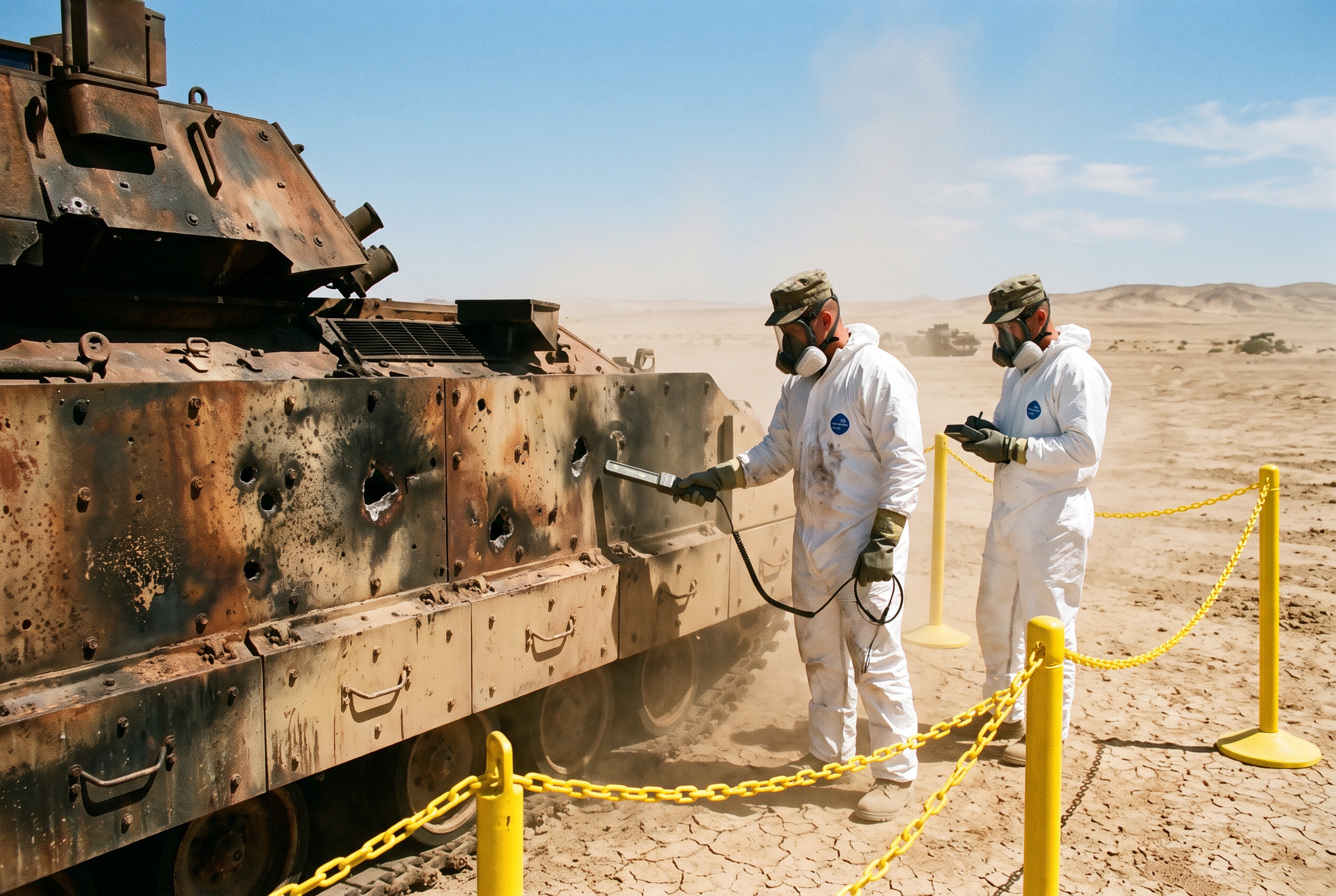
Depleted uranium is what remains after uranium is enriched. It is roughly 1.7 times denser than lead, which is why it was used for armor-piercing penetrators and for the armor on M1 tanks. It is also weakly radioactive and chemically toxic as a heavy metal — and the chemical toxicity, particularly to the kidneys, is the part most examiners underweight. When a DU round strikes armor it burns and fragments, throwing a fine uranium oxide dust into the vehicle and the surrounding air. That dust is inhalable, and it settles on everything.
The people most exposed were not the gunners. They were the crews inside vehicles hit by friendly DU fire, the recovery and maintenance teams who cut apart and hauled off struck vehicles, the cleanup details working in and around wrecks, and anyone handling DU rounds or working in a vehicle with DU armor. There is no presumption for depleted uranium. There is a VA DU Follow-Up Program that provides screening, and there is a solid facts-found route — but a screening test result is not a claim, and confusing the two is the most common mistake in this category.
What you were actually breathing, drinking, or touching
Depleted uranium metalUranium oxide aerosolEmbedded DU fragmentsHeavy metal particulate
No presumption — facts-found claim
There is no VA presumption for depleted uranium exposure. Every DU claim is a facts-found claim. The VA DU Follow-Up Program provides screening and clinical documentation that can support such a claim, but participation in it does not by itself establish service connection.
Where it was, when it was, and who was standing there
The exposure, in specifics
A claim is decided on specifics. Location, date range, and duty — in that combination — are what turn an assertion of exposure into a documented one.
Where DU was used
The 1990–1991 Gulf War produced the largest DU exposure event, primarily in Iraq and Kuwait. DU munitions were also used in Bosnia and Kosovo in the 1990s and in Iraq from 2003. DU armor was standard on M1A1 heavy armor tanks regardless of theater, and DU rounds were stored, handled, and fired in training at ranges in the United States.
How exposure occurs
Four ways. Inhalation of uranium oxide dust after an impact or fire. Embedded fragments from a DU round or spall inside the body, which continue to release uranium into the bloodstream for life. Ingestion of settled dust. Wound contamination during treatment at the point of injury.
Who was exposed
Armor crewmen in struck vehicles, recovery and maintenance personnel working on damaged equipment, cleanup and salvage details, ordnance and ammunition handlers, medical personnel treating contaminated casualties, and anyone who lived or worked around a vehicle graveyard.
What the follow-up program is
The VA Depleted Uranium Follow-Up Program offers a urine uranium bioassay and clinical evaluation to veterans with a plausible exposure history. It is a health surveillance program. It is useful evidence, and it is not a claim — filing for benefits is a separate act.
How you qualify
The routes available on this exposure
Work out which route your case is on before you gather a single document. Preparing the wrong evidence is the most common reason a truthful claim comes back denied.
Facts-found route
Direct service connection on the facts
Establish the exposure with unit records, incident and friendly fire reports, recovery mission documentation, or radiological survey records. Establish the diagnosis. Then obtain an opinion meeting the at least as likely as not standard. In DU cases the opinion must address chemical nephrotoxicity, not only radiation dose — an examiner who only calculates a radiation dose and stops has answered half the question.
Unit and incident records placing you in or around struck vehicles
Friendly fire investigation reports, which frequently name individual crew
Recovery, salvage, and maintenance mission records
VA DU Follow-Up Program bioassay results and clinical evaluation
Secondary route
Secondary service connection
Kidney impairment is the central DU concern, and kidney disease generates a long secondary chain under 38 CFR § 3.310 — hypertension, anemia, bone and mineral disorder, and cardiovascular disease. Each is separately ratable. Veterans with embedded fragments should also have those documented as a distinct, ongoing exposure rather than a historical event.
Two different things — never combine them
A presumption and a TERA determination are not the same thing
These two get mixed together constantly — by veterans, by service officers, and sometimes in the decision letter itself. They are separate mechanisms that answer separate questions. One asks where and when you served. The other asks what you did while you were there. Treating either one as a substitute for the other is how a winnable claim gets prepared the wrong way and comes back denied.
Here is the fastest way to tell which lane you are standing in. A presumption almost always comes out of a deployment or an assignment to a place that has already been named — Vietnam, the Gulf, the Korean DMZ, the burn-pit countries, Camp Lejeune. Congress or VA drew a box around a region and a set of dates, and if your service falls inside that box and your diagnosis is on the list attached to it, you are in the presumptive lane and the law does the connecting for you. TERA is for everything else. If your exposure did not come from being sent to one of those named locations — if it came from the aircraft you turned wrenches on, the fuel you pumped, the foam you sprayed, the paint and solvent you stripped with, the engine room you stood watch in, the stateside installation where the work itself was the hazard — then no list is ever going to carry your claim. That is a TERA case, and it is proved with your duties.
Read both columns before you decide what to gather. If you are in the presumptive lane, the work is proving your service facts — orders, dates, locations. If you are in the TERA lane, the work is documenting what you actually did and then getting a medical opinion that ties it to the diagnosis. Those are two entirely different piles of paper, and preparing the wrong one costs months. And plenty of veterans are standing in both lanes at the same time — one condition that qualifies off a deployment, another that only ever gets connected through the work.
Set by law — where and when you served
A presumption
A presumption is written into statute and regulation. It has three moving parts and all three have to line up: a specific place, a specific date range, and a diagnosis that appears on the list attached to that place. When they do, VA presumes the exposure and presumes the connection — you never have to produce a medical opinion tying the disease to the service.
It is decided on service records, not on medical evidence.
Miss the location or the date window by anything at all and the presumption simply does not apply.
The condition list is closed — a diagnosis that is not on it is not presumptive, however strong the science behind it.
If you do qualify, it is the fastest route to a decision that exists.
Based on what you actually did
A TERA determination
TERA stands for Toxic Exposure Risk Activity. It is VA’s finding that your service involved an activity that put you at risk of a hazard, and it comes out of your duties, your assignments, and the work you actually performed — not out of a list of places and dates. It is not a presumption, and on its own it does not grant service connection.
What it does: it puts the exposure into the record, and under 38 U.S.C. § 1168 it generally obligates VA to obtain an exam and a medical opinion when there is a current disability and the file is otherwise short of proof.
What it does not do: it does not concede the medical link. VA can find TERA and still deny the claim for “no nexus.”
It is also used on the health care side, to establish eligibility to enroll and to get the toxic exposure screening.
It is frequently missing from the file, or built off your primary job code alone — which misses the duties that actually exposed you.
Keep them apart — four rules that decide claims
No presumption does not mean no claim. It means your claim is facts-found, and the link gets built with evidence instead of handed to you by regulation.
A TERA finding is not a presumption. It never removes the need for a nexus opinion — it is what forces VA to go get one.
You can be in both lanes at once. Presumptive on one condition and facts-found on another, inside the same application.
Serving somewhere with a documented hazard is not the same as qualifying for a presumption. The presumption needs the exact place, the exact dates, and a listed condition — all three.
The condition lists
What is on a list, and what is not
Read the label above each list carefully. A presumptive list and a health-care eligibility list are two different things, and confusing them costs veterans claims every single day.
Health concerns associated with depleted uranium exposure
Not a VA presumptive list. These are the concerns identified in VA, DoD, and National Academies reviews of DU-exposed populations. Each claim requires its own medical opinion.
Kidney damage and reduced renal function
Chronic kidney disease
Elevated urinary uranium with proteinuria
Respiratory irritation and reduced lung function from oxide inhalation
Complications from retained embedded fragments
Bone deposition of uranium
Neurocognitive complaints reported in fragment-bearing cohorts
Reproductive and genotoxicity concerns under continuing study
How to apply
The filing order, with the actual forms
Order matters. Filing in the wrong sequence is how veterans lose months of back pay on a claim that was always going to be granted.
1
VA Form 21-0966
File the Intent to File
Obtaining unit and incident records takes time. The Intent to File preserves your effective date for up to a year while that development runs.
2
VA Form 10-10EZ
Enroll and request the DU Follow-Up Program
Enroll in VA health care and ask your provider for a referral into the Depleted Uranium Follow-Up Program. The bioassay and clinical evaluation become evidence in the claim, so start it early.
3
VA Form 21-4138
Document the exposure event
The vehicle, the date, the mission, whether you entered a struck hull, how long you worked the site, whether protective equipment was issued, and any wounds sustained. Name other crew who can corroborate it.
4
VA Form 21-526EZ
File the claim with renal function documented
Claim kidney impairment, respiratory conditions, and any fragment-related condition separately. Attach the bioassay, the renal labs, and the nexus opinion. Ask VA in writing to obtain the incident and radiological survey records.
5
VA Form 21-22a
Put an accredited agent on the file
DU claims are won or lost on federal records the veteran does not hold and on whether the examiner addresses chemical toxicity. Both are things a representative can force before a decision issues rather than after.
Evidence to gather
What belongs in the file before you file
Unit records, deployment orders, and after-action reports placing you at the incident or recovery site
Friendly fire or combat damage investigation reports naming the vehicle and crew
Recovery, salvage, or maintenance mission logs for struck equipment
Radiological survey or contamination control records from the site
VA DU Follow-Up Program urine bioassay results and clinical evaluation
Imaging documenting embedded metal fragments, and any surgical or operative reports
Complete renal function history — creatinine, eGFR, and urinalysis over time
What you will be told, and the answer
The shortcuts to expect
“The radiation dose was too low to cause harm.”
Radiation is only half of it. Depleted uranium is a chemically toxic heavy metal and the kidney is its primary target organ. An opinion that evaluates only the radiological dose has not addressed the nephrotoxic mechanism, and is incomplete on its face.
“Your bioassay was normal, so there was no exposure.”
A urine bioassay measures uranium being excreted now. It is not a lifetime dose record, and a normal result years after an inhalation event proves very little. Absence of a current biomarker is not evidence of absence of past exposure.
“You were screened in the follow-up program, so you are covered.”
Screening is health care. Compensation requires a filed claim. Many veterans have been in the DU Follow-Up Program for years and have never filed for benefits, because nobody told them these are two entirely separate systems.
Why representation changes the odds
Register with us on your depleted uranium claim
Tell an accredited agent what happened and we will review your situation first, then tell you honestly whether we can help. One form, one click, and a real person reads it.
We pursue the incident and friendly fire records that name your vehicle, which is the evidence that converts a general deployment into a documented DU event.
We make sure the exam question asks about heavy metal nephrotoxicity and not just radiation dose, because the way the question is written decides the answer.
We build the renal function trend from your records so declining kidney function reads as a progression instead of a single data point.
We separate the health care track from the compensation track, so veterans in the Follow-Up Program stop assuming they have already filed.
VA-Accredited Claims Agent #45147
Albert Thombs
An accredited agent personally reviews every request — we’ll reach out within 48 hours.
Registering opens the secure sign-up form of the advocate who is next to take a new file, in a new tab. If you would rather have someone look at your situation before you decide anything, ask for the free case review instead.
Office hours: Mon–Fri, 11am–6pm Pacific
Keep building the case
The era, the job, and the medical evidence that go with this exposure
Authorities: 38 CFR § 3.303(d); 38 CFR § 3.310; 38 CFR § 3.102. Radiation dose claims may alternatively be developed under 38 CFR § 3.311. Health surveillance through the VA Depleted Uranium Follow-Up Program. Exposure pathway and health effect findings from Department of Defense and National Academies of Sciences reviews of depleted uranium. General information for education, not legal or medical advice.
Both options are free · No obligation
Two ways to work with us — both free
Talking to a VA-accredited claims agent costs nothing either way. Pick the one that fits: get answers to your questions, or register to hire us to take on your claim.
Free information — just ask
You can ask Albert, our AI claims assistant, anything about exposure, evidence, or the claims process — he answers instantly. If you would rather have a direct, personal answer, send your question below and an accredited agent will come back to you. No cost, no obligation.
Or send your question
Ready to hire us? Register with us
For veterans who have decided they want us on their claim. Registering is free too, and it takes the registration form plus a signed VA Form 21-22a.
Until VA Form 21-22a is signed we cannot accept your claim, access your VA file, or do any work on your behalf. That is federal law, not firm policy.
What happens after you register
You register. This simply starts the conversation — you are not our client yet, and you owe us nothing.
You sign and return VA Form 21-22a. It appoints us as your accredited representative and gives us access to your VA file.
Once we have your signed 21-22a and access to your case, we verify everything is in order.
We review your case in full and conduct your interview with an accredited agent.
Only then do YOU decide whether to move forward with us. If you choose not to, we will not proceed on your behalf — no pressure, no obligation.