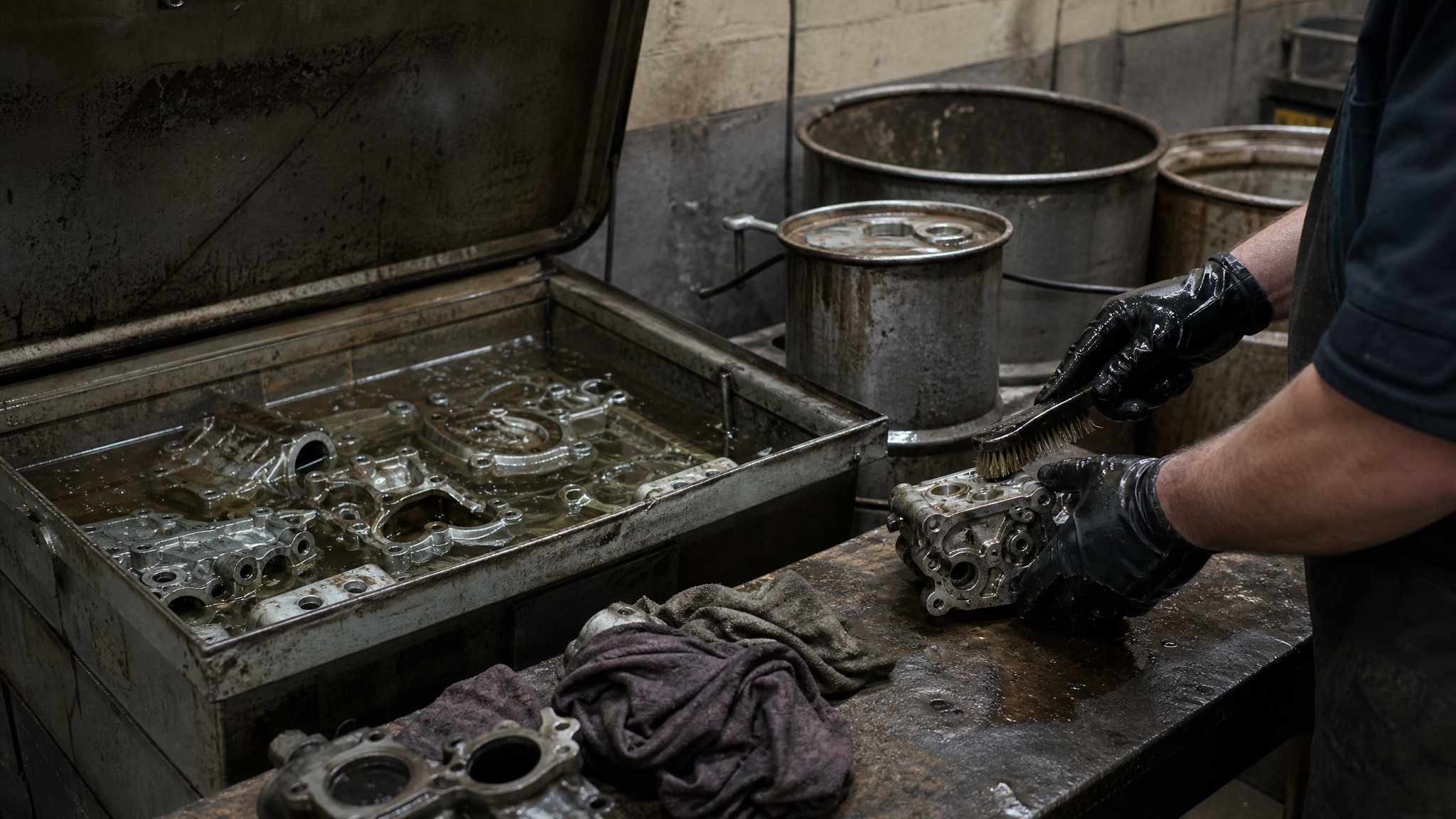
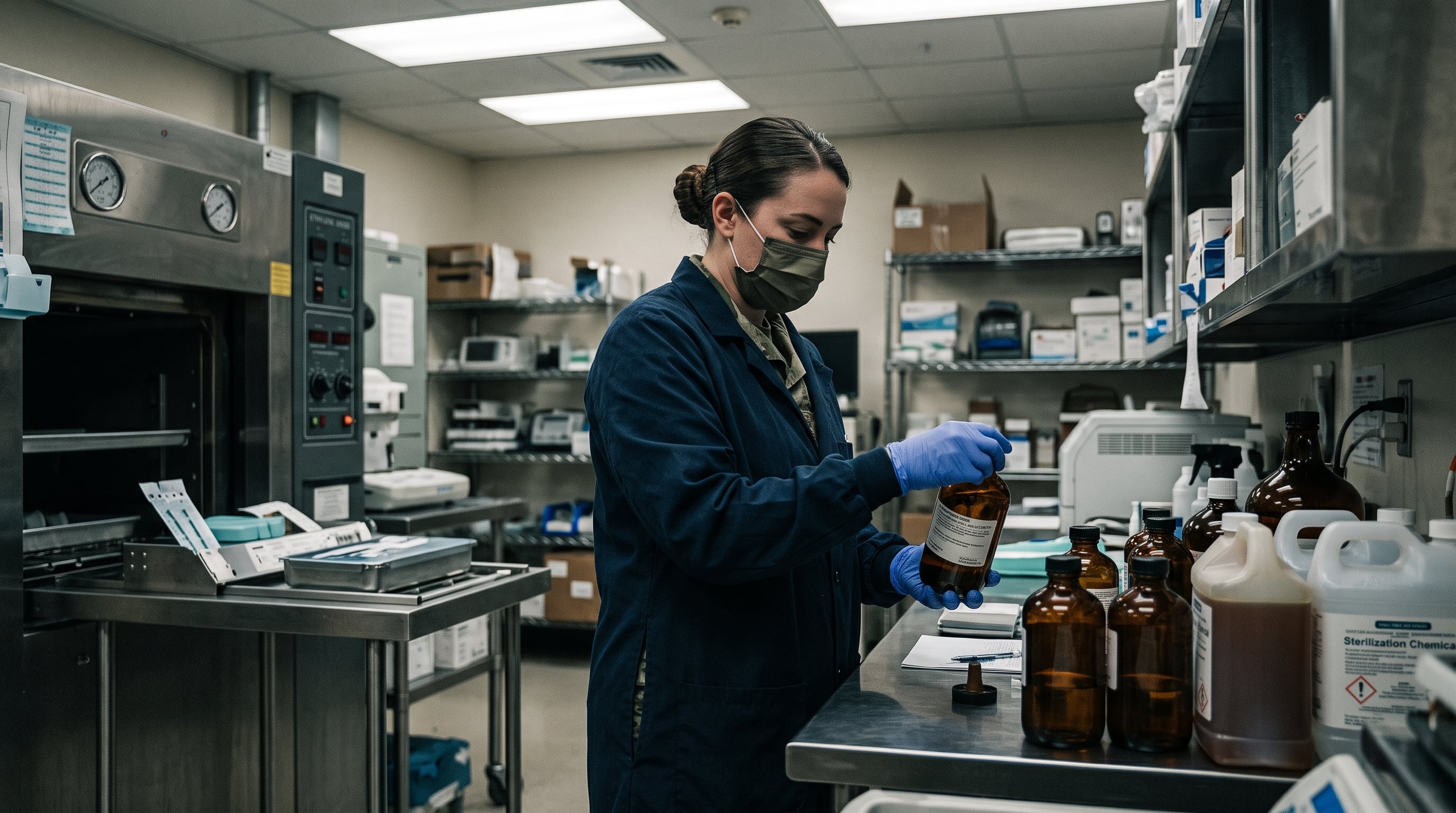
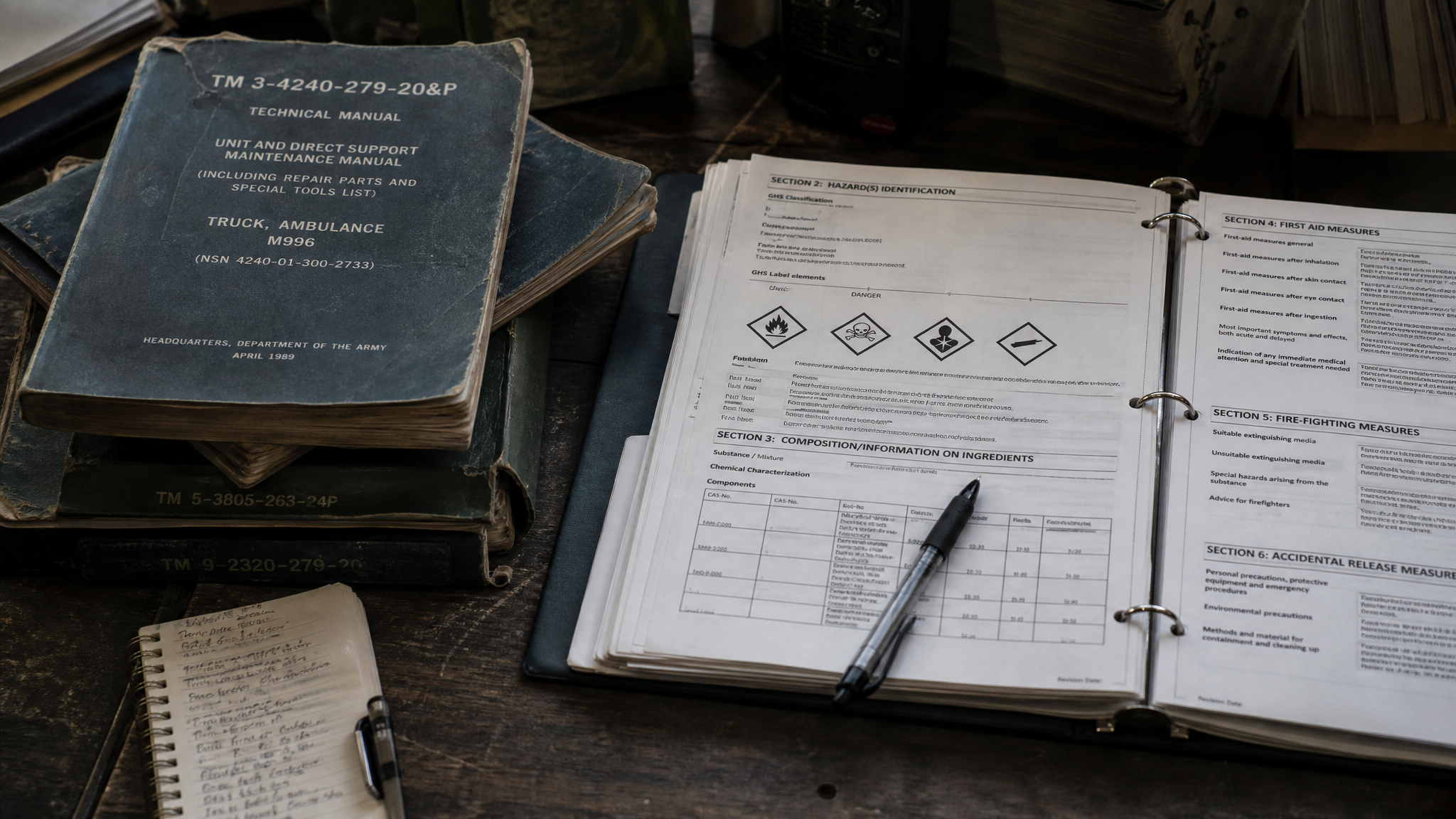
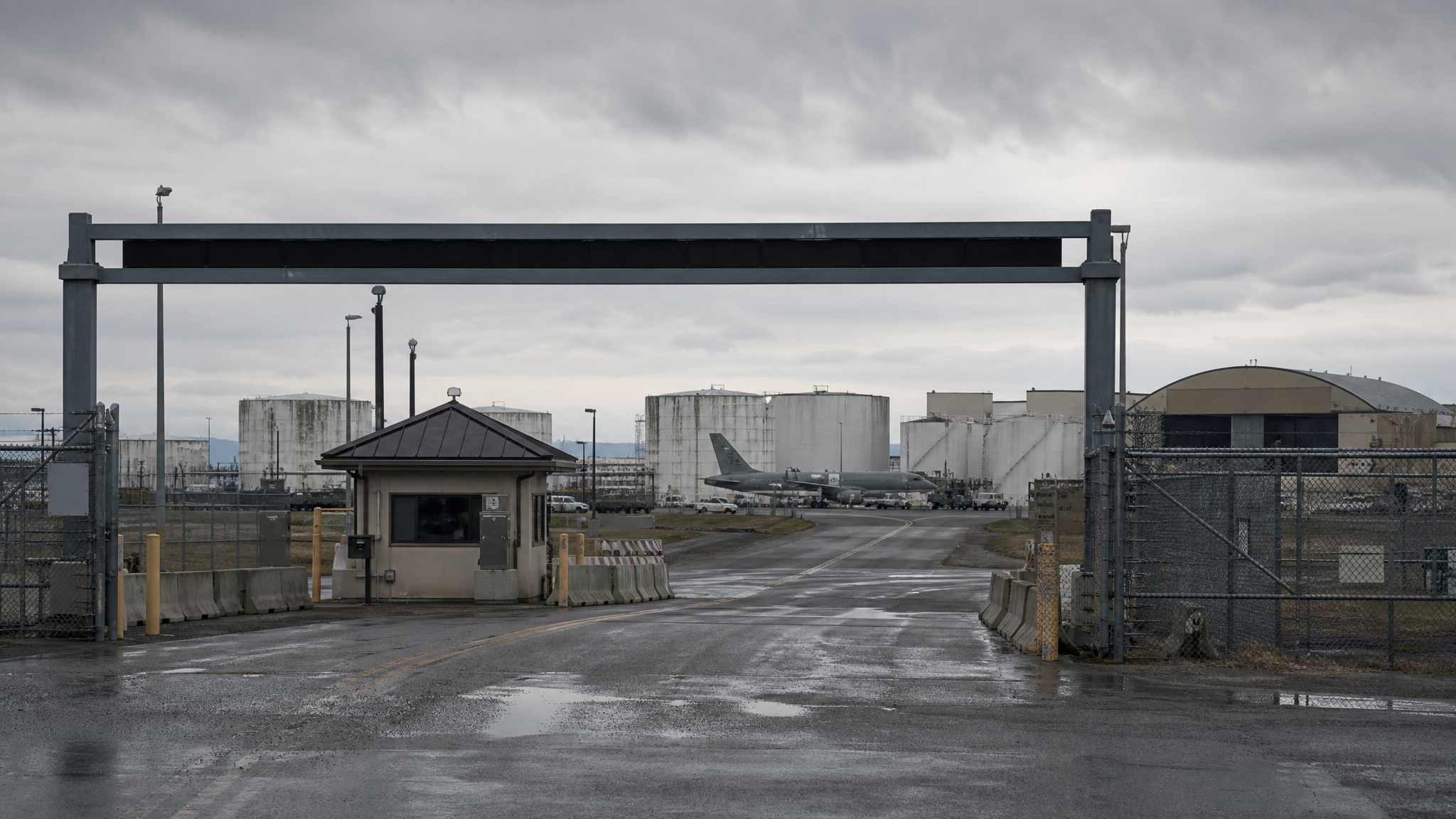
Motor-pool and shop mechanics live in solvents. Every brake job, engine teardown, and parts wash meant degreasers on the hands and vapor in the bay — often for years.
The examiner shortcut is to rely on the occupational title alone. The stronger record names the shop, the specific solvents stocked, and the asbestos-containing parts that were routine before modern substitutes arrived.
Two exposures dominate a mechanic’s profile: chlorinated solvents used to clean parts, and asbestos in brake and clutch linings. Both are well studied, and both need the work-area detail that a bare MOS code leaves out.
Related duties that carry the same exposure
A single job code hides the tasks that actually put you in contact with toxins. Count every one of these you performed.
Engine, transmission, and hydraulic overhaul
Brake and clutch work on legacy asbestos linings
Parts washing and vapor degreasing
Welding, grinding, and metal fabrication
Battery maintenance, radiator work, and painting
What these exposures can cost you
The two headline agents in a motor pool cause different, permanent kinds of damage. TCE and other chlorinated solvents are neurotoxic and are now linked to Parkinson’s disease and kidney cancer — recent research even ties routine solvent work to a markedly higher Parkinson’s risk. Asbestos from brake and clutch dust scars the lungs and can trigger mesothelioma, an almost always fatal cancer of the chest lining.
Both play a long game. Parkinson’s can emerge decades after the last parts wash, and asbestos disease commonly appears 20 to 50 years after exposure. A mechanic can spend a full career symptom-free and still be carrying the injury. That latency is why documenting the solvents and brake work now — not after a diagnosis — is what keeps the exposure provable when symptoms finally arrive.
Watch this
VA Benefits: Toxic Exposure Update
A plain-English overview from the U.S. Department of Veterans Affairs on toxic-exposure benefits and the PACT Act.
Now that you have seen what this job can cost you, here is how the exposure maps to a VA claim — and how to act on it below.
Turn this into a claim
Three questions decide almost every toxic-exposure claim. Here is how to answer them for your service — and how to get help doing it.
Do I qualify?
Almost every toxic-exposure claim comes down to three things — and you generally need all three.
A current diagnosis — a condition a doctor has actually documented, not just symptoms you live with.
An in-service exposure — proof your service put you in contact with the hazard: your MOS, the duties you performed, and your locations and dates.
A link between the two — either a PACT Act presumption that connects them for you, or a medical nexus opinion stating your service at least as likely as not caused the condition.
How to file your claim
You can start today, and filing does not require a lawyer. The path looks like this.
File an Intent to File first — it locks in your effective date and can protect up to a year of back pay while you gather evidence.
Pull your records — service treatment and personnel records, your ILER, any TERA memo, and private medical records for your diagnosis.
Submit VA Form 21-526EZ — online at VA.gov, by mail, or in person, with your evidence and a statement describing your exposure.
Prepare for the C&P exam — know your history cold, and if the exam is inadequate you can challenge it rather than accept a denial.
Want someone to do this with you?
You do not have to figure this out alone. Albert Thombs is a VA-accredited claims agent (#45147) who works the case directly with you.
Free case review — we look at your service, your diagnosis, and whether a presumption or a facts-found theory fits.
No upfront fee — on a first-time claim there is no charge to you.
Fees are recovery only: 20% of past-due benefits, never hourly, nothing on a first-time claim, under 38 C.F.R. § 14.636.
Each agent below is only compensable if the record shows the source and route. Match every one to what you actually did, where, and for how long.
TCE and other chlorinated solvents
What it is: Trichloroethylene (TCE) and related chlorinated solvents were the go-to vapor degreasers in the motor pool — poured into open tanks and parts washers to strip grease off components, often used bare-handed with little ventilation.
Where it came from: Vapor degreasing and parts cleaning
How it harms you: They absorb through the skin and the vapor is inhaled in a closed bay. TCE is linked in the medical literature to kidney cancer and to Parkinson’s disease through mechanisms such as oxidative stress, mitochondrial dysfunction, and neuroinflammation — which is why naming the specific degreaser, not just “solvent,” is what a nexus needs.
Why it matters: TCE is linked to Parkinson’s disease and kidney cancer; identify the specific degreaser.
Stoddard solvent / PD-680, mineral spirits
What it is: PD-680 (Stoddard solvent) and mineral spirits were the everyday petroleum-based cleaners in the shop parts washer — the solvent your hands sat in for much of a shift.
Where it came from: Parts washers and hand cleaning
How it harms you: The route is whole-shift skin contact plus inhaled vapor, and in a poorly ventilated bay the dose adds up over years. It is a recognized skin and respiratory irritant and a neurotoxicant, so the record should note how the parts washer was ventilated and how often you used it.
Why it matters: Whole-shift skin and vapor contact; note ventilation.
Asbestos
What it is: Brake linings, clutch facings, gaskets, and packing in the asbestos era were loaded with asbestos fibers. Every brake job and clutch change ground and blew that material into the air of the bay.
Where it came from: Brake and clutch linings, gaskets, and packing
How it harms you: The fibers are inhaled and lodge permanently in the lung lining. Decades later they can cause asbestosis, lung cancer, and mesothelioma — an aggressive, almost always fatal cancer of the chest lining. Because the disease surfaces 20 to 50 years out, documenting the brake and clutch work now is what keeps the claim provable when symptoms finally appear.
Why it matters: Grinding and blowing out brake dust released fibers — a mesothelioma and asbestosis concern.
Lead
What it is: Lead was everywhere in legacy vehicles — solder, batteries, radiator cores, wheel weights, and the residue of leaded-fuel systems the mechanic serviced by hand.
Where it came from: Solder, batteries, radiator work, and leaded-fuel systems
How it harms you: Lead is absorbed through contact and fume and accumulates in the body, where it injures the nervous system, raises blood pressure, and damages the kidneys long after the exposure stops. Tie the effect to the specific task — battery work, soldering, radiator repair — so it is documented as occupational, not chalked up to age.
Why it matters: Neurologic and cardiovascular effects; document the task.
Chromate primers, fuels, and exhaust
What it is: Corrosion-control primers on vehicles and equipment contain hexavalent chromium, and the bay air also held the fuel vapor and engine exhaust of machines run indoors.
Where it came from: Painting and running engines in the bay
How it harms you: Hexavalent chromium is an EPA- and IARC-classified lung carcinogen; priming and especially sanding old coatings throws it into the air as an inhalable dust. Combined with benzene-bearing fuel vapor and diesel exhaust, it stacks a confirmed carcinogen on top of the solvent load — document the painting, the engines running in the bay, and the ventilation.
Why it matters: Adds carcinogen and particulate exposure to the solvent load.
The overlooked exposure
Noise & hearing
Tinnitus and hearing loss are the two most common service-connected disabilities at the VA — and the easiest to overlook, because the damage is silent and builds over years. If this job put you around jet engines, weapons, or heavy machinery, hearing belongs in your claim.
Noise level on this job
High — engines, power tools, and shop machinery run for hours at a time.
Where the noise came from
Engine and generator run-upsImpact wrenches, grinders, and air toolsTest cells and shop machineryVehicle and track maintenance bays
What it can cause
Tinnitus — constant ringing, buzzing, or hissing
Sensorineural (permanent) hearing loss
Trouble following speech in a noisy room
Evidence that proves it
Enlistment vs. separation audiograms — compared side by side for a threshold shift
Maintenance, motor-pool, or shop assignment records
Hearing-conservation program enrollment and annual audiograms
Buddy statements about ringing ears and asking people to repeat themselves
Maintenance work generally rates a high probability of hazardous noise on VA's Duty MOS Noise Exposure Listing. Tinnitus is established largely on your own credible report; hearing loss must be confirmed by a VA audiogram that meets the measurement threshold.
Symptoms to watch for
These exposures can surface as everyday complaints long before anyone connects them to service. Knowing the warning signs helps you get screened early and get them documented in your record.
Every group below has its own full page — the complete warning-sign list, the signs that should not wait, the tests to ask for by name, and the words to say on the phone.Or jump straight to how to get an appointment
These are common warning signs, not a diagnosis. Only a clinician can evaluate them — but if any sound familiar, raise them at your next visit and ask that they be noted alongside your exposure history.
Turn this page into an appointment
How to get seen about this
Reading a symptom list changes nothing on its own. A dated note in your medical record does — for your health first, and years later for a claim. Below is every route to an appointment, the phrase that gets your exposure history written down, and the numbers to dial. Nothing on this page is a diagnosis, and none of it replaces your doctor.
Some things do not wait for a scheduler
Chest pain or pressure lasting more than a few minutes, or chest pain with sweating, nausea, or pain spreading to the jaw or arm
Sudden trouble breathing, or breathlessness while sitting still
Face droop, weakness or numbness on one side, slurred speech, or sudden confusion
Coughing up or vomiting blood, or bleeding that will not stop
A first seizure, or fainting you cannot explain
Call 911 or go to the nearest emergency room. Do not wait to reach a VA facility first, and do not drive yourself. Tell VA as soon as you can afterward — VA asks to be notified within 72 hours of emergency care received in the community — and keep every discharge paper and bill.
Call your VA medical center
Fastest
Calling your own VA facility is the quickest way to get an appointment. VA Health Connect gives you round-the-clock phone access to a scheduler, a nurse, and in many regions a provider.
Do not know your facility's number? Call MyVA411 at 800-698-2411, any hour, and ask to be connected to your VA medical center's scheduling line.
Say you are an established patient if you already have a primary care provider, and ask for the next available appointment with that provider.
If nothing is available soon, ask to be added to the cancellation list and ask whether a nurse can advise in the meantime.
Call VET-HOME — VA's exposure team
Exposure-specific
833-633-8846, Monday to Friday, 9:00 a.m. to 7:30 p.m. ET. VET-HOME stands for Veterans Exposure Team — Health Outcomes Military Exposures, and it exists for exactly this conversation.
Say: I want a military environmental exposure assessment. The intake center schedules you with a clinician specially trained in military environmental exposures — by telehealth, so it does not matter how far you live from a medical center. Any veteran enrolled in VA health care, anywhere in the United States or its territories, can use it.
The clinician documents your exposure history, answers exposure-related questions, and recommends follow-up. If labs, imaging, breathing tests, or a specialty consult are needed, they say so. Afterward VA mails you a letter with your results, what they mean, and the recommendations.
Two limits, so you are not surprised: VET-HOME clinicians do not prescribe medication and do not complete disability claim forms. What they produce is a dated VA record of your exposure history — which is the piece most claims are missing.
They also handle the environmental health registry evaluations, and those do not require VA health-care enrollment. If you would rather be seen in person, ask for the environmental health coordinator at your own facility instead — the list is further down this site's Talk To Your Doctor page.
Schedule online or message your care team
Sign in on VA.gov to schedule or request many appointments yourself. What you can book online depends on your facility and the type of care.
You can also send your care team a secure message through My HealtheVet. Use it for non-urgent things — replies typically take up to three business days.
Secure messaging is not for anything urgent. If you need an answer today, call instead.
Locked out or cannot find the option? The My HealtheVet help desk is 877-327-0022.
Not enrolled in VA health care yet
Call the VA Health Benefits Hotline at 877-222-8387, Monday to Friday, 8:00 a.m. to 8:00 p.m. ET, and say you want to enroll in VA health care.
Enrollment is what unlocks VA primary care and the toxic exposure screening. Under the PACT Act many veterans who were turned away years ago are now eligible, so do not assume an old answer still applies.
Enrolling does not mean giving up your own doctor. Plenty of veterans keep a civilian provider and use VA alongside it.
Enrolling in health care is separate from filing a disability claim. One does not require the other.
You see a civilian or private doctor
Ask the front desk for the next available appointment and tell them why: a symptom that has lasted weeks, plus chemical and airborne exposure during military service.
Bring this page, or write the exposures and years on one sheet of paper. Hand it over and ask for it to be scanned into your chart.
A community provider can order tests, refer you, and write your exposure history down — all of which helps. What they cannot do is VA's toxic exposure screening, which only happens inside VA's own record system.
Ask for a copy of the visit note and every result. Those copies are yours, and they are what a claim is eventually built from.
If you are in crisis right now
24/7
Dial 988 and press 1, or text 838255. The Veterans Crisis Line is staffed around the clock.
You do not need to be enrolled in VA health care, and you do not need a service-connected rating, to use it.
You can also start a confidential chat from VA's crisis line website, or ask any VA staff member to walk you to someone.
Ask for your toxic exposure screening
The PACT Act requires VA to offer this to every veteran enrolled in VA health care. It takes about five to ten minutes, and it is the cheapest way to get your exposure history into VA's own record in VA's own words.
What it is
A short set of questions asking whether you believe you were exposed to open burn pits and other airborne hazards, Agent Orange, radiation, Gulf War-related hazards, or contaminated water at Camp Lejeune.
Who can get it
Every veteran enrolled in VA health care. If you are not enrolled yet, enrollment comes first — call 877-222-8387.
How often
An initial screening, then at least once every five years. If you answer that you do not know whether you were exposed, VA schedules you again a year later.
How to get one
It is often done during a primary care or specialty visit — but you can ask for it sooner. Ask your primary care team directly, or ask your facility for its Toxic Exposure Screening Navigator by name.
What it is not
It is not an exam for any specific illness, and it is not part of the disability claims process. It is optional, and declining it does not affect your health care or your benefits.
Why bother
It creates a dated VA record that you raised military exposure. Years later, that entry is evidence that the concern predated the diagnosis.
A civilian or community provider cannot perform this screening — it lives inside VA's own health record. If you only see a private doctor, that is a reason to enroll in VA health care as well.
The burn pit registry: you are probably already in it
Since August 1, 2024, VA and the Defense Department enroll eligible veterans and service members in the Airborne Hazards and Open Burn Pit Registry automatically, from deployment records. For most people there is nothing to sign up for.
Automatic enrollment covers service between August 2, 1990 and August 31, 2021 in the listed operations and locations — Desert Shield, Desert Storm, Iraqi Freedom, Enduring Freedom and New Dawn, the Southwest Asia theater, Egypt, Afghanistan, Djibouti, Jordan, Lebanon, Syria, Uzbekistan, Yemen, and the associated airspace and waters.
You do not need to have been knowingly exposed, and you do not need any current health problem, to be included.
If you enrolled yourself before the redesign, your enrollment carried over. There is nothing to redo.
To check your status, contact the Environmental Health Coordinator at your VA facility.
The registry holds deployment and demographic data only. No medical information is stored in it.
Participation is optional and you can opt out. Being in the registry is not required to file a claim, and it does not affect your eligibility for care or benefits either way.
Being in the registry is not evidence of exposure on its own, and it is not a claim. Treat it as a research tool, and do not let anyone tell you a claim depends on it.
What to take with you
A one-page list of the chemicals and hazards you worked around, with the years and the base or ship
Your job title and MOS or rating, written the way the military wrote it
The symptoms that brought you in, and roughly when each one started
Any breathing tests, blood work, or imaging you already have, including from civilian doctors
A short list of what you want out of the visit — usually: document the exposure, order these tests, refer me
Someone who has watched the change in you, if memory or breathing is the concern
Write mechanics & equipment repair at the top of that sheet, in the words the military used for it.
Before you leave, and afterward
Ask for a copy of the visit note before you leave, and actually read it.
Check that your exposure history is in the note. If it is missing, say so and ask for it to be added — politely, but ask.
Get a copy of every test result, including the numbers, not just the word normal.
Keep your own folder. Paper you hold is worth more than paper you assume exists somewhere.
If a symptom persists after a normal test, go back. A normal result rules out some things, not everything.
The numbers, in one place
VET-HOME — VA's exposure team
833-633-8846
Monday to Friday, 9:00 a.m. to 7:30 p.m. ET
The number to call about a military environmental exposure specifically. VET-HOME books a free telehealth evaluation with a clinician trained in military exposures, and that clinician writes your exposure history into your VA record. Say you want a military environmental exposure assessment.
MyVA411 — VA main line
800-698-2411
24 hours a day, 7 days a week
The one number to call if you do not know who to call. Ask to be put through to your VA medical center's scheduling line, or press 0 for a person.
VA Health Benefits Hotline
877-222-8387
Monday to Friday, 8:00 a.m. to 8:00 p.m. ET
Enrolling in VA health care, health-care eligibility, VA medical bills, and community care billing.
Veterans Crisis Line
988, then press 1
24 hours a day, 7 days a week
Any crisis, and you do not need to be enrolled in VA health care to use it. You can also text 838255.
My HealtheVet help desk
877-327-0022
Monday to Friday
Trouble signing in, secure messaging, or online scheduling.
VA Benefits Hotline
800-827-1000
Monday to Friday, 8:00 a.m. to 9:00 p.m. ET
Claims, ratings, and back pay — the benefits side rather than the medical side.
TTY
711
Relay service
If you are deaf or hard of hearing.
These are VA's own published lines. If a number ever gives you a runaround, MyVA411 at 800-698-2411 will transfer you — it is staffed every hour of every day.
Conditions linked to these exposures
These are the diagnoses most often argued from this job. Open the evidence file for the medical studies, examiner shortcuts, and what a sound opinion must do.
None of these becomes a claim until a clinician writes it down. If a name on this list matches what you are already living with, get it evaluated and get the exposure history into the note.
Name the exact solvents and asbestos-era parts in black and white — turning “some degreaser” into TCE and “old brakes” into a documented asbestos component the examiner cannot brush aside.
Shop and motor-pool location
Places you inside the bay where the products were used, defeating the “could have worked anywhere” objection and anchoring the exposure to a real workspace.
Parts and overhaul records
Show the asbestos-era brake, clutch, and gasket work you performed — the fiber-releasing tasks that connect the diagnosis to the duty.
Buddy statements on solvent and brake work
Corroborate daily degreasing and brake-dust exposure that logs never recorded — first-hand proof of routine, hands-on contact.
Base contamination records (for example, Camp Lejeune TCE)
Connect a solvent career to a documented site event, adding objective government proof on top of your personal account.
A nexus opinion addressing latency
Because Parkinson’s and asbestos disease surface decades later, a strong opinion must explain the delay — a clinician who does so head-on defeats the VA’s favorite “too remote in time” denial.
The records to demand for this claim
Most exposure claims are decided on records the veteran never sees — and lost on the ones quietly missing from the file. Chase down all four below before you file, then read them yourself line by line.
The DoD–VA exposure database
Individual Longitudinal Exposure Record (ILER)
ILER is the joint DoD–VA system that compiles what the government already believes about your occupational and environmental exposures. VA raters and examiners pull it up to decide whether your job "really" exposed you — so a thin or blank ILER can quietly sink a claim before you ever see it.
How to get it: Request your own ILER report through VA / VHA — ask your VA provider or the environmental health coordinator at your VA medical center, or raise it with your representative. Get the actual report, read it line by line, and treat it as a draft, not gospel.
A missing or empty ILER entry is NOT proof you were not exposed — it means the database is incomplete, which is common. Never let an examiner treat "ILER is negative" as the end of the story; rebut it with your duty description, buddy statements, and unit records.
Toxic Exposure Risk Activity finding
TERA memorandum
A TERA memo is the VA’s formal finding that your service involved a Toxic Exposure Risk Activity. Under the PACT Act, when you have a current disability plus TERA evidence and the file is otherwise short of proof, VA is supposed to obtain a medical exam and opinion — which makes the TERA memo one of the most powerful pieces of paper in the file. Keep it separate from a presumption in your head: a presumption is set by law and turns on where and when you served plus a listed condition, while a TERA finding turns on the work you actually performed. Neither one replaces the other.
How to get it: VA is generally responsible for developing the TERA determination — but it is frequently missing from the electronic claims file, based only on your MOS, or simply wrong. Ask in writing whether a TERA memo was completed, request a copy, and if it is absent or MOS-only, submit your specific duties and locations and ask that it be corrected.
TERA conceded is NOT the same as a nexus conceded. VA can grant TERA and still deny the claim for "no link." You still need the medical opinion — but a correct TERA memo is what forces VA’s duty to get that exam in the first place.
STRs + OMPF / personnel file
Service Treatment & personnel records
Your Service Treatment Records (STRs) hold the in-service complaints, sick-call visits, and exams; your personnel file (OMPF) proves where you were and what you did. Together they anchor both the exposure and any early symptoms — and gaps in them are where claims are lost.
How to get it: Request complete copies (not summaries) through the VA claims process, the National Archives (NPRC), or milConnect. Read them page by page, list what is missing, and fill the holes with buddy statements, unit records, and your own dated timeline.
Do not assume the VA already has everything. Records are routinely incomplete or were never scanned into the electronic file. A missing sick-call entry is a hole to fill with lay evidence — not proof the symptom never happened.
What VA actually relied on
The complete electronic claims file (C-file)
The C-file is everything VA used to decide your claim — the ILER pull, any TERA memo, the exam, and every record on file. Requesting it is the only way to see exactly what evidence VA had, what it was missing, and where a denial went wrong.
How to get it: Request your C-file from VA (a Privacy Act / FOIA request, or through your representative). When it arrives, compare it against this checklist: is the ILER there, is a correct TERA memo there, are your STRs complete, and did the examiner actually address your documented exposure?
Most veterans never look at their own C-file — so they never learn the claim was decided on an incomplete record. If a document above is missing or wrong, that omission itself is often the strongest ground for a Supplemental Claim or appeal.
Test any presumption first — it is the shortest path. If none applies, the claim becomes a facts-found / direct case that needs a documented exposure and a medical nexus. Every rating and deadline below is an estimate; confirm the current status for your service.
TCE was one of the Camp Lejeune contaminants; a mechanic stationed there (1953–1987) should test the presumptive disease list, which includes Parkinson’s disease and kidney cancer among others.
Otherwise, TCE-to-Parkinson’s, TCE-to-kidney-cancer, and asbestos disease are usually facts-found claims needing documented exposure and a medical nexus.
Lawsuits & class actions vs. your VA claim
A VA disability claim is not a lawsuit. Some of these exposures also support a separate mass tort or trust claim against a manufacturer — a different system you can pursue at the same time. Here is how that maps to this job.
Product / bankruptcy-trust claims
Asbestos manufacturer trusts
Brake pads, clutch facings, gaskets, and engine components used in the asbestos era were made by companies later flooded with injury claims and forced into bankruptcy. To keep paying victims, courts required them to fund asbestos bankruptcy trusts now holding more than $30 billion combined. A mechanic diagnosed with mesothelioma, asbestos-related lung cancer, or asbestosis can file against these trusts — a process handled outside the VA against private manufacturers, not the military. It runs fully parallel to a VA claim: trust money does not reduce VA compensation or survivor DIC, and you can pursue both. Deadlines are strict (often keyed to the diagnosis date and varying by state), so confirm trust and litigation options promptly with an asbestos attorney — separate from your VA representative.
Special federal statute
Camp Lejeune Justice Act (CLJA)
TCE and other solvents were among the chemicals in Camp Lejeune’s contaminated water (1953–1987). A mechanic stationed there who developed a qualifying disease such as Parkinson’s disease or kidney cancer may have had a CLJA claim — but the filing window CLOSED on August 10, 2024, so no new claims can be filed. Those who filed in time may resolve through the settlement framework or federal litigation; that process is separate from and does not reduce VA benefits, and the VA’s Camp Lejeune presumptive list (which includes Parkinson’s disease and kidney cancer) remains available with no deadline. If you filed on time, confirm your claim’s status with your CLJA attorney.
You do not have to build this claim alone.
An accredited representative can order the missing records, name the legal theory that fits, and hold the VA to the evidence.
Albert Thombs · VA-accredited claims agent #45147
Who can help you file
Your VA disability claim is not a lawsuit, and there is no class action to “join.” It is an administrative claim decided by the VA — filing one does not require an attorney.
You can prepare it at no cost through a Veterans Service Organization, or with a VA-accredited claims agent who works the case directly with you. Albert Thombs is a VA-accredited claims agent (#45147).
On a first-time claim there is no fee to you. By law any fee is limited to work on an appeal of a denied or under-rated claim. Fees are recovery only: 20% of past-due benefits, never hourly, nothing on a first-time claim, under 38 C.F.R. § 14.636.
Build this profile into a claim the VA cannot wave off.
Bring your unit, every location, and every task above. As a VA-accredited claims agent, Albert can name the legal theory that fits, order the missing service and medical records, and build the exposure and nexus evidence into a claim the VA has to address. The case review is free.
Talking to a VA-accredited claims agent costs nothing either way. Pick the one that fits: get answers to your questions, or register to hire us to take on your claim.
Free information — just ask
You can ask Albert, our AI claims assistant, anything about exposure, evidence, or the claims process — he answers instantly. If you would rather have a direct, personal answer, send your question below and an accredited agent will come back to you. No cost, no obligation.
Or send your question
Ready to hire us? Register with us
For veterans who have decided they want us on their claim. Registering is free too, and it takes the registration form plus a signed VA Form 21-22a.
Until VA Form 21-22a is signed we cannot accept your claim, access your VA file, or do any work on your behalf. That is federal law, not firm policy.
What happens after you register
You register. This simply starts the conversation — you are not our client yet, and you owe us nothing.
You sign and return VA Form 21-22a. It appoints us as your accredited representative and gives us access to your VA file.
Once we have your signed 21-22a and access to your case, we verify everything is in order.
We review your case in full and conduct your interview with an accredited agent.
Only then do YOU decide whether to move forward with us. If you choose not to, we will not proceed on your behalf — no pressure, no obligation.