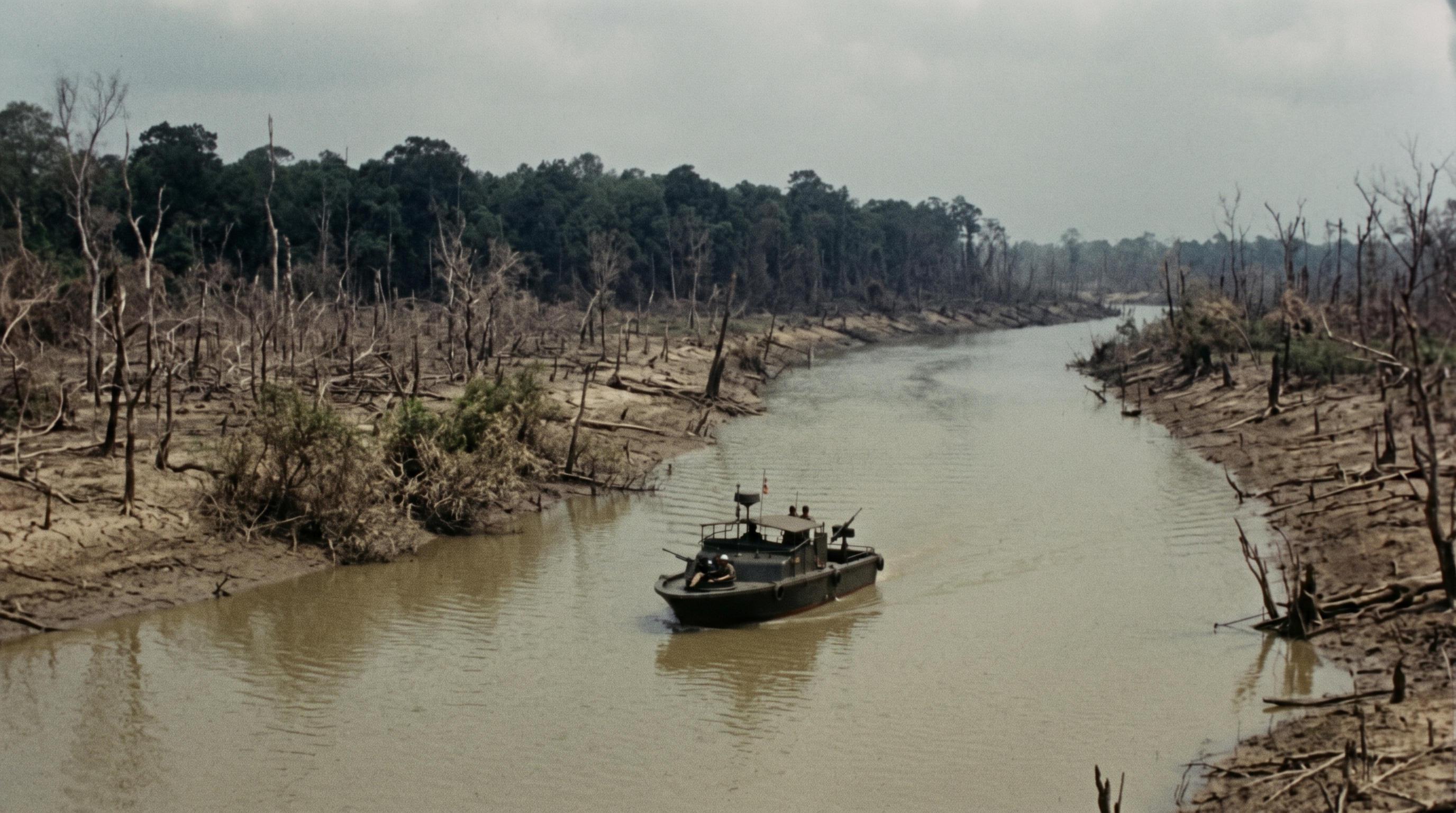
The Navy fought a second war in Vietnam, and it fought it in water the colour of coffee. Task Force 116 ran Operation Game Warden with river patrol boats from December 1965. Task Force 117, the Mobile Riverine Force, carried the Army’s 2nd Brigade of the 9th Infantry Division into the Mekong Delta aboard armoured troop carriers, monitors, and assault support patrol boats, living afloat on barracks ships because there was nowhere dry to put a base. Task Force 115 ran Market Time in fifty-foot swift boats. In November 1968 Vice Admiral Elmo Zumwalt folded all of it into SEALORDS. Coast Guard Squadron One put twenty-six eighty-two-foot cutters into the same shallows, split between An Thoi, Da Nang, and Cat Lo.
The men on those boats were ambushed from the treeline at ten yards, so the treeline was killed. Zumwalt ordered the riverbanks defoliated, and the herbicide went on from helicopters, from trucks, and from drums mounted on the boats themselves. That is the part that matters here, and it is the part almost nobody argues: a Brown Water sailor was not exposed to drift from a distant mission. He was exposed to spray applied deliberately to the bank he was ten feet away from, sometimes by his own crew. And none of it was logged the way the aerial missions were logged.
What you were actually breathing, drinking, or touching
Agent OrangeAgent BlueAgent White2,4-D2,4,5-TTCDD dioxinDirect spray and drift
Presumptive route available
Full presumption, and an old one. Service on the inland waterways of Vietnam between January 9, 1962 and May 7, 1975 is exposure as a matter of law under 38 CFR 3.307(a)(6)(iii) — and has been since the Agent Orange Act of 1991.
Where it was, when it was, and who was standing there
The exposure, in specifics
A claim is decided on specifics. Location, date range, and duty — in that combination — are what turn an assertion of exposure into a documented one.
The Mekong Delta and the river system
Rivers, canals, estuaries, and deltas — the four words the regulation actually uses. The Mekong and its branches, the Bassac, the Long Tau shipping channel, the Rung Sat Special Zone, the Vam Co, the Cua Viet in the north. Service on these waters is service in the Republic of Vietnam, not offshore of it, and has been treated that way since the presumption was written.
Task Force 116 — Operation Game Warden
Established 18 December 1965. Water-jet river patrol boats (PBRs) working the major rivers and canals: night curfew enforcement, minesweeping, interdiction, and insertion and extraction of SEAL teams. Supported from the air by HAL-3, the Seawolves, and later by VAL-4, the Black Ponies, in OV-10 Broncos.
Task Force 117 — the Mobile Riverine Force
Stood up in 1966 as the joint Army–Navy strike force in the delta. Armoured troop carriers — the Tango boats — monitors, and assault support patrol boats, operating from an afloat base of barracks ships, repair ships, and LSTs because fixed ground bases could not be held in the delta mud. If you were 9th Infantry Division and you went to work by boat, this is your task force too.
Task Force 115 — Market Time and the swift boats
Activated July 1965 for coastal interdiction. Swift boats (PCF) — fifty feet of aluminium — worked the shallows, the river mouths, and, after SEALORDS, well up the rivers themselves. A swift boat crew that ran the Cua Lon or the Bo De was on an inland waterway whatever the boat was originally designed for.
Coast Guard Squadron One
Formed May 1965. Twenty-six Point-class eighty-two-foot cutters chosen for shallow draft, split into Division 11 at An Thoi on Phu Quoc, Division 12 at Da Nang, and Division 13 at Cat Lo. They boarded junks, gave naval gunfire support, and worked SEALORDS alongside the Navy until the cutters were turned over to the Vietnamese Navy by August 1970. Coast Guard service counts exactly the same as Navy service here.
The riverbanks were sprayed on purpose
Operation Ranch Hand and its C-123s accounted for roughly ninety-five percent of the herbicide by volume, and those sorties were recorded. The remaining few percent went on by hand, by truck, by helicopter, and by boat — and the delta riverbanks were a priority target, because bare banks meant fewer ambushes. The National Academies have noted plainly that the military kept no systematic record of the quantity or the location of riverine and ground application. The spraying happened. The paperwork did not.
Served offshore?
Blue Water Navy has its own file.
If you served aboard a ship in the offshore waters of Vietnam rather than on the ground or up a river, the offshore presumption under 38 U.S.C. § 1116A, the twelve nautical mile line, the deck log evidence, and the retroactive effective-date rules are written out in full on their own page.
The herbicide itself, the ground and air operations, Thailand, the Korean DMZ, the storage and test sites, and the same 38 CFR 3.309(e) condition list read from the shore side rather than the water.
Work out which route your case is on before you gather a single document. Preparing the wrong evidence is the most common reason a truthful claim comes back denied.
Presumptive route
Presumptive service connection — inland waterway service
Three facts. One — you served aboard a vessel operating on the rivers, canals, estuaries, or delta of Vietnam. Two — it happened inside the January 9, 1962 to May 7, 1975 window. Three — you carry a condition on the 38 CFR 3.309(e) list. That is the whole test. You are not required to prove that a specific mission sprayed a specific bank on a specific day, and you never were.
The location rule is 38 CFR 3.307(a)(6)(iii); the condition list is 38 CFR 3.309(e).
Inland waterways are defined as rivers, canals, estuaries, and deltas — not a ship list.
This presumption predates the Blue Water Navy Act by nearly thirty years. It is not new law and it is not the 2019 law.
Facts-found route
Facts-found — when the vessel is not on any list
VA keeps a list of Navy and Coast Guard ships associated with Vietnam service, sorted into categories: vessels operating primarily or exclusively on inland waterways, vessels that entered them temporarily, vessels that docked to shore or pier, vessels in close coastal waters with documented shore activity, and vessels that put landing craft ashore. The list is an administrative convenience. It is not the boundary of the law. VA’s own procedures require a records review when a vessel is absent, and a great many small craft were never listed at all because nobody indexed them.
Absence from the ship list is not a basis for denial, and VA’s procedures say so.
A records request to the Joint Services Records Research Center can establish where a unit or vessel operated.
Lay statements from you and from shipmates are competent evidence of where the boat went.
Secondary route
Secondary conditions — what the presumptive disease caused
The presumptive disease opens the door; it is not the whole house. Diabetes drives neuropathy, retinopathy, and kidney disease. Ischemic heart disease drives the workload limits behind Total Disability based on Individual Unemployability. Prostate cancer leaves urinary and erectile residuals that are rated separately once treatment ends. A file that claims the headline condition and stops there is the most common way money is left on the table.
Diabetes to peripheral neuropathy, diabetic retinopathy, and chronic kidney disease.
Prostate cancer to voiding dysfunction, urinary frequency, and erectile dysfunction with special monthly compensation.
Ischemic heart disease to the METs limits that carry a TDIU argument.
Two different things — never combine them
A presumption and a TERA determination are not the same thing
These two get mixed together constantly — by veterans, by service officers, and sometimes in the decision letter itself. They are separate mechanisms that answer separate questions. One asks where and when you served. The other asks what you did while you were there. Treating either one as a substitute for the other is how a winnable claim gets prepared the wrong way and comes back denied.
Here is the fastest way to tell which lane you are standing in. A presumption almost always comes out of a deployment or an assignment to a place that has already been named — Vietnam, the Gulf, the Korean DMZ, the burn-pit countries, Camp Lejeune. Congress or VA drew a box around a region and a set of dates, and if your service falls inside that box and your diagnosis is on the list attached to it, you are in the presumptive lane and the law does the connecting for you. TERA is for everything else. If your exposure did not come from being sent to one of those named locations — if it came from the aircraft you turned wrenches on, the fuel you pumped, the foam you sprayed, the paint and solvent you stripped with, the engine room you stood watch in, the stateside installation where the work itself was the hazard — then no list is ever going to carry your claim. That is a TERA case, and it is proved with your duties.
Read both columns before you decide what to gather. If you are in the presumptive lane, the work is proving your service facts — orders, dates, locations. If you are in the TERA lane, the work is documenting what you actually did and then getting a medical opinion that ties it to the diagnosis. Those are two entirely different piles of paper, and preparing the wrong one costs months. And plenty of veterans are standing in both lanes at the same time — one condition that qualifies off a deployment, another that only ever gets connected through the work.
Set by law — where and when you served
A presumption
A presumption is written into statute and regulation. It has three moving parts and all three have to line up: a specific place, a specific date range, and a diagnosis that appears on the list attached to that place. When they do, VA presumes the exposure and presumes the connection — you never have to produce a medical opinion tying the disease to the service.
It is decided on service records, not on medical evidence.
Miss the location or the date window by anything at all and the presumption simply does not apply.
The condition list is closed — a diagnosis that is not on it is not presumptive, however strong the science behind it.
If you do qualify, it is the fastest route to a decision that exists.
Based on what you actually did
A TERA determination
TERA stands for Toxic Exposure Risk Activity. It is VA’s finding that your service involved an activity that put you at risk of a hazard, and it comes out of your duties, your assignments, and the work you actually performed — not out of a list of places and dates. It is not a presumption, and on its own it does not grant service connection.
What it does: it puts the exposure into the record, and under 38 U.S.C. § 1168 it generally obligates VA to obtain an exam and a medical opinion when there is a current disability and the file is otherwise short of proof.
What it does not do: it does not concede the medical link. VA can find TERA and still deny the claim for “no nexus.”
It is also used on the health care side, to establish eligibility to enroll and to get the toxic exposure screening.
It is frequently missing from the file, or built off your primary job code alone — which misses the duties that actually exposed you.
Keep them apart — four rules that decide claims
No presumption does not mean no claim. It means your claim is facts-found, and the link gets built with evidence instead of handed to you by regulation.
A TERA finding is not a presumption. It never removes the need for a nexus opinion — it is what forces VA to go get one.
You can be in both lanes at once. Presumptive on one condition and facts-found on another, inside the same application.
Serving somewhere with a documented hazard is not the same as qualifying for a presumption. The presumption needs the exact place, the exact dates, and a listed condition — all three.
The condition lists
What is on a list, and what is not
Read the label above each list carefully. A presumptive list and a health-care eligibility list are two different things, and confusing them costs veterans claims every single day.
Presumptive conditions — disability compensation
The herbicide list at 38 CFR 3.309(e). Diagnosed at any time after service. There is no manifestation deadline on this list.
AL amyloidosis
Bladder cancer
Chronic B-cell leukemias, including hairy cell leukemia
Chloracne or similar acneform disease
Type 2 diabetes mellitus
Hodgkin’s disease
High blood pressure (hypertension) — added by the PACT Act
Hypothyroidism — added by the PACT Act
Ischemic heart disease
Monoclonal gammopathy of undetermined significance (MGUS) — added by the PACT Act
Soft tissue sarcomas, excluding osteosarcoma, chondrosarcoma, Kaposi sarcoma, and mesothelioma
Birth defects in children of exposed veterans
A separate program under 38 CFR 3.814 and 3.815, filed by or for the child rather than on the veteran’s own claim. These regulations turn on service in the Republic of Vietnam, which is exactly what inland waterway service is — so this route is squarely available to Brown Water families. An accredited representative should file it, because it is not the veteran’s claim and it does not use the veteran’s forms.
Spina bifida, except spina bifida occulta, in a child of a veteran who served in Vietnam or the Korean DMZ
A broader list of covered birth defects in the child of a woman who served in Vietnam
How to apply
The filing order, with the actual forms
Order matters. Filing in the wrong sequence is how veterans lose months of back pay on a claim that was always going to be granted.
1
VA Form 21-0966
File the Intent to File first
Unit records from the National Archives take months to arrive. The Intent to File holds your effective date for one year while the paper is assembled, and it costs nothing.
2
VA Form 21-526EZ
File the claim and name the waterway
The Application for Disability Compensation. List every diagnosed condition rather than only the strongest one, and name the boat, the river division or task force, and the waterways you worked.
3
SF-180
Request the unit records
Command history reports, war diaries, and muster rolls are held at the National Archives. For a small craft this is the paper that does the work a deck log would have done on a destroyer.
4
VA Form 21-4142
Authorise the private records
The release that lets VA collect civilian oncology, cardiology, and endocrinology records. Most of this treatment happened outside the VA system, which means the strongest medical evidence is usually sitting in a private chart.
5
VA Form 21-534EZ
For survivors
The application for Dependency and Indemnity Compensation, survivors pension, and accrued benefits — the right form when the veteran has died, including where he was denied years ago on a record that was never properly developed.
6
VA Form 21-22a
Appoint an accredited representative
This file turns on archival unit records and on which regulation the adjudicator applied. Appointing an accredited agent or attorney puts someone on the file who can order the war diaries, read the old denial, and check the effective date. We do not give claim strategy on this page — that conversation belongs with your representative.
Evidence to gather
What belongs in the file before you file
DD-214 showing Navy or Coast Guard service inside the January 9, 1962 to May 7, 1975 window.
Personnel record showing assignment to a river division, a boat unit, a task force, or a specific hull.
Command history reports and war diaries from the National Archives — the substitute for deck logs when the craft was too small to keep one, and the single most useful document in most Brown Water files.
Muster rolls placing you aboard a named vessel on named dates.
Award and decoration citations that name the river, the canal, the operation, or the division.
VA’s Navy and Coast Guard ships list, if your vessel appears — a shortcut, never a requirement.
Statements from shipmates describing where the boat operated and what was sprayed.
The original denial letter and its date, if you were turned down before. On a herbicide file that piece of paper is what a retroactive effective date is measured from.
A current diagnosis in writing from any credentialed physician, and the treatment records behind it.
What you will be told, and the answer
The shortcuts to expect
“"Your vessel is not on the VA ships list."”
The list is an administrative aid, not the law, and VA’s own procedures say absence from it is not a denial. When a vessel is unlisted the adjudicator is supposed to develop the record — unit records, war diaries, a Joint Services Records Research Center request — not close the file. Small craft are systematically under-represented on that list for the simple reason that nobody ever indexed them.
“"You were Blue Water Navy."”
This is the most expensive misclassification in the population. Blue Water is the offshore rule under 38 U.S.C. § 1116A, effective 2020. Brown Water is the inland rule under 38 CFR 3.307(a)(6)(iii), in force since 1991. Being adjudicated under the wrong one can move an effective date by decades. If a decision letter discusses twelve nautical miles when you served on a canal, it is answering a question nobody asked.
“"There is no record of herbicide spraying on that waterway."”
The HERBS files record aerial sorties. Herbicide applied from boats, trucks, and backpacks — which is how the riverbanks were largely treated — was never systematically recorded, a gap the National Academies have documented. Absence of a spray record is not evidence of no spraying, and in any case the presumption does not require you to produce one.
“"A boat that size did not keep a deck log, so there is nothing to prove it."”
Then the proof is somewhere else. Command history reports, war diaries, muster rolls, operation orders, and award citations all place a unit on a named waterway. The absence of one document class is not the absence of the record.
“"Da Nang Harbour and Vung Tau were ruled offshore, so you do not qualify."”
That fight is largely over. VA classified the deep-water harbours — Da Nang, Cam Ranh, Vung Tau and Ganh Rai Bay, Qui Nhon — as offshore rather than inland, and stopped adding ships for Ganh Rai and Qui Nhon on February 2, 2016. The Court called that reasoning arbitrary in Gray v. McDonald. But since January 1, 2020, everything inside twelve nautical miles is presumptive anyway under § 1116A, so for Vietnam service the harbour argument no longer decides the claim. It can still matter to the effective date, which is a conversation for your representative.
“"The 2019 law is why you are covered, so payment starts in 2020."”
Wrong twice. Inland waterway service was covered in 1991, not 2019, so the 2019 effective-date discussion does not apply to you at all. And where an earlier claim was denied, the Nehmer rules at 38 CFR 3.816 can reach back to that original claim. A decision that starts the clock at 2020 on a river file should be read carefully by someone accredited.
Why representation changes the odds
Register with us on your brown water navy — vietnam inland waterways claim
Tell an accredited agent what happened and we will review your situation first, then tell you honestly whether we can help. One form, one click, and a real person reads it.
The commonest defect in a Brown Water decision is that it was adjudicated as a Blue Water case. Reading which regulation the letter actually applied is the first thing worth doing, and it is frequently the whole case.
When the vessel is unlisted, the file becomes a records project at the National Archives — command history reports and war diaries rather than deck logs. That is unfamiliar work for a claimant and routine work for a representative.
These veterans were covered from 1991 forward, which means a denial from the nineties can still carry a Nehmer effective date. Nobody at VA volunteers that.
The birth-defect programs under 3.814 and 3.815 are squarely open to this population and are almost never filed, because they are the child’s claim rather than the veteran’s.
Prostate cancer and ischemic heart disease residuals are chronically under-rated once the active phase ends. Reading the rating criteria against the actual medical record is where the correction happens.
VA-Accredited Claims Agent #45147
Albert Thombs
An accredited agent personally reviews every request — we’ll reach out within 48 hours.
Registering opens the secure sign-up form of the advocate who is next to take a new file, in a new tab. If you would rather have someone look at your situation before you decide anything, ask for the free case review instead.
Office hours: Mon–Fri, 11am–6pm Pacific
Keep building the case
The era, the job, and the medical evidence that go with this exposure
Inland waterway presumption: 38 CFR 3.307(a)(6)(iii), implementing the Agent Orange Act of 1991, Public Law 102-4. Condition list: 38 CFR 3.309(e), as amended by the PACT Act of 2022. Retroactive effective dates: 38 CFR 3.816, the Nehmer rules. Offshore companion rule: 38 U.S.C. 1116A. Case law on harbour classification: Gray v. McDonald, 27 Vet. App. 313 (2015); Gray v. Secretary of Veterans Affairs, 875 F.3d 1102 (Fed. Cir. 2017). General information for education, not legal or medical advice.
Both options are free · No obligation
Two ways to work with us — both free
Talking to a VA-accredited claims agent costs nothing either way. Pick the one that fits: get answers to your questions, or register to hire us to take on your claim.
Free information — just ask
You can ask Albert, our AI claims assistant, anything about exposure, evidence, or the claims process — he answers instantly. If you would rather have a direct, personal answer, send your question below and an accredited agent will come back to you. No cost, no obligation.
Or send your question
Ready to hire us? Register with us
For veterans who have decided they want us on their claim. Registering is free too, and it takes the registration form plus a signed VA Form 21-22a.
Until VA Form 21-22a is signed we cannot accept your claim, access your VA file, or do any work on your behalf. That is federal law, not firm policy.
What happens after you register
You register. This simply starts the conversation — you are not our client yet, and you owe us nothing.
You sign and return VA Form 21-22a. It appoints us as your accredited representative and gives us access to your VA file.
Once we have your signed 21-22a and access to your case, we verify everything is in order.
We review your case in full and conduct your interview with an accredited agent.
Only then do YOU decide whether to move forward with us. If you choose not to, we will not proceed on your behalf — no pressure, no obligation.