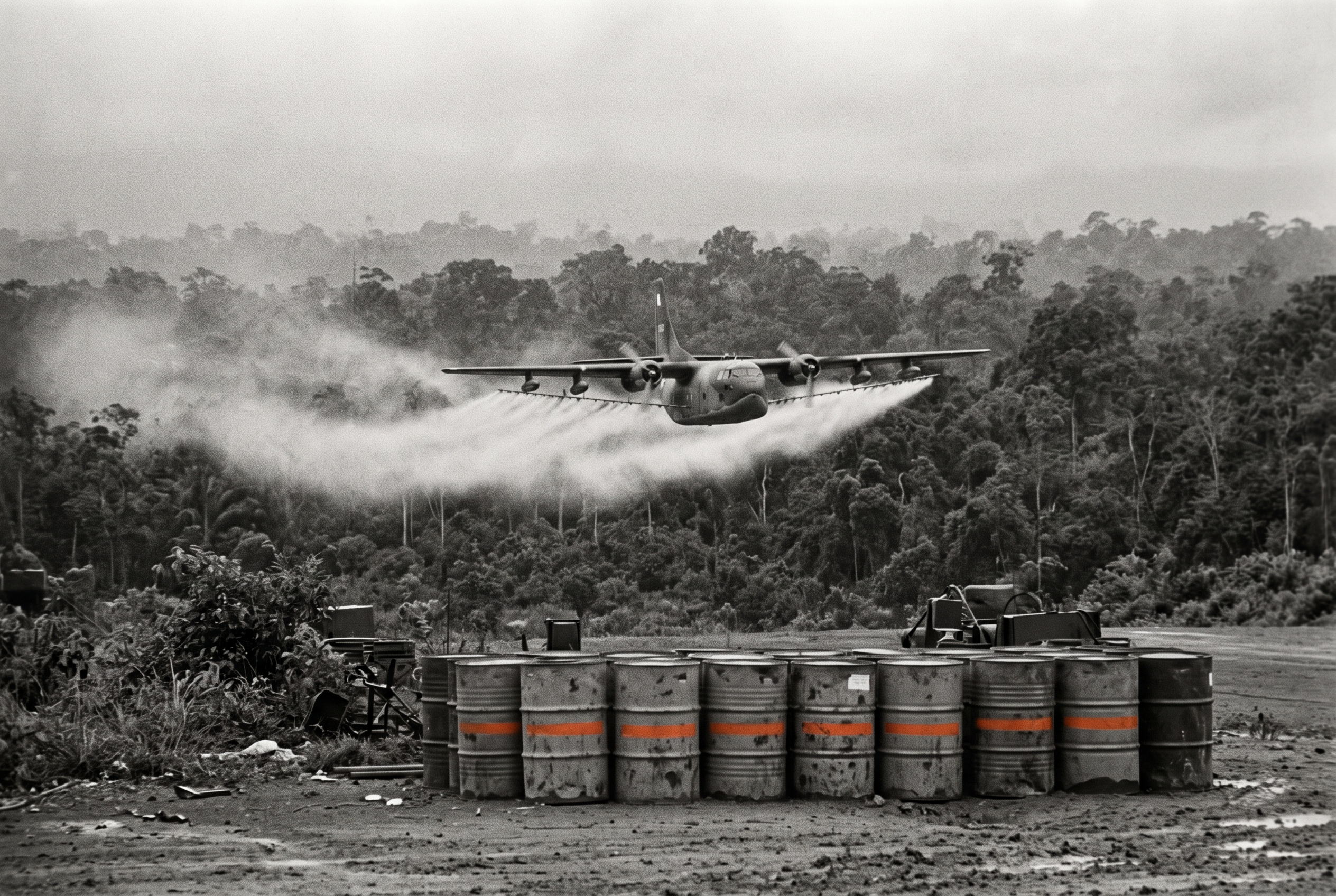
Agent Orange was not one chemical. It was a family of tactical herbicides — Orange, Blue, White, Purple, Pink, and Green — mixed to strip jungle canopy and destroy crops. The problem was never the herbicide alone. It was TCDD dioxin, an unintended byproduct of manufacturing 2,4,5-T, and one of the most persistent toxic compounds ever produced. Dioxin does not wash off, break down quickly, or leave the body on any timeline that matters to a human being. It stores in fat tissue and keeps signalling for decades, which is why a man sprayed at twenty-two develops ischemic heart disease at fifty-eight and the VA still concedes the connection.
The men and women exposed were not only the ones under the spray runs. They loaded the drums, flushed the tanks, hosed down the aircraft, drank from wells inside the perimeter, slept on defoliated ground, and hauled empty barrels that were later cut in half and used as burn barrels and barbecue pits. VA presumptions are written around location and date, not around whether you personally handled the chemical — so if your feet were in the right place in the right window, you do not have to prove you touched anything.
What you were actually breathing, drinking, or touching
Agent Orange2,4-D2,4,5-TTCDD dioxinAgent Blue (cacodylic acid)Agent White (picloram)Agent Purple / Pink / Green
Presumptive route available
A full presumption exists. If your service falls inside a listed location and date window and you carry a listed condition, VA concedes both the exposure and the medical link.
Where it was, when it was, and who was standing there
The exposure, in specifics
A claim is decided on specifics. Location, date range, and duty — in that combination — are what turn an assertion of exposure into a documented one.
Republic of Vietnam and its inland waterways
Service in the Republic of Vietnam between January 9, 1962 and May 7, 1975, including inland waterways. The Blue Water Navy Vietnam Veterans Act extended the presumption to service in the offshore territorial seas out to 12 nautical miles during the same window — which restored thousands of destroyer, carrier, and supply-ship sailors who had been shut out for a generation.
The Korean Demilitarized Zone
Service in or near the Korean DMZ between September 1, 1967 and August 31, 1971. The Army sprayed the southern boundary of the DMZ to clear infiltration lanes. Units in the 2nd and 7th Infantry Divisions and their attached support elements are the most common qualifying assignments, but any unit that operated in or near the zone in the window counts.
Thailand — Royal Thai Air Force bases
Service in Thailand between January 9, 1962 and June 30, 1976. The PACT Act removed the old perimeter requirement. Previously a veteran had to show duty at the fence line — security police, dog handler, perimeter maintenance. Now service anywhere on a Royal Thai Air Force base — U-Tapao, Ubon, Nakhon Phanom, Udorn, Takhli, Korat, or Don Muang — is enough.
Laos, Cambodia, Guam, American Samoa, Johnston Atoll
Laos between December 1, 1965 and September 30, 1969. Cambodia at Mimot or Krek, Kampong Cham Province, between April 16, 1969 and April 30, 1969. Guam or American Samoa, or their territorial waters, between January 9, 1962 and July 31, 1980. Johnston Atoll, or a ship that called at Johnston Atoll, between January 1, 1972 and September 30, 1977.
Storage, testing, and disposal sites in the United States
Herbicides were tested, stored, and destroyed at domestic and overseas sites that are not on the presumptive list — Eglin AFB in Florida, Fort Detrick in Maryland, Gulfport in Mississippi, Kelly and Fort Ord among others. A veteran at one of these sites is not presumptive, but is not shut out. The claim is filed on a facts-found basis using the Department of Defense herbicide site list as the exposure proof.
Served offshore?
Blue Water Navy has its own file.
If you served aboard a ship in the offshore waters of Vietnam rather than on the ground or up a river, the offshore presumption under 38 U.S.C. § 1116A, the twelve nautical mile line, the deck log evidence, and the retroactive effective-date rules are written out in full on their own page.
River patrol boats, swift boats, and the Mobile Riverine Force were covered by the inland waterway presumption from 1991 — a different regulation, a different date, and a different evidence problem than the offshore rule. The task forces, the riverbank spraying, and the unit records that stand in for a deck log are set out on their own page.
Work out which route your case is on before you gather a single document. Preparing the wrong evidence is the most common reason a truthful claim comes back denied.
Presumptive route
Route one — the presumption
Two facts and you are in. First, service in a listed place during the listed window. Second, a diagnosed condition on the presumptive list. You do not need a nexus letter, you do not need to prove you were near a spray run, and you do not need to explain the chemistry. The regulation does that work for you. The only thing left to argue is the rating percentage, which is where most of the money actually is.
Service dates and location come from your DD-214, orders, and personnel file.
The diagnosis comes from any credentialed physician — VA or private.
The condition must be diagnosed. Symptoms alone will not trigger a presumption.
There is no filing deadline on a presumptive claim. A 1970 discharge can file today.
Facts-found route
Route two — facts found, when the presumption does not reach you
If you served at a storage, test, or disposal site, or your condition is not on the presumptive list, the claim becomes a direct service-connection claim. You must show three things: an in-service exposure event, a current diagnosis, and a medical nexus linking the two. This route is harder, it is slower, and it is won far more often with representation than without — but it is won, routinely, and it is how the presumptive list grew in the first place.
Prove the exposure with the DoD herbicide storage and test site list, unit histories, or a buddy statement.
Prove the diagnosis with current treatment records.
Prove the link with a private nexus opinion that cites the dioxin literature, not a one-line note.
Secondary route
Route three — the conditions your presumptive condition caused
A granted presumptive condition becomes a service-connected condition, and anything it causes or aggravates is claimable as secondary service connection. Type 2 diabetes granted under Agent Orange routinely produces diabetic peripheral neuropathy, diabetic retinopathy, and diabetic nephropathy. Ischemic heart disease produces functional limitation that supports a TDIU claim. These secondaries are frequently worth more combined than the original grant and they are the single most commonly missed piece of an Agent Orange file.
Diabetes to peripheral neuropathy of each extremity, rated separately per limb.
Diabetes to retinopathy, nephropathy, and erectile dysfunction with special monthly compensation.
Ischemic heart disease to the workload limits that support Total Disability based on Individual Unemployability.
Two different things — never combine them
A presumption and a TERA determination are not the same thing
These two get mixed together constantly — by veterans, by service officers, and sometimes in the decision letter itself. They are separate mechanisms that answer separate questions. One asks where and when you served. The other asks what you did while you were there. Treating either one as a substitute for the other is how a winnable claim gets prepared the wrong way and comes back denied.
Here is the fastest way to tell which lane you are standing in. A presumption almost always comes out of a deployment or an assignment to a place that has already been named — Vietnam, the Gulf, the Korean DMZ, the burn-pit countries, Camp Lejeune. Congress or VA drew a box around a region and a set of dates, and if your service falls inside that box and your diagnosis is on the list attached to it, you are in the presumptive lane and the law does the connecting for you. TERA is for everything else. If your exposure did not come from being sent to one of those named locations — if it came from the aircraft you turned wrenches on, the fuel you pumped, the foam you sprayed, the paint and solvent you stripped with, the engine room you stood watch in, the stateside installation where the work itself was the hazard — then no list is ever going to carry your claim. That is a TERA case, and it is proved with your duties.
Read both columns before you decide what to gather. If you are in the presumptive lane, the work is proving your service facts — orders, dates, locations. If you are in the TERA lane, the work is documenting what you actually did and then getting a medical opinion that ties it to the diagnosis. Those are two entirely different piles of paper, and preparing the wrong one costs months. And plenty of veterans are standing in both lanes at the same time — one condition that qualifies off a deployment, another that only ever gets connected through the work.
Set by law — where and when you served
A presumption
A presumption is written into statute and regulation. It has three moving parts and all three have to line up: a specific place, a specific date range, and a diagnosis that appears on the list attached to that place. When they do, VA presumes the exposure and presumes the connection — you never have to produce a medical opinion tying the disease to the service.
It is decided on service records, not on medical evidence.
Miss the location or the date window by anything at all and the presumption simply does not apply.
The condition list is closed — a diagnosis that is not on it is not presumptive, however strong the science behind it.
If you do qualify, it is the fastest route to a decision that exists.
Based on what you actually did
A TERA determination
TERA stands for Toxic Exposure Risk Activity. It is VA’s finding that your service involved an activity that put you at risk of a hazard, and it comes out of your duties, your assignments, and the work you actually performed — not out of a list of places and dates. It is not a presumption, and on its own it does not grant service connection.
What it does: it puts the exposure into the record, and under 38 U.S.C. § 1168 it generally obligates VA to obtain an exam and a medical opinion when there is a current disability and the file is otherwise short of proof.
What it does not do: it does not concede the medical link. VA can find TERA and still deny the claim for “no nexus.”
It is also used on the health care side, to establish eligibility to enroll and to get the toxic exposure screening.
It is frequently missing from the file, or built off your primary job code alone — which misses the duties that actually exposed you.
Keep them apart — four rules that decide claims
No presumption does not mean no claim. It means your claim is facts-found, and the link gets built with evidence instead of handed to you by regulation.
A TERA finding is not a presumption. It never removes the need for a nexus opinion — it is what forces VA to go get one.
You can be in both lanes at once. Presumptive on one condition and facts-found on another, inside the same application.
Serving somewhere with a documented hazard is not the same as qualifying for a presumption. The presumption needs the exact place, the exact dates, and a listed condition — all three.
The condition lists
What is on a list, and what is not
Read the label above each list carefully. A presumptive list and a health-care eligibility list are two different things, and confusing them costs veterans claims every single day.
Presumptive conditions — disability compensation
Diagnosed at any time after service. There is no manifestation deadline on this list.
AL amyloidosis
Bladder cancer
Chronic B-cell leukemias, including hairy cell leukemia
Chloracne or similar acneform disease
Type 2 diabetes mellitus
Hodgkin's disease
High blood pressure (hypertension) — added by the PACT Act
Hypothyroidism — added by the PACT Act
Ischemic heart disease
Monoclonal gammopathy of undetermined significance (MGUS) — added by the PACT Act
Soft tissue sarcomas, excluding osteosarcoma, chondrosarcoma, Kaposi sarcoma, and mesothelioma
Birth defects in children of exposed veterans
Filed by or for the child, not on the veteran’s own claim.
Spina bifida, except spina bifida occulta, in a child of a veteran who served in Vietnam or the Korean DMZ
A broader list of covered birth defects in the child of a woman who served in Vietnam
How to apply
The filing order, with the actual forms
Order matters. Filing in the wrong sequence is how veterans lose months of back pay on a claim that was always going to be granted.
1
VA Form 21-0966
Lock your effective date first
File an Intent to File before anything else. It freezes the effective date for one year while you gather records. On a presumptive claim with a long history, that single form is frequently worth more than any other document in the file.
2
VA Form 21-526EZ
File the compensation claim
List every diagnosed condition, including the ones you think are unrelated. Name the exposure in plain language — where you were and when. Do not attempt to argue the science; the presumption does that.
3
VA Form 21-4142 and 21-4142a
Release your private treatment records
Authorise VA to collect from every private provider who has treated the condition. Long private treatment histories are the strongest evidence of severity, and severity is what sets the percentage.
4
VA Form 21-4138
Put the exposure narrative in the file in your own words
A short, dated statement describing your duty station, your job, and what you were around. Buddy statements from men in your unit go in the same way and carry real weight when the unit records are thin.
5
VA Form 21-22a
Appoint an accredited agent
This is the form that puts a representative on your file with full access to the claim and the evidence. Talk to us before you file it so it is filed correctly the first time.
Evidence to gather
What belongs in the file before you file
DD-214 showing Vietnam, Thailand, Korea, or the other listed service.
Personnel file — the DA Form 20 or equivalent — showing the unit and duty station by date.
Unit histories or morning reports placing your unit inside the presumptive window.
For Thailand, any document showing assignment to a Royal Thai Air Force base — the perimeter requirement is gone.
For Blue Water Navy, deck logs or the ship history showing operation inside 12 nautical miles.
The DoD herbicide storage and test site list for a domestic or non-listed foreign site.
A current diagnosis, in writing, from any credentialed physician.
Treatment records showing how long the condition has been under care — this drives the effective date argument.
What you will be told, and the answer
The shortcuts to expect
“"You were Blue Water Navy, so you are not presumptive."”
Outdated. The Blue Water Navy Vietnam Veterans Act restored the presumption for service in the offshore territorial seas out to 12 nautical miles. If your file was denied on the old rule, that denial is a candidate for a supplemental claim, and in some cases for a retroactive effective date back to the original filing.
“"You were in Thailand but not on the perimeter."”
Also outdated. The PACT Act removed the perimeter requirement. Service anywhere on a Royal Thai Air Force base in the window qualifies. A rater still applying the perimeter test is applying a rule that no longer exists.
“"Your hypertension is age-related, not herbicide-related."”
Hypertension is on the presumptive list as of the PACT Act. Once the presumption applies, the rater does not get to substitute a different theory of cause. The burden flips — VA must produce affirmative evidence to rebut a presumption, not merely a plausible alternative.
“"There is no record you were exposed."”
For a presumptive claim there does not have to be. The presumption runs on location and date, not on a documented exposure event. Producing your orders is the proof. Anyone asking you for a spray record is asking for something the regulation does not require.
Why representation changes the odds
Register with us on your agent orange & tactical herbicides claim
Tell an accredited agent what happened and we will review your situation first, then tell you honestly whether we can help. One form, one click, and a real person reads it.
Presumptive grants are the easy part. The percentage is the fight — and an underrated grant is a permanent, compounding loss that most veterans never appeal.
Secondary conditions are missed on the majority of Agent Orange files we review. Diabetes alone commonly carries four to six separately ratable secondaries.
Old denials under the pre-Blue Water Navy and pre-PACT rules are frequently reopenable, sometimes with a retroactive effective date measured in years.
We read the rating criteria before the exam, not after the decision, so the examiner is asked the questions that actually determine the percentage.
VA-Accredited Claims Agent #45147
Albert Thombs
An accredited agent personally reviews every request — we’ll reach out within 48 hours.
Registering opens the secure sign-up form of the advocate who is next to take a new file, in a new tab. If you would rather have someone look at your situation before you decide anything, ask for the free case review instead.
Office hours: Mon–Fri, 11am–6pm Pacific
Keep building the case
The era, the job, and the medical evidence that go with this exposure
Presumptive locations and dates: 38 CFR 3.307(a)(6), as amended by the Sergeant First Class Heath Robinson Honoring our PACT Act of 2022. Presumptive conditions: 38 CFR 3.309(e). Offshore territorial seas: Blue Water Navy Vietnam Veterans Act of 2019. General information for education, not legal or medical advice.
Both options are free · No obligation
Two ways to work with us — both free
Talking to a VA-accredited claims agent costs nothing either way. Pick the one that fits: get answers to your questions, or register to hire us to take on your claim.
Free information — just ask
You can ask Albert, our AI claims assistant, anything about exposure, evidence, or the claims process — he answers instantly. If you would rather have a direct, personal answer, send your question below and an accredited agent will come back to you. No cost, no obligation.
Or send your question
Ready to hire us? Register with us
For veterans who have decided they want us on their claim. Registering is free too, and it takes the registration form plus a signed VA Form 21-22a.
Until VA Form 21-22a is signed we cannot accept your claim, access your VA file, or do any work on your behalf. That is federal law, not firm policy.
What happens after you register
You register. This simply starts the conversation — you are not our client yet, and you owe us nothing.
You sign and return VA Form 21-22a. It appoints us as your accredited representative and gives us access to your VA file.
Once we have your signed 21-22a and access to your case, we verify everything is in order.
We review your case in full and conduct your interview with an accredited agent.
Only then do YOU decide whether to move forward with us. If you choose not to, we will not proceed on your behalf — no pressure, no obligation.