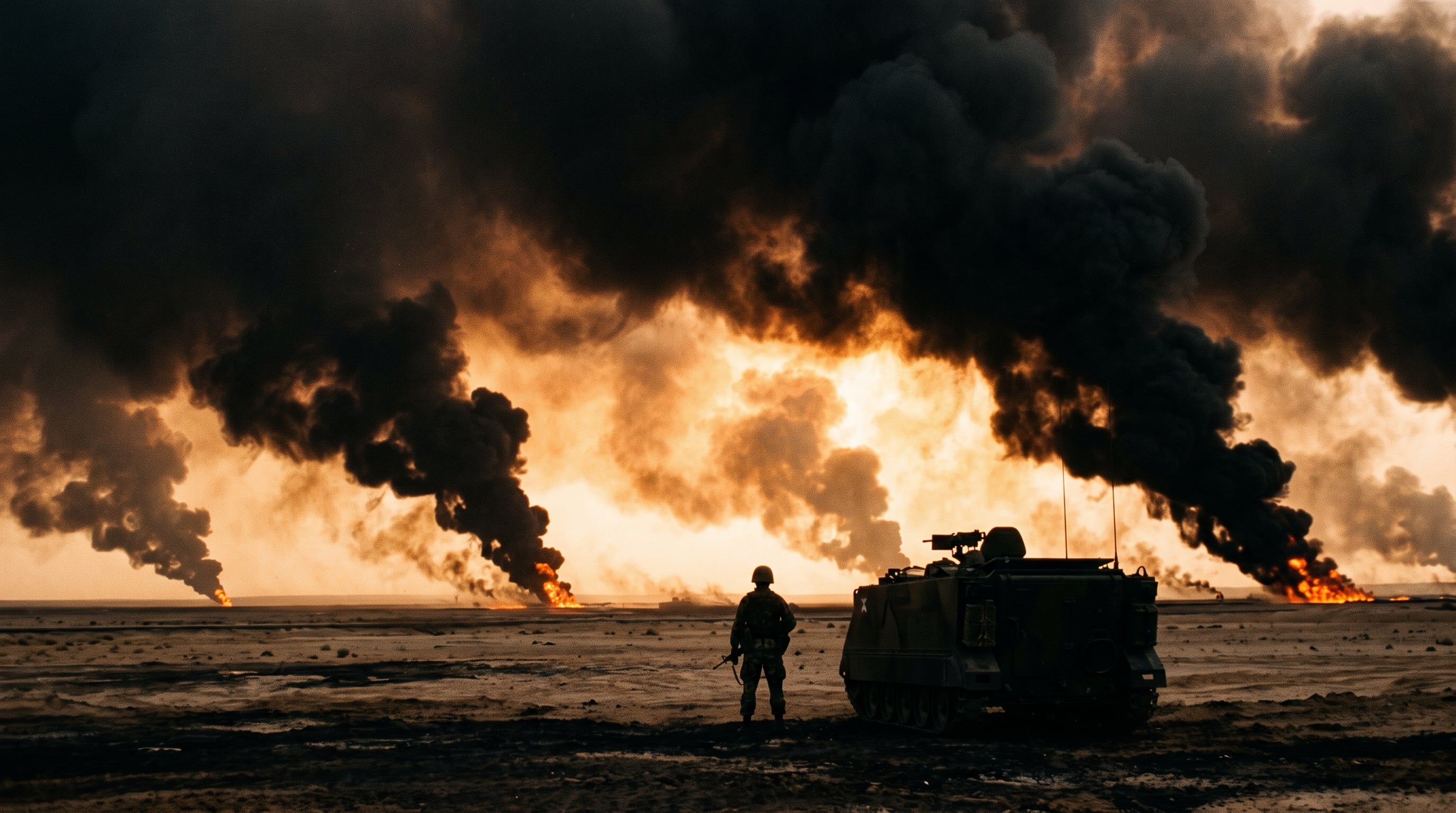
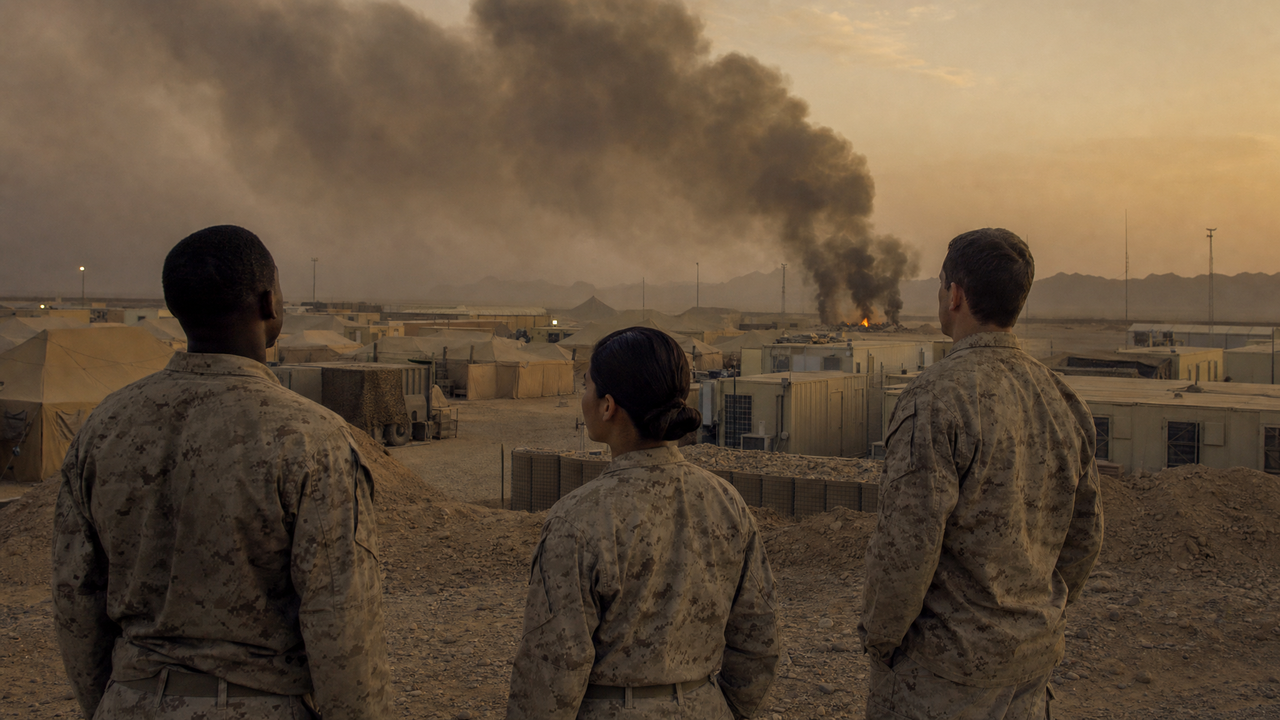
The 1991 Gulf War produced a stack of simultaneous exposures unlike anything before it. Retreating Iraqi forces set more than 600 Kuwaiti oil wells on fire, and the smoke plume blanketed the theatre for months. The demolition of the ammunition depot at Khamisiyah in March 1991 released a chemical agent plume that the Department of Defense later estimated reached tens of thousands of service members. Troops were issued pyridostigmine bromide tablets as a nerve agent pretreatment, sprayed with organophosphate pesticides, dosed with DEET and permethrin, and left breathing fine desert particulate the entire time.
What came out of it was a pattern of illness that did not fit any diagnostic box: fatigue that did not resolve, widespread pain, memory and concentration failure, gastrointestinal disturbance, headaches, and rashes. VA’s answer is 38 CFR 3.317, which is unlike anything else in the compensation system — it allows service connection for a qualifying chronic disability without a diagnosis at all. Most Gulf War veterans have never been told this rule exists, and file claims that get denied for lack of a diagnosis the regulation does not require.
What you were actually breathing, drinking, or touching
Oil well fire smokeSarin and cyclosarin (Khamisiyah plume)Pyridostigmine bromide (PB pills)Organophosphate pesticidesDEET and permethrinDepleted uraniumFine desert particulate
Presumptive route available
A presumption exists under 38 CFR 3.317 for undiagnosed illness and medically unexplained chronic multisymptom illness — the disability must manifest to a degree of 10 percent or more.
Where it was, when it was, and who was standing there
The exposure, in specifics
A claim is decided on specifics. Location, date range, and duty — in that combination — are what turn an assertion of exposure into a documented one.
The Southwest Asia theater of operations
Iraq, Kuwait, Saudi Arabia, the neutral zone, Bahrain, Qatar, the United Arab Emirates, Oman, the Gulf of Aden, the Gulf of Oman, the Persian Gulf, the Arabian Sea, the Red Sea, and the airspace above them.
The Kuwaiti oil fires
More than 600 wells burned from February 1991 into November 1991. The plume carried soot, sulphur dioxide, hydrogen sulphide, benzene, and polycyclic aromatic hydrocarbons across the entire theatre, not only over Kuwait.
Khamisiyah
The demolition of the Khamisiyah depot in March 1991 released sarin and cyclosarin. The Department of Defense modelled the plume afterward and notified service members it estimated were within it. Notification letters were sent — but many veterans moved and never received one.
Pyridostigmine bromide and pesticides
PB tablets were issued as a nerve agent pretreatment and taken widely. Organophosphate and carbamate pesticides were applied heavily in living areas, and permethrin-treated uniforms and DEET were in constant use.
How you qualify
The routes available on this exposure
Work out which route your case is on before you gather a single document. Preparing the wrong evidence is the most common reason a truthful claim comes back denied.
Presumptive route
Route one — undiagnosed illness under 3.317
This is the regulation almost nobody knows about. Service in the Southwest Asia theater plus a qualifying chronic disability that cannot be attributed to a known diagnosis, manifesting to 10 percent or more, is service-connected. That covers an undiagnosed illness outright, and it covers a medically unexplained chronic multisymptom illness — which the regulation names as including chronic fatigue syndrome, fibromyalgia, and functional gastrointestinal disorders such as irritable bowel syndrome. A specified list of infectious diseases is also presumptive.
No diagnosis is required for an undiagnosed illness claim. That is the entire point of the rule.
The disability must be chronic — present for six months or more.
It must reach a compensable level of 10 percent or more.
Chronic fatigue syndrome, fibromyalgia, and functional GI disorders are named in the regulation.
Facts-found route
Route two — diagnosed conditions from a specific exposure
If your condition has a firm diagnosis, 3.317 does not apply to it and the claim is filed direct instead. That is where the specific exposures matter: the oil fire plume for respiratory and cardiovascular disease, the Khamisiyah plume for neurological findings, and PB and organophosphates for the neurotoxicity literature. Many Gulf War veterans need both routes at once — the undiagnosed symptoms under 3.317 and the diagnosed conditions filed directly.
Ask whether you received a Khamisiyah notification letter, and request confirmation if you are unsure.
Oil fire smoke exposure supports respiratory and cardiovascular nexus arguments.
PACT Act burn pit presumptions also apply to service on or after August 2, 1990 — the two overlap.
Secondary route
Route three — the pile-on effect
Chronic pain and chronic fatigue reliably produce sleep disturbance, depression, and anxiety, and each of those is separately compensable as secondary to the granted primary. The combined functional effect is also the strongest ground for Total Disability based on Individual Unemployability in this population, which pays at the 100 percent rate without requiring a 100 percent schedular rating.
Chronic pain and fatigue to sleep disorder and mental health treatment.
Functional gastrointestinal disorder to nutritional deficiency and weight change.
The whole picture to Total Disability based on Individual Unemployability.
Two different things — never combine them
A presumption and a TERA determination are not the same thing
These two get mixed together constantly — by veterans, by service officers, and sometimes in the decision letter itself. They are separate mechanisms that answer separate questions. One asks where and when you served. The other asks what you did while you were there. Treating either one as a substitute for the other is how a winnable claim gets prepared the wrong way and comes back denied.
Here is the fastest way to tell which lane you are standing in. A presumption almost always comes out of a deployment or an assignment to a place that has already been named — Vietnam, the Gulf, the Korean DMZ, the burn-pit countries, Camp Lejeune. Congress or VA drew a box around a region and a set of dates, and if your service falls inside that box and your diagnosis is on the list attached to it, you are in the presumptive lane and the law does the connecting for you. TERA is for everything else. If your exposure did not come from being sent to one of those named locations — if it came from the aircraft you turned wrenches on, the fuel you pumped, the foam you sprayed, the paint and solvent you stripped with, the engine room you stood watch in, the stateside installation where the work itself was the hazard — then no list is ever going to carry your claim. That is a TERA case, and it is proved with your duties.
Read both columns before you decide what to gather. If you are in the presumptive lane, the work is proving your service facts — orders, dates, locations. If you are in the TERA lane, the work is documenting what you actually did and then getting a medical opinion that ties it to the diagnosis. Those are two entirely different piles of paper, and preparing the wrong one costs months. And plenty of veterans are standing in both lanes at the same time — one condition that qualifies off a deployment, another that only ever gets connected through the work.
Set by law — where and when you served
A presumption
A presumption is written into statute and regulation. It has three moving parts and all three have to line up: a specific place, a specific date range, and a diagnosis that appears on the list attached to that place. When they do, VA presumes the exposure and presumes the connection — you never have to produce a medical opinion tying the disease to the service.
It is decided on service records, not on medical evidence.
Miss the location or the date window by anything at all and the presumption simply does not apply.
The condition list is closed — a diagnosis that is not on it is not presumptive, however strong the science behind it.
If you do qualify, it is the fastest route to a decision that exists.
Based on what you actually did
A TERA determination
TERA stands for Toxic Exposure Risk Activity. It is VA’s finding that your service involved an activity that put you at risk of a hazard, and it comes out of your duties, your assignments, and the work you actually performed — not out of a list of places and dates. It is not a presumption, and on its own it does not grant service connection.
What it does: it puts the exposure into the record, and under 38 U.S.C. § 1168 it generally obligates VA to obtain an exam and a medical opinion when there is a current disability and the file is otherwise short of proof.
What it does not do: it does not concede the medical link. VA can find TERA and still deny the claim for “no nexus.”
It is also used on the health care side, to establish eligibility to enroll and to get the toxic exposure screening.
It is frequently missing from the file, or built off your primary job code alone — which misses the duties that actually exposed you.
Keep them apart — four rules that decide claims
No presumption does not mean no claim. It means your claim is facts-found, and the link gets built with evidence instead of handed to you by regulation.
A TERA finding is not a presumption. It never removes the need for a nexus opinion — it is what forces VA to go get one.
You can be in both lanes at once. Presumptive on one condition and facts-found on another, inside the same application.
Serving somewhere with a documented hazard is not the same as qualifying for a presumption. The presumption needs the exact place, the exact dates, and a listed condition — all three.
The condition lists
What is on a list, and what is not
Read the label above each list carefully. A presumptive list and a health-care eligibility list are two different things, and confusing them costs veterans claims every single day.
Qualifying chronic disabilities under 38 CFR 3.317
Must be chronic and must manifest to a degree of 10 percent or more.
Undiagnosed illness — no diagnosis required
Chronic fatigue syndrome
Fibromyalgia
Functional gastrointestinal disorders, including irritable bowel syndrome
Chronic unexplained fatigue
Widespread musculoskeletal pain
Neurological and neuropsychological signs and symptoms
Sleep disturbances
Headache, including chronic migraine
Skin conditions and unexplained rashes
Respiratory signs and symptoms
Cardiovascular signs and symptoms
Presumptive infectious diseases for Southwest Asia service
Brucellosis
Campylobacter jejuni
Coxiella burnetii (Q fever)
Malaria
Mycobacterium tuberculosis
Nontyphoid Salmonella
Shigella
Visceral leishmaniasis
West Nile virus
How to apply
The filing order, with the actual forms
Order matters. Filing in the wrong sequence is how veterans lose months of back pay on a claim that was always going to be granted.
1
VA Form 21-0966
File the Intent to File
Hold the effective date for one year while you build the symptom record, which is the slow part of a 3.317 claim.
2
VA Form 21-526EZ
File and cite 38 CFR 3.317 by name
List the symptoms, not a diagnosis you do not have. State plainly that you are claiming under 38 CFR 3.317 for undiagnosed illness or medically unexplained chronic multisymptom illness.
3
Get the Gulf War registry exam
The Gulf War Registry health exam is free, does not require enrolment in VA health care, and creates a documented baseline. It is not a claim, but it is useful evidence.
4
VA Form 21-4138
File your statement and your lay evidence
A dated symptom journal and statements from a spouse, a coworker, or a supervisor describing the change in you are the strongest evidence available for a claim with no diagnosis behind it.
5
VA Form 21-22a
Appoint an accredited agent
Gulf War claims are denied at a notoriously high rate, almost always for the wrong reason. Talk to us before filing.
Evidence to gather
What belongs in the file before you file
DD-214 and orders establishing service in the Southwest Asia theater.
Any Khamisiyah notification letter, or a request to confirm whether you were within the modelled plume.
Records showing pyridostigmine bromide issue, if your unit documented it.
A symptom journal covering six months or more — this is genuine evidence for an undiagnosed illness claim and it is what most files are missing.
Lay statements from family and coworkers describing the change in function since 1991.
Treatment records showing symptoms being investigated and no diagnosis being reached — negative workups help this claim.
Employment records showing lost time, accommodations, or termination.
What you will be told, and the answer
The shortcuts to expect
““There is no diagnosis, so there is nothing to service-connect.””
That is exactly backwards. 38 CFR 3.317 exists precisely for undiagnosed illness. The absence of a diagnosis is a qualifying feature of the claim, not a defect in it. This is the single most damaging misunderstanding in Gulf War claims.
““Your symptoms are attributable to a known condition.””
Then that condition should be claimed and rated on its own, and the remaining unexplained symptoms should still be evaluated under 3.317. Attributing part of the picture does not dispose of the rest of it.
““It has been too long since the Gulf War.””
There is no filing deadline on a VA compensation claim, and no sunset applies to your right to claim under 3.317. Anyone telling you the window closed is wrong.
““This is a mental health problem.””
Neurological and neuropsychological signs and symptoms are expressly listed in 3.317 as qualifying manifestations. Reclassifying a physical presentation as psychiatric to avoid the regulation is a well-worn shortcut and it is answerable.
Why representation changes the odds
Register with us on your gulf war hazards & undiagnosed illness claim
Tell an accredited agent what happened and we will review your situation first, then tell you honestly whether we can help. One form, one click, and a real person reads it.
Most Gulf War denials rest on demanding a diagnosis that 38 CFR 3.317 does not require. Getting the claim framed correctly at filing avoids the denial entirely.
PACT Act burn pit presumptions also cover service on or after August 2, 1990. Running both theories together is stronger than choosing one.
Lay evidence carries unusual weight here because there is often no objective test. Knowing how to structure it is a real advantage.
Total Disability based on Individual Unemployability is the outcome that matters most in this population and it is rarely claimed without representation.
VA-Accredited Claims Agent #45147
Albert Thombs
An accredited agent personally reviews every request — we’ll reach out within 48 hours.
Registering opens the secure sign-up form of the advocate who is next to take a new file, in a new tab. If you would rather have someone look at your situation before you decide anything, ask for the free case review instead.
Office hours: Mon–Fri, 11am–6pm Pacific
Keep building the case
The era, the job, and the medical evidence that go with this exposure
Undiagnosed illness and medically unexplained chronic multisymptom illness: 38 CFR 3.317. Presumptive infectious diseases: 38 CFR 3.317(c). Southwest Asia theater burn pit presumptions: the PACT Act of 2022. General information for education, not legal or medical advice.
Both options are free · No obligation
Two ways to work with us — both free
Talking to a VA-accredited claims agent costs nothing either way. Pick the one that fits: get answers to your questions, or register to hire us to take on your claim.
Free information — just ask
You can ask Albert, our AI claims assistant, anything about exposure, evidence, or the claims process — he answers instantly. If you would rather have a direct, personal answer, send your question below and an accredited agent will come back to you. No cost, no obligation.
Or send your question
Ready to hire us? Register with us
For veterans who have decided they want us on their claim. Registering is free too, and it takes the registration form plus a signed VA Form 21-22a.
Until VA Form 21-22a is signed we cannot accept your claim, access your VA file, or do any work on your behalf. That is federal law, not firm policy.
What happens after you register
You register. This simply starts the conversation — you are not our client yet, and you owe us nothing.
You sign and return VA Form 21-22a. It appoints us as your accredited representative and gives us access to your VA file.
Once we have your signed 21-22a and access to your case, we verify everything is in order.
We review your case in full and conduct your interview with an accredited agent.
Only then do YOU decide whether to move forward with us. If you choose not to, we will not proceed on your behalf — no pressure, no obligation.