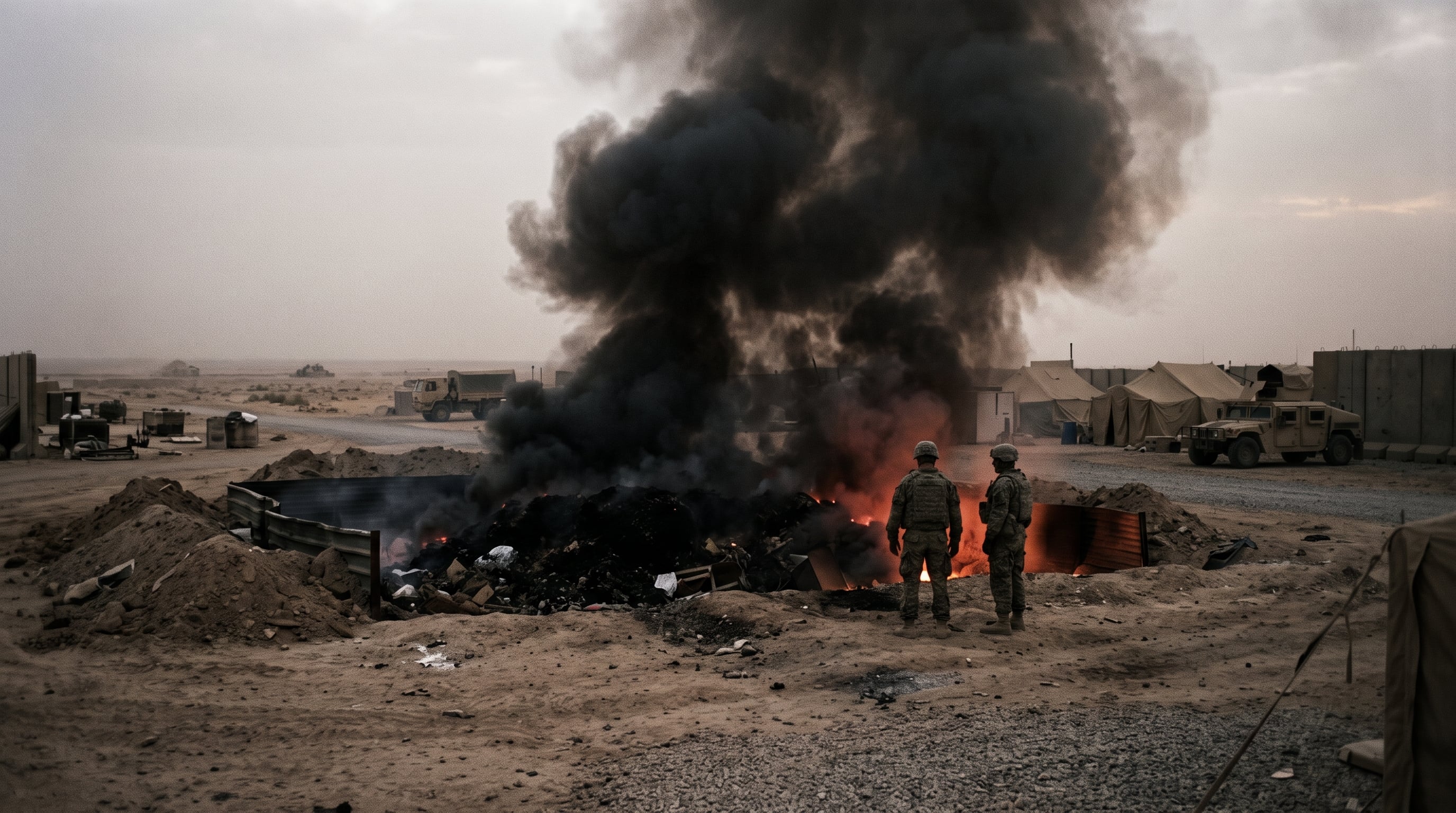
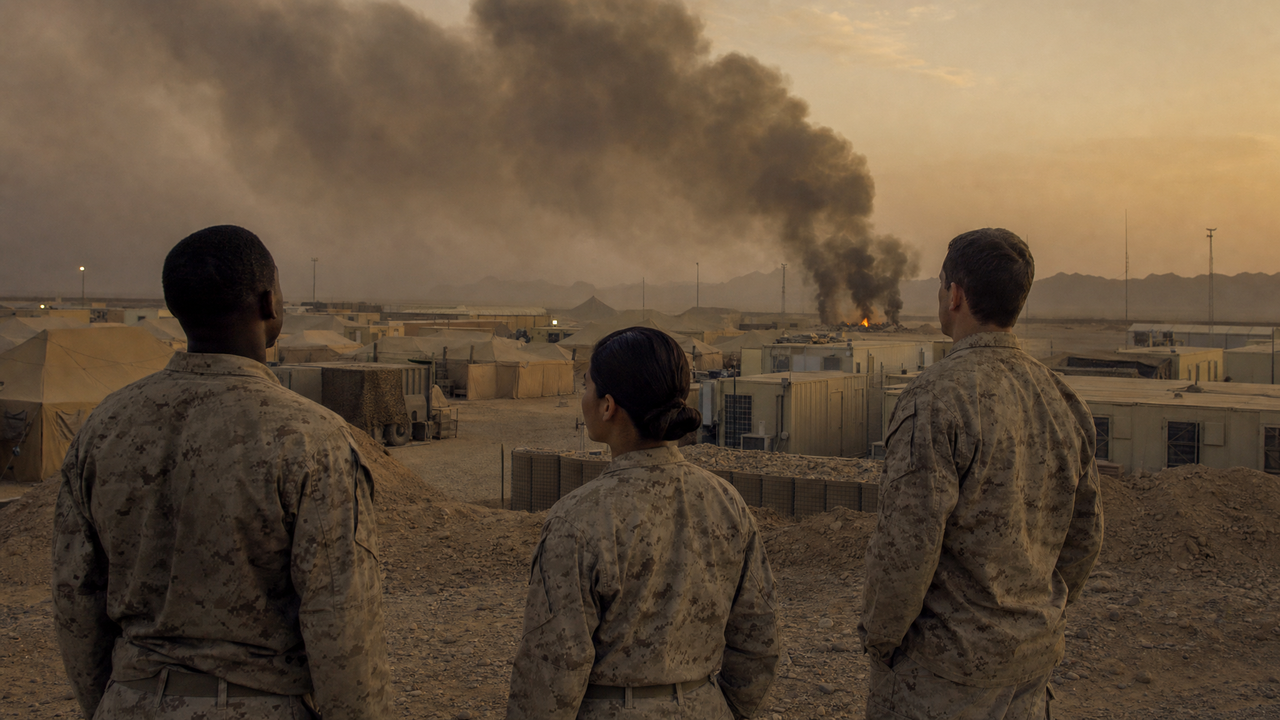
A burn pit was a hole in the ground. Into it went plastics, styrofoam, medical waste, batteries, tires, paint, solvents, human waste, unexploded ordnance, and vehicle parts. It was lit with JP-8 jet fuel and it burned around the clock. The pit at Joint Base Balad covered roughly ten acres and consumed as much as two hundred tons of waste a day. Nobody wore respiratory protection, the smoke plume moved with the wind across the housing units, and the men and women sleeping downwind breathed it for twelve months at a stretch.
The PACT Act of 2022 is the largest expansion of VA toxic exposure benefits in the history of the agency, and burn pits are its centre. It created a presumption of exposure for anyone who served in the listed locations in the listed windows, and it made more than twenty conditions presumptive on top of that. The practical effect is enormous: a veteran with constrictive bronchiolitis who spent a decade being told his breathing problem was asthma he brought with him now has a regulation on his side instead of against him.
What you were actually breathing, drinking, or touching
A full presumption exists under the PACT Act. Serve in a covered location in the covered window, carry a listed condition, and both the exposure and the medical link are conceded.
Where it was, when it was, and who was standing there
The exposure, in specifics
A claim is decided on specifics. Location, date range, and duty — in that combination — are what turn an assertion of exposure into a documented one.
Gulf War theatre — on or after August 2, 1990
Bahrain, Iraq, Kuwait, Oman, Qatar, Saudi Arabia, Somalia, and the United Arab Emirates — including the airspace above these countries. Service on or after August 2, 1990 in any of them establishes the presumption of exposure.
Post-9/11 theatre — on or after September 11, 2001
Everything above, plus Afghanistan, Djibouti, Egypt, Jordan, Lebanon, Syria, Yemen, and Uzbekistan — including the airspace above them. Service on or after September 11, 2001 in any of these locations establishes the presumption.
What counts as service there
Boots on the ground is not the only qualifier. Service in the airspace above a covered location counts, which brings in aircrew who flew the routes without landing. Short deployments count. TDY counts. There is no minimum number of days in the burn pit presumption — unlike Camp Lejeune, which has a thirty-day rule.
Automatic health-care enrolment
Since August 1, 2024, VA health care enrolment is open to every veteran who served in a covered location during the covered periods — broadly, August 2, 1990 through August 31, 2021 for the combat and toxic-exposure cohorts — without first needing a service-connected rating. Health care and disability compensation are separate systems; getting into one does not decide the other, but getting into VA health care builds the treatment record that wins the other.
How you qualify
The routes available on this exposure
Work out which route your case is on before you gather a single document. Preparing the wrong evidence is the most common reason a truthful claim comes back denied.
Presumptive route
Route one — the PACT Act presumption
Service in a covered location during the covered period plus a diagnosis on the presumptive list. That is the whole test. No nexus letter, no proof you lived beside the pit, no air sampling data. The asthma exception is the one detail people miss: asthma is presumptive when it was diagnosed after service, which means a childhood asthma diagnosis in your entrance physical will be used against you and has to be addressed directly rather than ignored.
Location and dates come off the DD-214 and your deployment orders.
The diagnosis can come from a VA or a private physician.
There is no minimum deployment length in the burn pit presumption.
Airspace service over a covered country qualifies the same as ground service.
Facts-found route
Route two — conditions that are not on the list
Sleep apnea, chronic migraine, gastroesophageal reflux, and rhinosinusitis complications are extremely common in this population and only some of them made the presumptive list. Those claims are filed direct: exposure event, current diagnosis, and a medical nexus connecting them. The burn pit literature is strong enough to support a well-written nexus opinion, and the exposure half of the equation is already easy because the PACT Act concedes it.
The exposure is conceded by the PACT Act even when the condition is not presumptive — that is half the case already won.
The nexus opinion must engage the particulate and dioxin literature specifically.
Continuity of symptoms since deployment is powerful evidence — sick call slips, unit medical records, letters home.
Secondary route
Route three — what the lung disease is doing to the rest of you
A service-connected respiratory condition drives secondary claims that most veterans never file. Chronic hypoxia produces cor pulmonale and right-heart strain. Steroid dependence produces weight gain, bone loss, and glucose intolerance. Constant breathlessness produces sleep disruption, depression, and the functional limits that support Total Disability based on Individual Unemployability. Each of those is a separate, separately rated claim.
Respiratory disease to sleep disturbance and mental health treatment.
Long-term corticosteroid use to osteoporosis and glucose intolerance.
Severe pulmonary limitation to Total Disability based on Individual Unemployability.
Two different things — never combine them
A presumption and a TERA determination are not the same thing
These two get mixed together constantly — by veterans, by service officers, and sometimes in the decision letter itself. They are separate mechanisms that answer separate questions. One asks where and when you served. The other asks what you did while you were there. Treating either one as a substitute for the other is how a winnable claim gets prepared the wrong way and comes back denied.
Here is the fastest way to tell which lane you are standing in. A presumption almost always comes out of a deployment or an assignment to a place that has already been named — Vietnam, the Gulf, the Korean DMZ, the burn-pit countries, Camp Lejeune. Congress or VA drew a box around a region and a set of dates, and if your service falls inside that box and your diagnosis is on the list attached to it, you are in the presumptive lane and the law does the connecting for you. TERA is for everything else. If your exposure did not come from being sent to one of those named locations — if it came from the aircraft you turned wrenches on, the fuel you pumped, the foam you sprayed, the paint and solvent you stripped with, the engine room you stood watch in, the stateside installation where the work itself was the hazard — then no list is ever going to carry your claim. That is a TERA case, and it is proved with your duties.
Read both columns before you decide what to gather. If you are in the presumptive lane, the work is proving your service facts — orders, dates, locations. If you are in the TERA lane, the work is documenting what you actually did and then getting a medical opinion that ties it to the diagnosis. Those are two entirely different piles of paper, and preparing the wrong one costs months. And plenty of veterans are standing in both lanes at the same time — one condition that qualifies off a deployment, another that only ever gets connected through the work.
Set by law — where and when you served
A presumption
A presumption is written into statute and regulation. It has three moving parts and all three have to line up: a specific place, a specific date range, and a diagnosis that appears on the list attached to that place. When they do, VA presumes the exposure and presumes the connection — you never have to produce a medical opinion tying the disease to the service.
It is decided on service records, not on medical evidence.
Miss the location or the date window by anything at all and the presumption simply does not apply.
The condition list is closed — a diagnosis that is not on it is not presumptive, however strong the science behind it.
If you do qualify, it is the fastest route to a decision that exists.
Based on what you actually did
A TERA determination
TERA stands for Toxic Exposure Risk Activity. It is VA’s finding that your service involved an activity that put you at risk of a hazard, and it comes out of your duties, your assignments, and the work you actually performed — not out of a list of places and dates. It is not a presumption, and on its own it does not grant service connection.
What it does: it puts the exposure into the record, and under 38 U.S.C. § 1168 it generally obligates VA to obtain an exam and a medical opinion when there is a current disability and the file is otherwise short of proof.
What it does not do: it does not concede the medical link. VA can find TERA and still deny the claim for “no nexus.”
It is also used on the health care side, to establish eligibility to enroll and to get the toxic exposure screening.
It is frequently missing from the file, or built off your primary job code alone — which misses the duties that actually exposed you.
Keep them apart — four rules that decide claims
No presumption does not mean no claim. It means your claim is facts-found, and the link gets built with evidence instead of handed to you by regulation.
A TERA finding is not a presumption. It never removes the need for a nexus opinion — it is what forces VA to go get one.
You can be in both lanes at once. Presumptive on one condition and facts-found on another, inside the same application.
Serving somewhere with a documented hazard is not the same as qualifying for a presumption. The presumption needs the exact place, the exact dates, and a listed condition — all three.
The condition lists
What is on a list, and what is not
Read the label above each list carefully. A presumptive list and a health-care eligibility list are two different things, and confusing them costs veterans claims every single day.
Presumptive cancers — PACT Act
Head cancer of any type
Neck cancer of any type
Respiratory cancer of any type
Gastrointestinal cancer of any type
Reproductive cancer of any type
Lymphoma of any type
Lymphomatic cancer of any type
Kidney cancer
Brain cancer
Melanoma
Pancreatic cancer
Presumptive illnesses — PACT Act
Asthma qualifies only when it was diagnosed after service.
Asthma diagnosed after service
Chronic bronchitis
Chronic obstructive pulmonary disease (COPD)
Constrictive bronchiolitis or obliterative bronchiolitis
Emphysema
Granulomatous disease
Interstitial lung disease
Pleuritis
Pulmonary fibrosis
Sarcoidosis
Chronic rhinitis
Chronic sinusitis
How to apply
The filing order, with the actual forms
Order matters. Filing in the wrong sequence is how veterans lose months of back pay on a claim that was always going to be granted.
1
VA Form 21-0966
File an Intent to File the same day you decide
It holds your effective date for one year. Every month of back pay depends on this date, and the form takes minutes.
2
VA Form 10-10EZ
Enrol in VA health care
Since August 1, 2024 the toxic exposure cohorts are eligible without a rating. Enrolment gets you the PACT Act toxic exposure screening and, more importantly, builds the treatment record the compensation claim will be decided on.
3
VA Form 21-526EZ
File the compensation claim
Claim every diagnosed respiratory and cancer condition. Name the deployment location and dates. If you have a condition that is not on the presumptive list, claim it anyway and support it separately — leaving it off costs you the effective date.
4
DBQ 21-0960L-series
Get the respiratory examination right
Respiratory ratings run on measured numbers — FEV-1, FEV-1/FVC, DLCO. Make sure the testing is done on a bad day, not a good one, and that the examiner records the medication you are on to stay functional.
5
VA Form 21-22a
Appoint an accredited agent
Put a representative on the file with full access. Talk to us first so the form is completed correctly and filed in the right order.
Evidence to gather
What belongs in the file before you file
DD-214 and deployment orders establishing the covered location and date.
Post-Deployment Health Assessment and Reassessment forms — these frequently record the respiratory complaint at the time.
Sick call records from deployment showing cough, wheeze, or shortness of breath in theatre.
Airborne Hazards and Open Burn Pit Registry questionnaire — useful supporting context, but the registry is not a claim and filing it does nothing to your compensation case on its own.
Pulmonary function testing, including post-bronchodilator values, because the rating criteria are numerical.
A surgical lung biopsy report if you have one — constrictive bronchiolitis is often invisible on imaging and spirometry.
Buddy statements describing the pit, its distance from the housing units, and the prevailing wind.
The PACT Act toxic exposure screening from your VA provider, offered at least every five years.
What you will be told, and the answer
The shortcuts to expect
“"Your pulmonary function test is normal, so there is no disability."”
Constrictive bronchiolitis is a small-airways disease that routinely produces normal spirometry and normal chest imaging. It is diagnosed on surgical biopsy. A normal PFT does not rule it out, and a decision that rests only on a normal PFT has not addressed the actual disease.
“"You had asthma as a child."”
Then the issue is aggravation, not causation. A pre-existing condition that was permanently worsened by service is service-connected for the degree of worsening. VA must show by clear and unmistakable evidence that it was not aggravated — that is a high bar and it is rarely met.
“"You smoked."”
Smoking history does not defeat a presumption. Once the PACT Act presumption applies, the rater must produce affirmative evidence rebutting it, not simply point at an alternative cause. Concurrent causes do not cancel a conceded one.
“"You only deployed for four months."”
There is no minimum deployment length in the burn pit presumption. The thirty-day rule belongs to Camp Lejeune and does not apply here. A rater importing it is applying the wrong regulation.
Why representation changes the odds
Register with us on your burn pits & airborne hazards claim
Tell an accredited agent what happened and we will review your situation first, then tell you honestly whether we can help. One form, one click, and a real person reads it.
Constrictive bronchiolitis is denied constantly on normal spirometry. Knowing to force the biopsy question is the difference between a zero and a compensable rating.
Respiratory ratings are driven by a small set of measured values. If the exam captures the wrong ones, the percentage is wrong and the appeal takes two more years.
A large share of PACT Act claims are underrated rather than denied, and an underrated grant is quietly the most expensive mistake in the system.
We identify the non-presumptive conditions worth claiming alongside the presumptive ones, so the whole file moves at once instead of in three separate rounds.
VA-Accredited Claims Agent #45147
Albert Thombs
An accredited agent personally reviews every request — we’ll reach out within 48 hours.
Registering opens the secure sign-up form of the advocate who is next to take a new file, in a new tab. If you would rather have someone look at your situation before you decide anything, ask for the free case review instead.
Office hours: Mon–Fri, 11am–6pm Pacific
Keep building the case
The era, the job, and the medical evidence that go with this exposure
Presumptive locations, periods, and conditions: the Sergeant First Class Heath Robinson Honoring our PACT Act of 2022, 38 USC 1119 and 1120. Toxic exposure screening: PACT Act § 603. General information for education, not legal or medical advice.
Both options are free · No obligation
Two ways to work with us — both free
Talking to a VA-accredited claims agent costs nothing either way. Pick the one that fits: get answers to your questions, or register to hire us to take on your claim.
Free information — just ask
You can ask Albert, our AI claims assistant, anything about exposure, evidence, or the claims process — he answers instantly. If you would rather have a direct, personal answer, send your question below and an accredited agent will come back to you. No cost, no obligation.
Or send your question
Ready to hire us? Register with us
For veterans who have decided they want us on their claim. Registering is free too, and it takes the registration form plus a signed VA Form 21-22a.
Until VA Form 21-22a is signed we cannot accept your claim, access your VA file, or do any work on your behalf. That is federal law, not firm policy.
What happens after you register
You register. This simply starts the conversation — you are not our client yet, and you owe us nothing.
You sign and return VA Form 21-22a. It appoints us as your accredited representative and gives us access to your VA file.
Once we have your signed 21-22a and access to your case, we verify everything is in order.
We review your case in full and conduct your interview with an accredited agent.
Only then do YOU decide whether to move forward with us. If you choose not to, we will not proceed on your behalf — no pressure, no obligation.