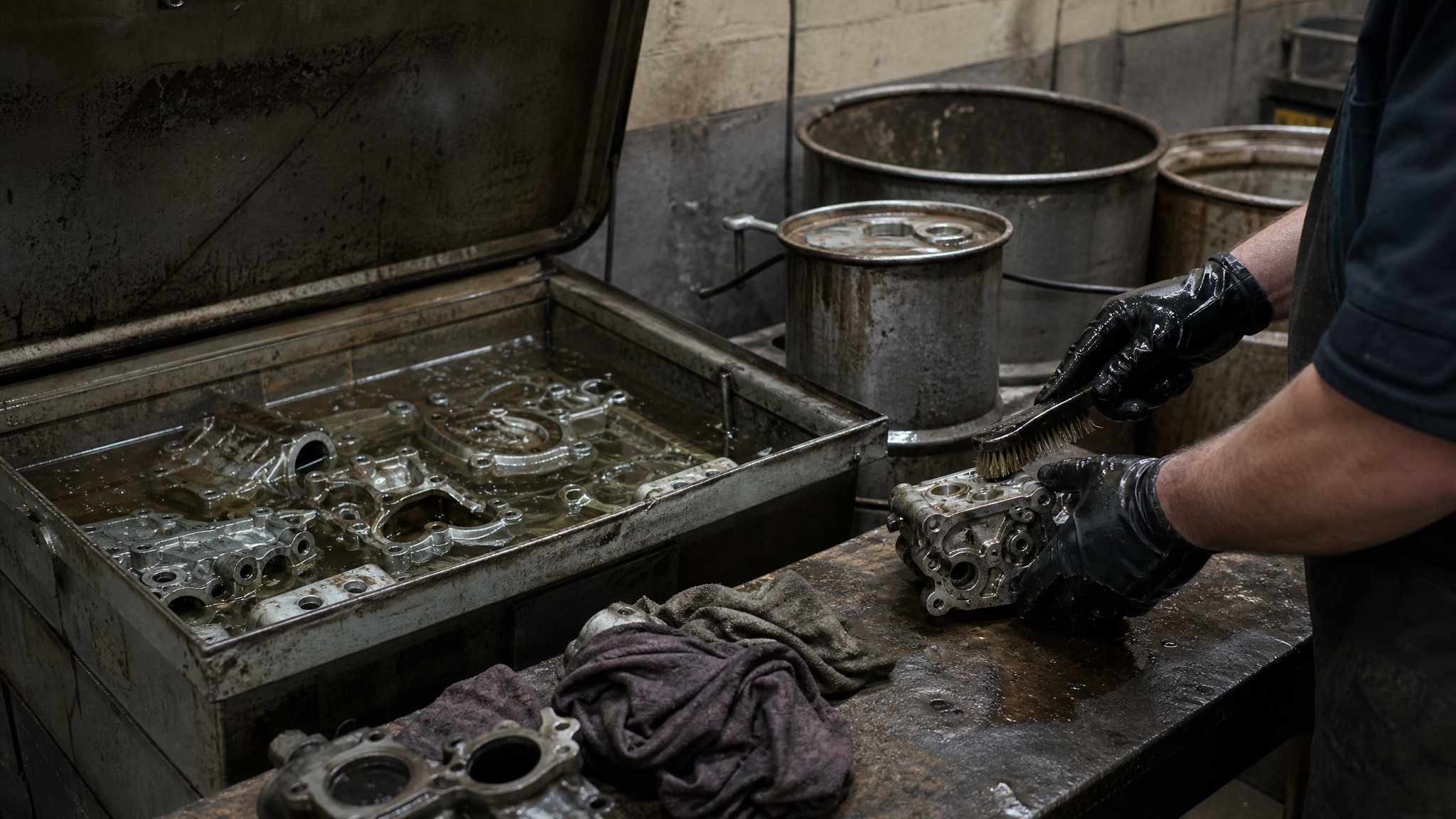
Every motor pool, hangar bay, engine shop, and armory ran on solvent. Parts went into an open tank of degreaser and came out clean. Nobody wore a respirator, the shop doors stayed shut in winter, and the waste went into a drum out back or straight onto the ground. Trichloroethylene and perchloroethylene are the two names that matter most, because both are classified as carcinogenic to humans and both are readily absorbed through the skin as well as the lungs. A mechanic with his forearms in a parts washer eight hours a day was dosing himself two ways at once.
There is no VA presumption for solvent exposure, and you will be told that as though it ends the conversation. It does not. Solvent claims are won on the facts, and the facts are usually recoverable: your MOS or AFSC, the shop you worked in, the equipment you maintained, and the industrial hygiene and safety records that document what was in the tank. Where solvent reached groundwater the environmental record is public. Where it did not, the occupational record still establishes the exposure — the job itself is the evidence.
What you were actually breathing, drinking, or touching
Trichloroethylene (TCE)Perchloroethylene (PCE)Methylene chlorideCarbon tetrachloride1,1,1-trichloroethaneMethyl ethyl ketone (MEK)Toluene and xylene
No presumption — facts-found claim
VA has no presumptive list for industrial solvent exposure. Every solvent claim is a facts-found claim — you prove the exposure, the diagnosis, and the medical link between them. Where the solvent reached base drinking water, a separate route may apply.
Where it was, when it was, and who was standing there
The exposure, in specifics
A claim is decided on specifics. Location, date range, and duty — in that combination — are what turn an assertion of exposure into a documented one.
Where the exposure happened
Motor pools and vehicle maintenance bays, aircraft hangars and engine shops, avionics and electronics repair, armories and weapons cleaning, printing and photo labs, dry cleaning facilities, and any shop with a parts washer, vapor degreaser, or solvent dip tank. Shipboard engineering spaces belong on this list too — the same chemicals in a compartment with no outside air.
When it happened
Heaviest use ran from the 1950s through the late 1990s. TCE was the standard degreaser for decades. Carbon tetrachloride was still in fire extinguishers and cleaning kits into the 1960s. Substitution and ventilation requirements tightened through the 1990s, but solvent use never stopped — it only changed formulation.
Who was exposed
Wheeled and tracked vehicle mechanics, aircraft and powerplant mechanics, avionics technicians, machinists, welders, small arms repairers, hull technicians and machinist mates, fuel systems specialists, and the supply and civilian shop personnel who handled and disposed of the drums.
How the dose stacked up
Solvent vapor is heavier than air and settles low in a closed bay. Skin absorption adds to what the lungs take in. A single shift is not the issue — years of daily contact in an unventilated shop is what produces the exposure history a nexus opinion can rest on.
How you qualify
The routes available on this exposure
Work out which route your case is on before you gather a single document. Preparing the wrong evidence is the most common reason a truthful claim comes back denied.
Facts-found route
Direct service connection on the facts
This is the primary route and it has three parts. First, a current diagnosis. Second, proof of the in-service solvent exposure — MOS or AFSC, unit, shop, dates, and what you handled. Third, a medical opinion that links the two, stating that it is at least as likely as not that the diagnosed condition resulted from that exposure. That phrase is the legal standard under 38 CFR § 3.102, and an opinion that does not reach it does not carry the claim.
DD-214, evaluation reports, and training records that establish the job
Buddy statements from people who worked the same bay
Industrial hygiene surveys, safety stand-down records, or shop SOPs naming the chemical
Your own detailed statement of the daily routine, on VA Form 21-4138
Secondary route
Secondary service connection
A condition caused or aggravated by an already service-connected condition is itself compensable under 38 CFR § 3.310. Solvent claims produce these routinely — chronic kidney disease following a service-connected cancer treated with nephrotoxic therapy, or peripheral neuropathy secondary to an established solvent-related condition. Aggravation counts. If service connection makes an existing condition measurably worse, the increase is compensable.
Two different things — never combine them
A presumption and a TERA determination are not the same thing
These two get mixed together constantly — by veterans, by service officers, and sometimes in the decision letter itself. They are separate mechanisms that answer separate questions. One asks where and when you served. The other asks what you did while you were there. Treating either one as a substitute for the other is how a winnable claim gets prepared the wrong way and comes back denied.
Here is the fastest way to tell which lane you are standing in. A presumption almost always comes out of a deployment or an assignment to a place that has already been named — Vietnam, the Gulf, the Korean DMZ, the burn-pit countries, Camp Lejeune. Congress or VA drew a box around a region and a set of dates, and if your service falls inside that box and your diagnosis is on the list attached to it, you are in the presumptive lane and the law does the connecting for you. TERA is for everything else. If your exposure did not come from being sent to one of those named locations — if it came from the aircraft you turned wrenches on, the fuel you pumped, the foam you sprayed, the paint and solvent you stripped with, the engine room you stood watch in, the stateside installation where the work itself was the hazard — then no list is ever going to carry your claim. That is a TERA case, and it is proved with your duties.
Read both columns before you decide what to gather. If you are in the presumptive lane, the work is proving your service facts — orders, dates, locations. If you are in the TERA lane, the work is documenting what you actually did and then getting a medical opinion that ties it to the diagnosis. Those are two entirely different piles of paper, and preparing the wrong one costs months. And plenty of veterans are standing in both lanes at the same time — one condition that qualifies off a deployment, another that only ever gets connected through the work.
Set by law — where and when you served
A presumption
A presumption is written into statute and regulation. It has three moving parts and all three have to line up: a specific place, a specific date range, and a diagnosis that appears on the list attached to that place. When they do, VA presumes the exposure and presumes the connection — you never have to produce a medical opinion tying the disease to the service.
It is decided on service records, not on medical evidence.
Miss the location or the date window by anything at all and the presumption simply does not apply.
The condition list is closed — a diagnosis that is not on it is not presumptive, however strong the science behind it.
If you do qualify, it is the fastest route to a decision that exists.
Based on what you actually did
A TERA determination
TERA stands for Toxic Exposure Risk Activity. It is VA’s finding that your service involved an activity that put you at risk of a hazard, and it comes out of your duties, your assignments, and the work you actually performed — not out of a list of places and dates. It is not a presumption, and on its own it does not grant service connection.
What it does: it puts the exposure into the record, and under 38 U.S.C. § 1168 it generally obligates VA to obtain an exam and a medical opinion when there is a current disability and the file is otherwise short of proof.
What it does not do: it does not concede the medical link. VA can find TERA and still deny the claim for “no nexus.”
It is also used on the health care side, to establish eligibility to enroll and to get the toxic exposure screening.
It is frequently missing from the file, or built off your primary job code alone — which misses the duties that actually exposed you.
Keep them apart — four rules that decide claims
No presumption does not mean no claim. It means your claim is facts-found, and the link gets built with evidence instead of handed to you by regulation.
A TERA finding is not a presumption. It never removes the need for a nexus opinion — it is what forces VA to go get one.
You can be in both lanes at once. Presumptive on one condition and facts-found on another, inside the same application.
Serving somewhere with a documented hazard is not the same as qualifying for a presumption. The presumption needs the exact place, the exact dates, and a listed condition — all three.
The condition lists
What is on a list, and what is not
Read the label above each list carefully. A presumptive list and a health-care eligibility list are two different things, and confusing them costs veterans claims every single day.
Conditions the medical literature associates with TCE and PCE
Not a VA presumptive list. These are associations reported in the peer-reviewed and federal toxicology literature. Each one still has to be proven on the facts of your case with a medical opinion.
Kidney cancer (renal cell carcinoma)
Non-Hodgkin lymphoma
Liver cancer
Bladder cancer
Multiple myeloma
Parkinson disease
Chronic kidney disease
Scleroderma and other autoimmune disease
Cardiac defects in offspring of exposed parents
Peripheral neuropathy
Cognitive and memory impairment
Chronic liver disease
How to apply
The filing order, with the actual forms
Order matters. Filing in the wrong sequence is how veterans lose months of back pay on a claim that was always going to be granted.
1
VA Form 21-0966
Lock in your effective date first
File the Intent to File before anything else. It preserves the effective date for up to one year while you assemble evidence, and a preserved date can be worth many months of retroactive pay.
2
VA Form 21-4138
Write the exposure statement
A statement in support of claim describing the shop, the tank, the product names you remember, the ventilation, the protective equipment you were and were not issued, and the hours per day. Specific beats dramatic. Dates, places, and routine.
3
VA Form 21-4142 and 21-4142a
Authorize release of private records
Every civilian provider who diagnosed or treated the condition. Without the authorization VA will decide on an incomplete record, and an incomplete record is how claims get denied on evidence that exists.
4
VA Form 21-526EZ
File the claim itself
List every diagnosed condition separately. Attach the nexus opinion, the exposure statement, the buddy statements, and any environmental or industrial hygiene record you obtained. Do not file a bare claim and hope the examiner develops it for you.
5
VA Form 21-22a
Appoint representation before the exam
An accredited agent can review the exam request, challenge an inadequate opinion, and correct the record before a decision issues. After the decision the same fix takes a supplemental claim under VA Form 20-0995 or a higher-level review under VA Form 20-0996 and costs you months.
Evidence to gather
What belongs in the file before you file
DD-214 and every performance evaluation that names the shop, the equipment, or the maintenance mission
MOS, AFSC, or NEC documentation and the school records that go with it
Buddy statements naming the parts washer, the degreaser tank, or the specific product used
Industrial hygiene surveys, safety inspections, or hazard communication sheets from the installation
EPA Superfund or Installation Restoration Program records if the shop area was later remediated
Complete civilian medical records establishing the diagnosis and its date
A written nexus opinion using the at-least-as-likely-as-not standard, with the reasoning shown
What you will be told, and the answer
The shortcuts to expect
“There is no presumption, so there is no claim.”
A presumption is a shortcut, not a requirement. Facts-found service connection has always been available under 38 CFR § 3.303(d), and most solvent grants come through it. The absence of a presumptive list changes the amount of evidence you need, not your eligibility.
“Your records do not show solvent exposure.”
Service records almost never itemize chemical exposure — that is not what they were for. What they do show is the job, and the job establishes the exposure when paired with the documented chemical inventory of that occupation. VA is obligated to consider the circumstances of your service, not just what a clerk typed.
“You smoked, so the cause is your smoking.”
A second risk factor does not remove a service cause. The standard is at least as likely as not — a fifty-fifty split goes to the veteran under 38 CFR § 3.102. An examiner who attributes everything to smoking without addressing the occupational exposure has written an inadequate opinion, and that is a challengeable defect.
Why representation changes the odds
Register with us on your industrial solvents and degreasers claim
Tell an accredited agent what happened and we will review your situation first, then tell you honestly whether we can help. One form, one click, and a real person reads it.
We identify which solvent your specific shop and era actually used, instead of arguing a generic chemical exposure that an examiner can wave off.
We pull the environmental and industrial hygiene record for that installation and put a document in the file, not an assertion.
We read the exam request before you are examined and object when the question posed to the examiner is written in a way that can only produce a denial.
We check every claimed condition for a secondary chain under 38 CFR § 3.310, which is where most of the missed rating percentage in solvent cases lives.
VA-Accredited Claims Agent #45147
Albert Thombs
An accredited agent personally reviews every request — we’ll reach out within 48 hours.
Registering opens the secure sign-up form of the advocate who is next to take a new file, in a new tab. If you would rather have someone look at your situation before you decide anything, ask for the free case review instead.
Office hours: Mon–Fri, 11am–6pm Pacific
Keep building the case
The era, the job, and the medical evidence that go with this exposure
Authorities: 38 CFR § 3.303(d) direct service connection; 38 CFR § 3.310 secondary service connection and aggravation; 38 CFR § 3.102 reasonable doubt. Chemical classifications from the National Toxicology Program Report on Carcinogens and the EPA IRIS assessments for trichloroethylene and tetrachloroethylene. General information for education, not legal or medical advice.
Both options are free · No obligation
Two ways to work with us — both free
Talking to a VA-accredited claims agent costs nothing either way. Pick the one that fits: get answers to your questions, or register to hire us to take on your claim.
Free information — just ask
You can ask Albert, our AI claims assistant, anything about exposure, evidence, or the claims process — he answers instantly. If you would rather have a direct, personal answer, send your question below and an accredited agent will come back to you. No cost, no obligation.
Or send your question
Ready to hire us? Register with us
For veterans who have decided they want us on their claim. Registering is free too, and it takes the registration form plus a signed VA Form 21-22a.
Until VA Form 21-22a is signed we cannot accept your claim, access your VA file, or do any work on your behalf. That is federal law, not firm policy.
What happens after you register
You register. This simply starts the conversation — you are not our client yet, and you owe us nothing.
You sign and return VA Form 21-22a. It appoints us as your accredited representative and gives us access to your VA file.
Once we have your signed 21-22a and access to your case, we verify everything is in order.
We review your case in full and conduct your interview with an accredited agent.
Only then do YOU decide whether to move forward with us. If you choose not to, we will not proceed on your behalf — no pressure, no obligation.