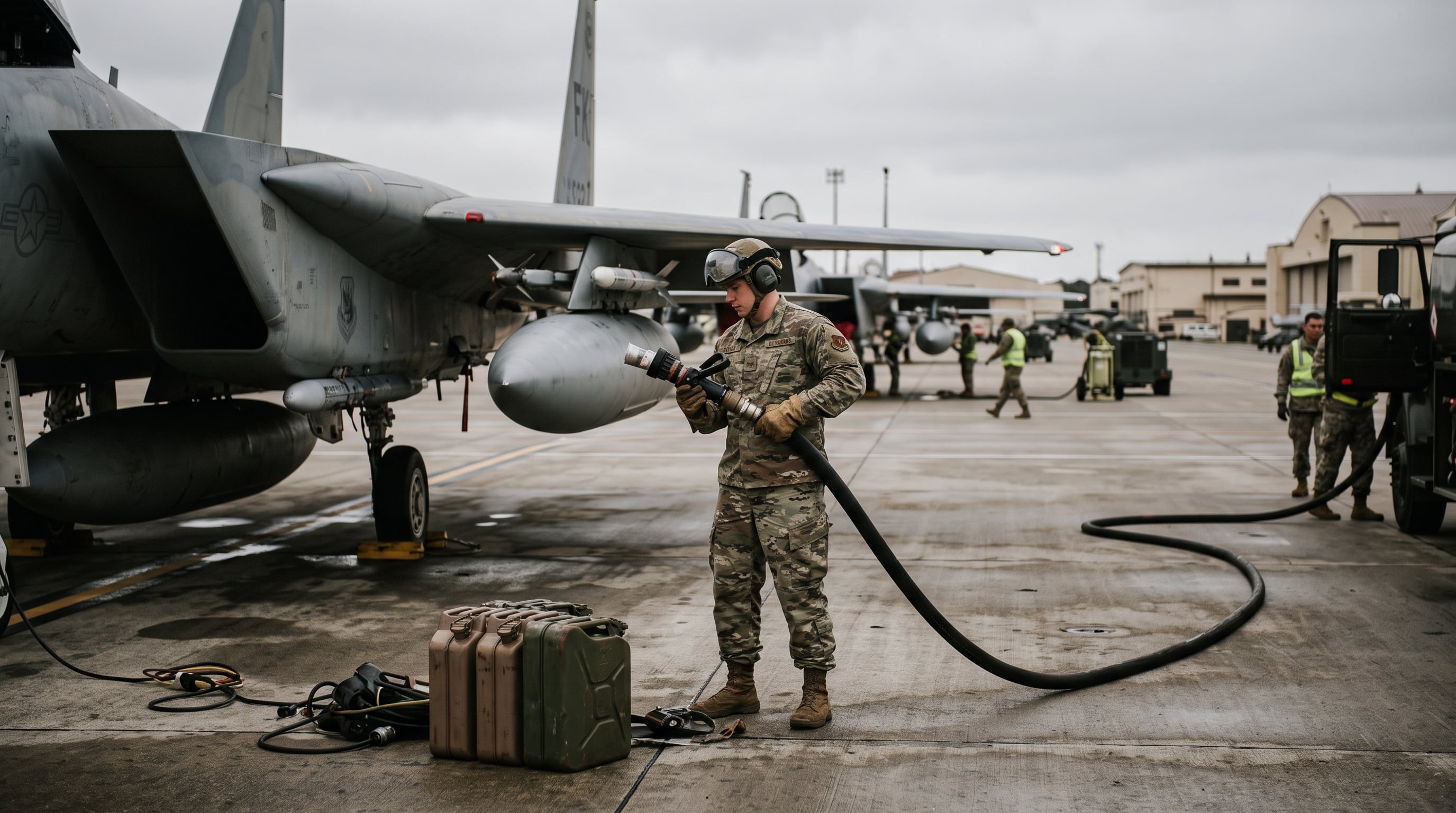
Benzene is not a contaminant in military fuel. It is an ingredient. Jet fuel, diesel, and gasoline all contain it, and the men and women who pumped, tested, spilled, and breathed those fuels took a benzene dose every shift. Benzene is a confirmed human carcinogen with a specific and well-documented effect: it damages bone marrow, and marrow damage is how leukemia, myelodysplastic syndrome, and aplastic anemia begin. This is one of the clearest cause-and-effect chains in all of occupational medicine.
JP-8 made it worse. When the military transitioned from JP-4 to JP-8 in the 1990s, it gained a less explosive fuel and lost volatility — JP-8 evaporates slowly, so it soaks into skin and clothing and keeps releasing vapor for hours. Fuel handlers wore it home. Add diesel exhaust in the motor pool, generator exhaust in every tactical operations center, and leaded avgas on older flight lines, and you have a hydrocarbon exposure history that no presumption covers but that a properly built record proves.
What you were actually breathing, drinking, or touching
BenzeneJP-4 and JP-8 jet fuelDiesel exhaustLeaded aviation gasolineTolueneNaphthalenePolycyclic aromatic hydrocarbons
No presumption — facts-found claim
There is no VA presumption for fuel or benzene exposure. These are facts-found claims. The strength of a benzene claim comes from the medical literature, which is unusually specific about which blood and marrow diseases benzene causes.
Where it was, when it was, and who was standing there
The exposure, in specifics
A claim is decided on specifics. Location, date range, and duty — in that combination — are what turn an assertion of exposure into a documented one.
Where the exposure happened
Flight lines and refueling points, fuel farms and tank farms, POL yards, aircraft and vehicle maintenance bays, shipboard fuel and engineering spaces, generator sheds and TOC power points, and any confined area where an engine idled — including motor pools with the bay doors closed.
When it happened
Continuous across every era. Leaded aviation gasoline dominated the propeller era and persisted at general aviation fields. JP-4 was the primary jet fuel from the 1950s. The services converted to JP-8 through the 1990s, which increased dermal and vapor contact time rather than reducing it.
Who was exposed
Petroleum supply specialists and fuel distribution system operators, aircraft refuelers, aviation fuels technicians, aircraft and vehicle mechanics, motor transport operators, generator mechanics, engineering and boiler technicians afloat, and crash and rescue crews who worked in fuel vapor by definition.
How the dose stacked up
Fuel absorbs through skin, and saturated coveralls keep the exposure going long after the shift ends. Vapor concentrates in tanks, bilges, and closed bays. Exhaust adds a second hydrocarbon load. The claim is built on cumulative years of daily contact, not on any single spill.
How you qualify
The routes available on this exposure
Work out which route your case is on before you gather a single document. Preparing the wrong evidence is the most common reason a truthful claim comes back denied.
Facts-found route
Direct service connection on the facts
Prove the diagnosis, prove the exposure, and connect them with a medical opinion meeting the at least as likely as not standard. Fuel claims have an advantage most facts-found claims lack: the job title alone establishes the exposure. A petroleum supply specialist handled fuel. That is what the job is. The remaining work is documenting duration and intensity, then getting an opinion that engages with the benzene literature specifically rather than speaking in generalities.
DD-214 and evaluations naming the fuel, POL, or refueling mission
Flight line access badges, hazardous duty pay records, or fuel handler certifications
Buddy statements describing spills, saturated uniforms, and confined-space work
A statement on VA Form 21-4138 covering hours per day, protective equipment, and years
Secondary route
Secondary service connection
Under 38 CFR § 3.310, conditions caused or aggravated by a service-connected condition are compensable in their own right. Benzene cases produce long secondary chains — chemotherapy-related cardiomyopathy, peripheral neuropathy, immunosuppression, and the mental health conditions that follow a cancer diagnosis. Each one is a separate rating. They are also the most commonly missed part of the claim.
Two different things — never combine them
A presumption and a TERA determination are not the same thing
These two get mixed together constantly — by veterans, by service officers, and sometimes in the decision letter itself. They are separate mechanisms that answer separate questions. One asks where and when you served. The other asks what you did while you were there. Treating either one as a substitute for the other is how a winnable claim gets prepared the wrong way and comes back denied.
Here is the fastest way to tell which lane you are standing in. A presumption almost always comes out of a deployment or an assignment to a place that has already been named — Vietnam, the Gulf, the Korean DMZ, the burn-pit countries, Camp Lejeune. Congress or VA drew a box around a region and a set of dates, and if your service falls inside that box and your diagnosis is on the list attached to it, you are in the presumptive lane and the law does the connecting for you. TERA is for everything else. If your exposure did not come from being sent to one of those named locations — if it came from the aircraft you turned wrenches on, the fuel you pumped, the foam you sprayed, the paint and solvent you stripped with, the engine room you stood watch in, the stateside installation where the work itself was the hazard — then no list is ever going to carry your claim. That is a TERA case, and it is proved with your duties.
Read both columns before you decide what to gather. If you are in the presumptive lane, the work is proving your service facts — orders, dates, locations. If you are in the TERA lane, the work is documenting what you actually did and then getting a medical opinion that ties it to the diagnosis. Those are two entirely different piles of paper, and preparing the wrong one costs months. And plenty of veterans are standing in both lanes at the same time — one condition that qualifies off a deployment, another that only ever gets connected through the work.
Set by law — where and when you served
A presumption
A presumption is written into statute and regulation. It has three moving parts and all three have to line up: a specific place, a specific date range, and a diagnosis that appears on the list attached to that place. When they do, VA presumes the exposure and presumes the connection — you never have to produce a medical opinion tying the disease to the service.
It is decided on service records, not on medical evidence.
Miss the location or the date window by anything at all and the presumption simply does not apply.
The condition list is closed — a diagnosis that is not on it is not presumptive, however strong the science behind it.
If you do qualify, it is the fastest route to a decision that exists.
Based on what you actually did
A TERA determination
TERA stands for Toxic Exposure Risk Activity. It is VA’s finding that your service involved an activity that put you at risk of a hazard, and it comes out of your duties, your assignments, and the work you actually performed — not out of a list of places and dates. It is not a presumption, and on its own it does not grant service connection.
What it does: it puts the exposure into the record, and under 38 U.S.C. § 1168 it generally obligates VA to obtain an exam and a medical opinion when there is a current disability and the file is otherwise short of proof.
What it does not do: it does not concede the medical link. VA can find TERA and still deny the claim for “no nexus.”
It is also used on the health care side, to establish eligibility to enroll and to get the toxic exposure screening.
It is frequently missing from the file, or built off your primary job code alone — which misses the duties that actually exposed you.
Keep them apart — four rules that decide claims
No presumption does not mean no claim. It means your claim is facts-found, and the link gets built with evidence instead of handed to you by regulation.
A TERA finding is not a presumption. It never removes the need for a nexus opinion — it is what forces VA to go get one.
You can be in both lanes at once. Presumptive on one condition and facts-found on another, inside the same application.
Serving somewhere with a documented hazard is not the same as qualifying for a presumption. The presumption needs the exact place, the exact dates, and a listed condition — all three.
The condition lists
What is on a list, and what is not
Read the label above each list carefully. A presumptive list and a health-care eligibility list are two different things, and confusing them costs veterans claims every single day.
Conditions the literature links to benzene and fuel exposure
Not a VA presumptive list. Benzene has among the strongest occupational evidence bases of any industrial chemical, but each claim is still decided on its own facts with a medical opinion.
Acute myeloid leukemia
Acute lymphocytic leukemia
Chronic lymphocytic leukemia
Myelodysplastic syndrome
Aplastic anemia
Multiple myeloma
Non-Hodgkin lymphoma
Bladder cancer
Kidney cancer
Chronic respiratory irritation and reduced lung function
Peripheral neuropathy
Chronic dermatitis
How to apply
The filing order, with the actual forms
Order matters. Filing in the wrong sequence is how veterans lose months of back pay on a claim that was always going to be granted.
1
VA Form 21-0966
File the Intent to File immediately
This matters more in blood cancer cases than almost anywhere else, because treatment timelines are long and the effective date drives the retroactive award. One form, filed today, protects up to a year.
2
VA Form 21-4138
Document the fuel history in writing
Fuel type, years, hours per day, spills, uniform saturation, confined space entries, and whether respirators or gloves were issued and actually available. This statement is evidence and it is weighed as evidence.
3
VA Form 21-4142 and 21-4142a
Release the hematology and oncology records
Include every prior CBC you can locate, even normal ones. A trend line of falling counts is corroboration that a single snapshot cannot provide.
4
VA Form 21-526EZ
File the claim with the opinion attached
Claim the primary condition and every secondary condition separately. Attach the nexus opinion up front. A claim filed with the opinion already in it is decided on your evidence instead of an examiner guess.
5
VA Form 21-22a
Get representation on the file
An accredited agent can request expedited handling where the diagnosis warrants it, review the exam request before the exam, and preserve appellate rights under VA Form 20-0995, VA Form 20-0996, or VA Form 10182 if the decision comes back wrong.
Evidence to gather
What belongs in the file before you file
DD-214, MOS or AFSC records, and any fuel handling or hazardous material certification
Performance evaluations that describe the refueling, POL, or motor transport mission
Hazardous duty or flight line pay records placing you in the environment
Buddy statements about spills, soaked uniforms, tank entry, and vapor exposure
Complete blood count history — early abnormal CBCs are powerful corroboration of marrow injury
Oncology and hematology records establishing the diagnosis and its date
A nexus opinion that cites the benzene literature and states the at-least-as-likely-as-not conclusion
What you will be told, and the answer
The shortcuts to expect
“Fuel exposure is not a recognized VA exposure.”
Recognition is not the standard. Evidence is. 38 CFR § 3.303(d) permits service connection for any disease shown to have been incurred in service, and benzene carcinogenicity is settled science accepted by the National Toxicology Program, IARC, and OSHA.
“You cannot show how much benzene you were exposed to.”
No veteran can produce a personal dosimetry record, and VA does not require one. The exposure is established by occupation, duration, and setting — the same way every other occupational disease claim in the country is established.
“Leukemia is idiopathic, so it cannot be connected.”
Idiopathic means the cause was not identified in that patient, not that no cause exists. An examiner who writes idiopathic without addressing a documented multi-year benzene exposure has not answered the question posed, and the opinion is inadequate as a matter of law — which makes it challengeable.
Why representation changes the odds
Register with us on your fuels, benzene, and exhaust claim
Tell an accredited agent what happened and we will review your situation first, then tell you honestly whether we can help. One form, one click, and a real person reads it.
We match the fuel to the era — JP-4 before the conversion, JP-8 after — so the exposure argument fits the actual chemistry of what you handled.
We build the CBC trend line from your records, which turns an assertion of marrow injury into a documented progression.
We push for expedited handling where the diagnosis supports it, so the claim moves at the speed the illness does.
We claim the secondary conditions in the first filing instead of leaving rating percentage on the table for a later supplemental claim.
VA-Accredited Claims Agent #45147
Albert Thombs
An accredited agent personally reviews every request — we’ll reach out within 48 hours.
Registering opens the secure sign-up form of the advocate who is next to take a new file, in a new tab. If you would rather have someone look at your situation before you decide anything, ask for the free case review instead.
Office hours: Mon–Fri, 11am–6pm Pacific
Keep building the case
The era, the job, and the medical evidence that go with this exposure
Authorities: 38 CFR § 3.303(d); 38 CFR § 3.310; 38 CFR § 3.102. Benzene is listed as known to be a human carcinogen in the National Toxicology Program Report on Carcinogens and classified Group 1 by the International Agency for Research on Cancer. OSHA regulates occupational benzene exposure under 29 CFR § 1910.1028. General information for education, not legal or medical advice.
Both options are free · No obligation
Two ways to work with us — both free
Talking to a VA-accredited claims agent costs nothing either way. Pick the one that fits: get answers to your questions, or register to hire us to take on your claim.
Free information — just ask
You can ask Albert, our AI claims assistant, anything about exposure, evidence, or the claims process — he answers instantly. If you would rather have a direct, personal answer, send your question below and an accredited agent will come back to you. No cost, no obligation.
Or send your question
Ready to hire us? Register with us
For veterans who have decided they want us on their claim. Registering is free too, and it takes the registration form plus a signed VA Form 21-22a.
Until VA Form 21-22a is signed we cannot accept your claim, access your VA file, or do any work on your behalf. That is federal law, not firm policy.
What happens after you register
You register. This simply starts the conversation — you are not our client yet, and you owe us nothing.
You sign and return VA Form 21-22a. It appoints us as your accredited representative and gives us access to your VA file.
Once we have your signed 21-22a and access to your case, we verify everything is in order.
We review your case in full and conduct your interview with an accredited agent.
Only then do YOU decide whether to move forward with us. If you choose not to, we will not proceed on your behalf — no pressure, no obligation.