
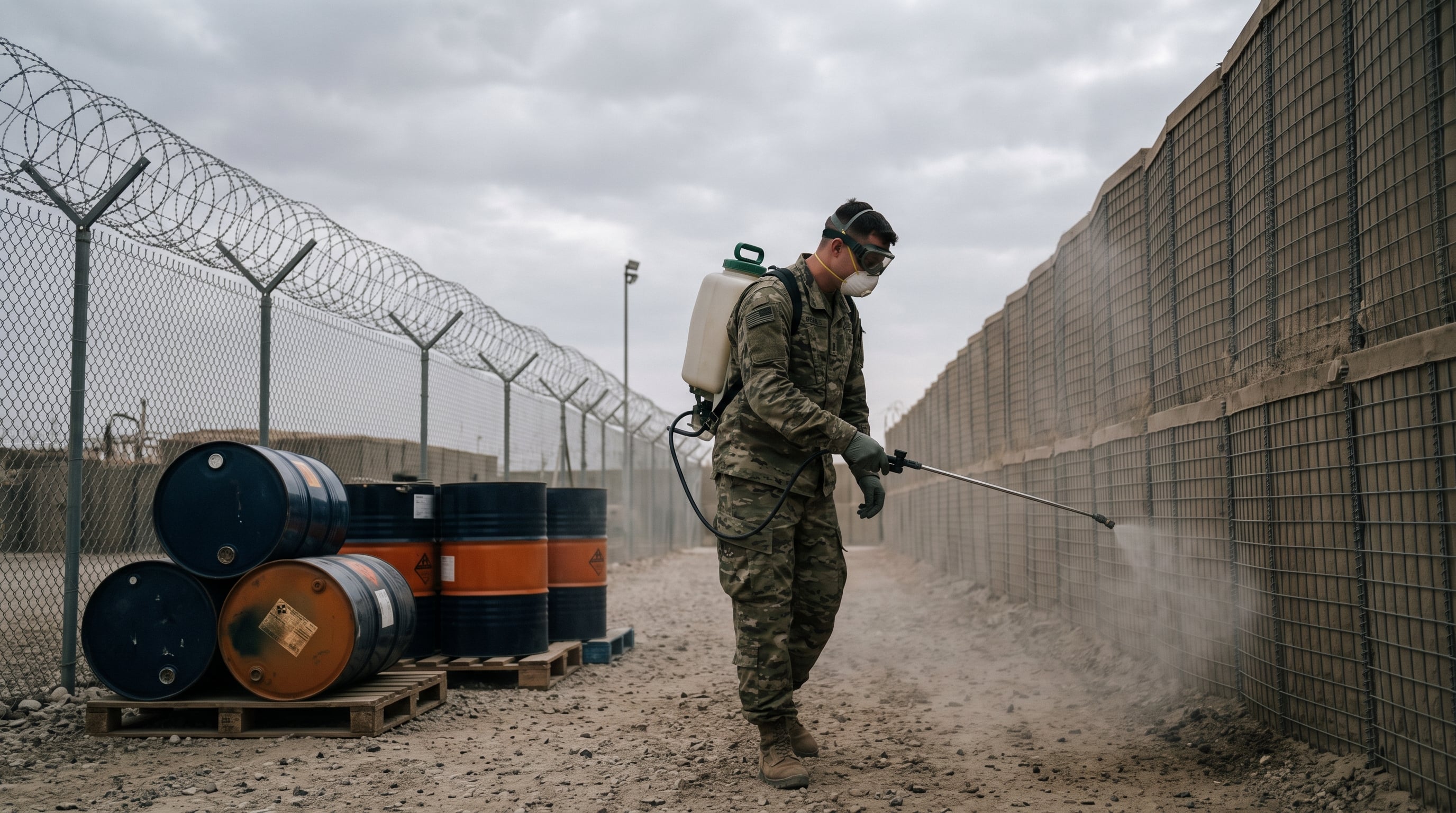
Tactical herbicides
VA recognizes presumptive herbicide exposure for qualifying units that served in or near the Korean DMZ from September 1, 1967, through August 31, 1971.
Korea claims can involve tactical herbicides near the DMZ, radiation, fuels, pesticides, asbestos, and industrial chemicals. Qualifying DMZ service has a defined presumptive window; service outside it may still support direct, facts-found exposure.
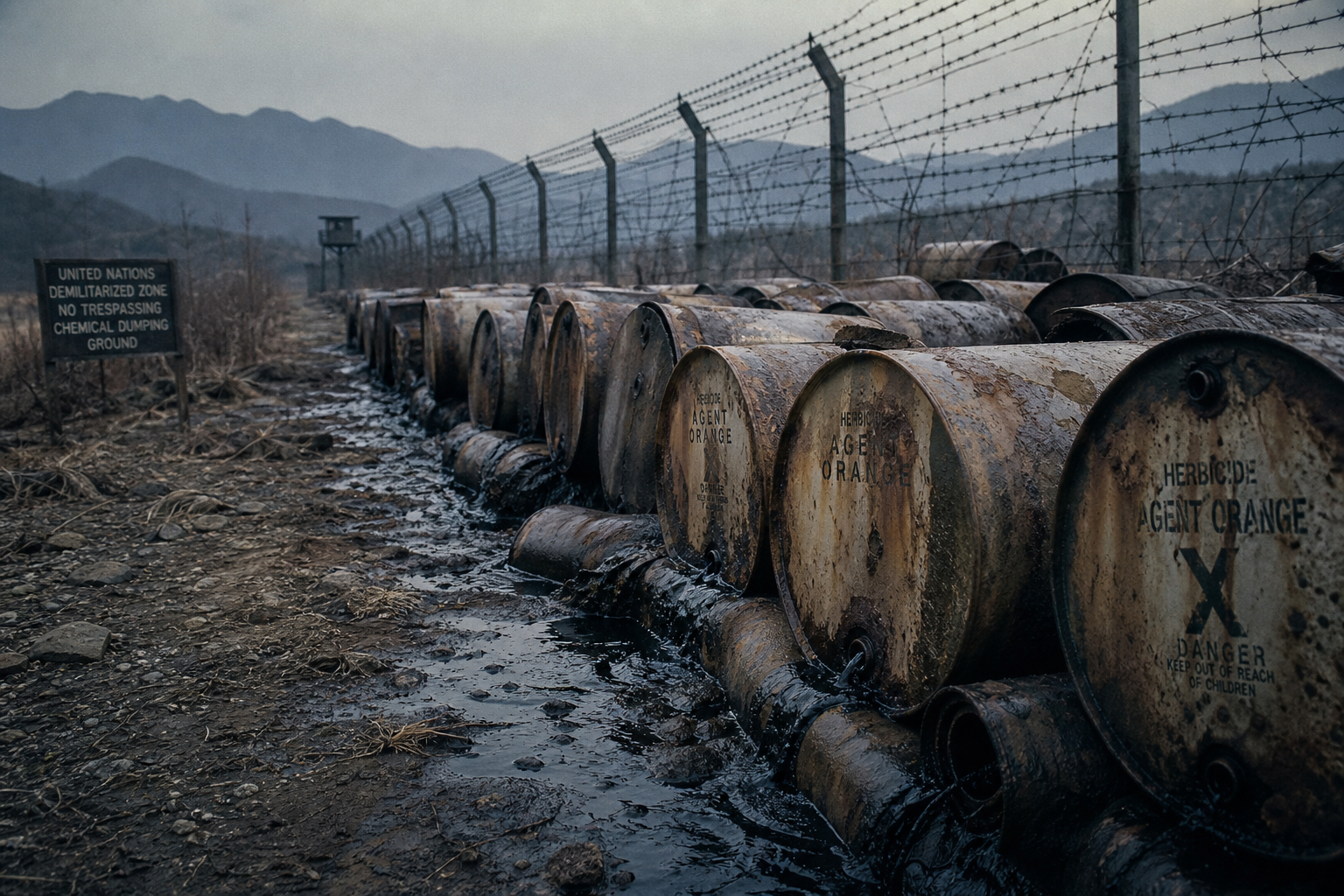
VA recognizes presumptive herbicide exposure for qualifying units that served in or near the Korean DMZ from September 1, 1967, through August 31, 1971.

Maintenance, supply, transport, communications, and field duties may involve solvents, fuels, exhaust, coatings, and contaminated equipment.

A radiation claim requires the correct pathway: a defined radiation-risk activity, § 3.311 radiogenic-disease development, or direct service connection.
VA explains the herbicide itself and why it damages health decades after contact. This is the same chemical sprayed along the Korean DMZ corridor, so the science here is the science behind a Korea herbicide claim. What the video does not settle is whether your unit and your dates fall inside the DMZ presumption — that is a records question, and it is the one that decides the claim.
Source: U.S. Department of Veterans Affairs, official channel
The Korean War file is really two files, and both of them start at a disadvantage. The men who fought between 1950 and 1953 carry a records problem: the July 1973 fire at the National Personnel Records Center in St. Louis destroyed roughly 80 percent of Army personnel records for service members discharged between November 1, 1912 and January 1, 1960 — precisely this population. The morning reports, rosters, and unit journals that would prove where a company actually stood no longer exist. The men who served later, along the Korean demilitarized zone, carry a different problem: the herbicide presumption for Korea is the narrowest one in the law. VA presumes exposure only for service in or near the DMZ between September 1, 1967 and August 31, 1971, and only for units VA has accepted as having operated there. A veteran who walked the same fence line in 1966, or in 1972, gets nothing automatic at all.
The second obstacle is age. Every condition this era produces — type 2 diabetes, ischemic heart disease, peripheral neuropathy, parkinsonism, bladder cancer — is also a condition of being eighty years old, and examiners write exactly that. The answer is not to argue that aging is irrelevant. The answer is to get the exposure into the record before the medical argument starts: the unit designation and its documented location, temporary duty orders, the camp or depot and what was stored, sprayed, or burned there, the job actually performed rather than the code printed on the DD-214, and a clinician willing to write that the exposure at least as likely as not contributed. Once exposure is established, age becomes one opinion against another instead of the only opinion in the file.
Two veterans of the same conflict rarely carry the same claim, and veterans of different conflicts often carry the same one. The first panel is what belongs to this era alone. The second is the layer this era shares with the rest of the site — and it is the layer that reopens old denials.
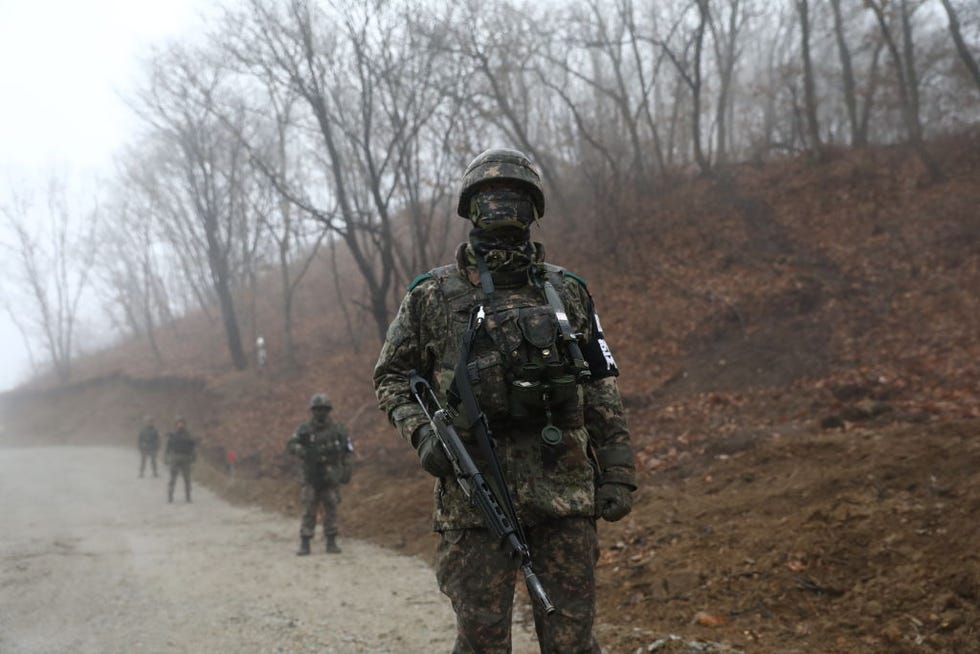
These hazards belong to this era. A decision-maker will not think of them unless your file names them.

This is the part most Korean War veterans are never told. Several exposures in your file are governed by the same regulations that decide Vietnam, Gulf War, and post-9/11 claims.
Exposure is only half of a claim. The other half is a diagnosis the law will connect to it. Here is what these exposures are known to cause, sorted by the regulation that actually decides it — because a presumptive condition and a facts-found condition are argued in completely different ways, and filing one as the other is how good claims die.

If your service falls inside the DMZ window and you carry any diagnosis on this list, VA presumes the herbicide exposure caused it. No medical opinion linking it to service is required. The list at 38 CFR § 3.309(e) holds eighteen entries:

Nothing here is presumed. Each of these is granted when the file establishes the exposure, the diagnosis, and a medical opinion connecting the two. This is where the majority of Korean War claims actually live, and where they need help.
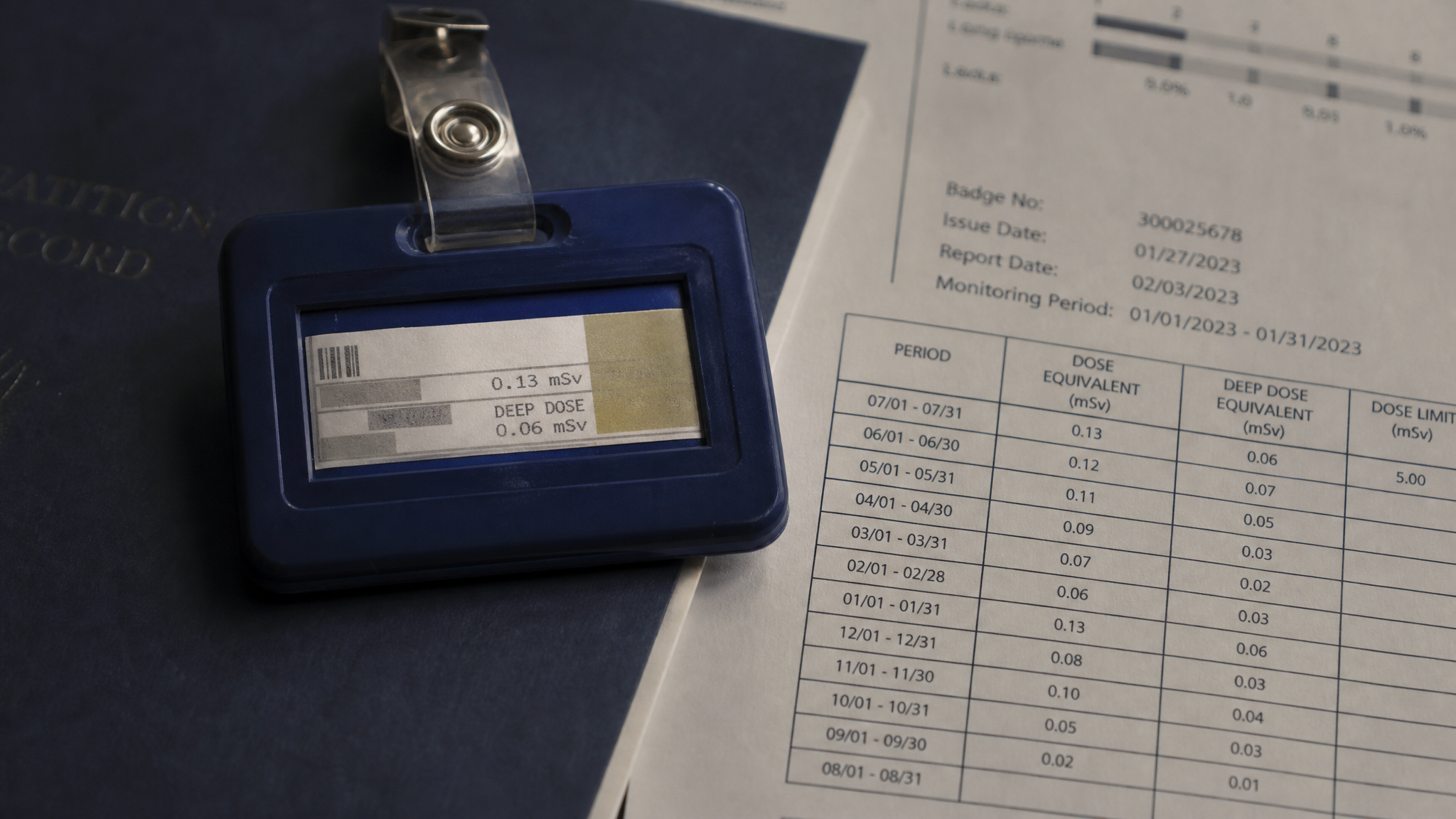
Radiation is one word to a veteran and three different regulations to VA. Naming the wrong one gets a claim denied on procedure instead of merit.
Early-onset peripheral neuropathy is the one item on the herbicide list with a time limit built into it: it must have become manifest to a degree of 10 percent within one year of the last exposure. Neuropathy that appeared decades later is not excluded from compensation — it is simply argued on the facts, or as a complication of presumptive diabetes, instead of under the presumption.
A percentage is not a judgment about how sick you are. It is a description of documented function measured against fixed criteria. Below are the actual criteria for the conditions this era produces most often, quoted from the rating schedule, so you can see exactly what your records need to say.
38 CFR § 4.119
Requires more than one daily injection of insulin, a restricted diet, and regulation of activities, with episodes of ketoacidosis or hypoglycemic reactions requiring at least three hospitalizations per year or weekly visits to a diabetic care provider, plus either progressive loss of weight and strength or complications that would be compensable if separately evaluated.
Requires one or more daily injections of insulin, a restricted diet, and regulation of activities, with episodes of ketoacidosis or hypoglycemic reactions requiring one or two hospitalizations per year or twice a month visits to a diabetic care provider, plus complications that would not be compensable if separately evaluated.
Requires one or more daily injections of insulin, a restricted diet, and regulation of activities.
In plain terms: This is the tier the most files belong in and the most files miss. All three elements have to appear in the records, including a provider writing that strenuous activity must be avoided. "Regulation of activities" is defined in the schedule as avoidance of strenuous occupational and recreational activities.
Requires insulin and a restricted diet, or an oral hypoglycemic agent and a restricted diet.
Manageable by a restricted diet only.
Compensable complications of diabetes are rated separately unless they are used to support a 100 percent evaluation. Peripheral neuropathy, retinopathy, kidney disease, and erectile dysfunction are the four that go unclaimed most often — a veteran sitting at 20 percent for diabetes alone is usually leaving several separate ratings on the table.
38 CFR § 4.104, General Rating Formula for Diseases of the Heart
Chronic congestive heart failure; or a workload of 3.0 METs or less resulting in dyspnea, fatigue, angina, dizziness, or syncope; or left ventricular dysfunction with an ejection fraction of less than 30 percent.
More than one episode of acute congestive heart failure in the past year; or a workload greater than 3.0 but not greater than 5.0 METs resulting in dyspnea, fatigue, angina, dizziness, or syncope; or an ejection fraction of 30 to 50 percent.
A workload greater than 5.0 but not greater than 7.0 METs resulting in dyspnea, fatigue, angina, dizziness, or syncope; or evidence of cardiac hypertrophy or dilatation on electrocardiogram, echocardiogram, or X-ray.
A workload greater than 7.0 but not greater than 10.0 METs resulting in dyspnea, fatigue, angina, dizziness, or syncope; or continuous medication required.
One MET is the energy cost of standing quietly at rest, equal to 3.5 milliliters of oxygen consumed per kilogram of body weight per minute. When exercise testing cannot be performed for medical reasons, the examiner is required to provide an estimated METs level. An examination that comes back with no METs figure and no explanation is an inadequate examination, and that is worth saying out loud in a Higher-Level Review.
38 CFR § 4.104
Diastolic pressure predominantly 130 or more.
Diastolic pressure predominantly 120 or more.
Diastolic pressure predominantly 110 or more, or systolic pressure predominantly 200 or more.
Diastolic pressure predominantly 100 or more; or systolic pressure predominantly 160 or more; or a history of diastolic pressure predominantly 100 or more in a person who requires continuous medication for control.
In plain terms: Read the last clause twice. A veteran whose readings are now controlled by medication still meets the 10 percent criterion if the history shows diastolic pressure predominantly 100 or more. Controlled is not the same as unratable.
Hypertension only became a presumptive herbicide condition when the PACT Act was signed in August 2022. A Korean DMZ veteran who was denied hypertension before that date was denied under a law that no longer exists. That claim can be filed again.
38 CFR § 4.124a
Minimum rating for paralysis agitans with ascertainable residuals.
The 30 percent is a floor, not a ceiling, and it is where far too many Parkinson files stop. Above the minimum, the evaluation is built from the residuals themselves — tremor, rigidity, bradykinesia, speech and swallowing impairment, cognitive change, bowel and bladder impairment, and loss of function in each affected extremity — each rated under its own diagnostic code and then combined. A file that shows only "diagnosed with Parkinson disease" will be paid the minimum. A file that documents each residual separately is rated on what the disease actually took.
Nothing on this page is a promise about your claim. The point of quoting the criteria is that a percentage is a description of documented function — so the examination and the treatment records have to describe your function in the same language the schedule uses. When they do not, the problem is the examination, not the veteran.
Combine your ratingsThere are three ways into this era, and they are not interchangeable. Find the door your service actually fits before you write a word on a form.

Service in or near the Korean demilitarized zone between September 1, 1967 and August 31, 1971, in a unit VA has accepted as operating there. Inside this door, exposure is conceded and a listed disease is presumed service-connected.
What the file needs

Served in 1966, or 1972, or somewhere else entirely, or your disease is not on the list. Presumptions are a shortcut, never the only route. Direct service connection under 38 CFR § 3.303(d) has no list and no window — it needs proof.
What the file needs

The most common under-rating in this era is not a denial at all. It is a granted condition whose consequences were never claimed. Diabetes is granted at 20 percent, and the neuropathy, retinopathy, kidney disease, and heart disease it produced sit in the medical records unclaimed for years.
What the file needs
Order matters more than speed. Every step below is free, and the first one protects money you have not been awarded yet.
An Intent to File locks your effective date for one year. Everything you are later awarded is paid back to the date VA received that form, not the date you finished gathering evidence. It takes minutes and costs nothing.
One form can carry many conditions, but each one has to be named. "Breathing problems" is not a claim; asthma, chronic sinusitis, and chronic rhinitis are three claims with three sets of criteria, and each is rated on its own before the ratings are combined.
The Individual Longitudinal Exposure Record compiles what the government already knows about where you served and what was there. For exposure that is not on a presumptive list, ask for a Toxic Exposure Risk Activity determination under 38 U.S.C. § 1168 — that determination is what turns an unlisted exposure into a developed one.
Form 21-22a appoints an accredited agent or attorney; form 21-22 appoints a veterans service organization. Representation is never required. No one may lawfully charge you a fee to prepare or file an original claim.
A Supplemental Claim (20-0995) is for new and relevant evidence. Higher-Level Review (20-0996) is for a decision that got the existing evidence wrong and allows no new evidence. A Board appeal (10182) is for the law itself. Choosing the wrong lane can cost a year and, in the worst case, an effective date.
Filing an original claim is free, and it is against the law for anyone to charge you a fee to prepare or file one. Fees are permitted only after a decision has been issued, under a written agreement with an accredited representative. If someone asks you for money to start a claim, walk away.

This is a free VA health examination for veterans with possible herbicide exposure. It is not a claim, and it is not a compensation and pension examination — but it puts a documented exposure concern and a baseline of your health into the VA system, which is exactly what an old file usually lacks.
Ask the Environmental Health Coordinator at your VA medical center, or ask your VA primary care team to place the referral. If you do not know who your coordinator is, call MyVA411 at 800-698-2411 — available 24 hours a day, seven days a week — and ask to be connected to the Environmental Health Coordinator at your facility.
Signing up for a registry exam is not filing a claim, and being in a registry is not evidence that you were exposed. Do both: get the exam so your health is documented, and file the claim so the clock on your effective date starts running.
Registry exams and exposure evaluations start with a clinician. Our doctor page has the words to use at the appointment, the direct phone number and VA email of the exposure coordinator at your own VA medical center, and every VA registry you can sign up for.

The exposure did not stop at the fence line. Children of veterans who served in or near the Korean DMZ during the recognized herbicide window can carry a birth-defect benefit, and a surviving spouse or child may qualify for tax-free monthly support if a service-connected condition eventually takes the veteran's life.
Both options are free · No obligation
Talking to a VA-accredited claims agent costs nothing either way. Pick the one that fits: get answers to your questions, or register to hire us to take on your claim.

Free information — just ask
You can ask Albert, our AI claims assistant, anything about exposure, evidence, or the claims process — he answers instantly. If you would rather have a direct, personal answer, send your question below and an accredited agent will come back to you. No cost, no obligation.

Ready to hire us? Register with us
For veterans who have decided they want us on their claim. Registering is free too, and it takes the registration form plus a signed VA Form 21-22a.
Until VA Form 21-22a is signed we cannot accept your claim, access your VA file, or do any work on your behalf. That is federal law, not firm policy.
What happens after you register
An accredited agent personally reviews every request — we’ll reach out within 48 hours.