
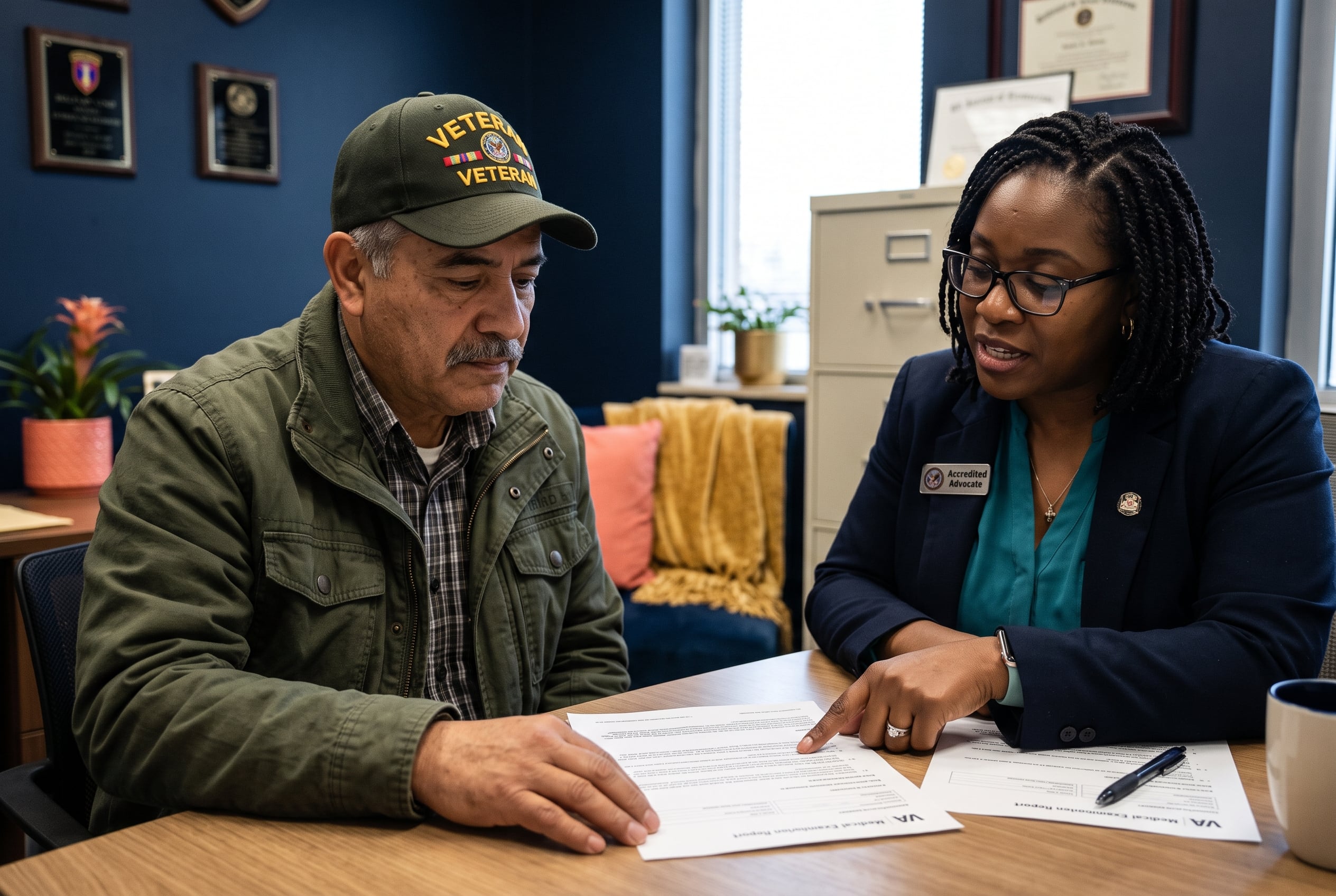
The compensation and pension exam is the hinge your entire claim swings on. A rating specialist who has never met you will read that report and assign a number. If the report is wrong, the number is wrong, and it stays wrong until somebody makes it right.
I read a lot of these reports. The bad ones share a handful of recognizable defects, and all of them are challengeable.
First, the legal footing
You are not asking VA for a favor when you challenge an exam. Two principles are on your side:
- Barr v. Nicholson — when VA undertakes to provide an examination, it must provide an adequate one. An inadequate exam does not satisfy VA's duty to assist.
- Nieves-Rodriguez v. Peake — the probative value of a medical opinion comes from the reasoning behind it, not from the credentials of the person who signed it. A conclusion with no explanation carries little weight regardless of who wrote it.
- Stefl v. Nicholson — a medical opinion must support its conclusion with a reasoned analysis. "Less likely than not related to service" with nothing after it is not an opinion; it is an assertion.
Those three cases are the frame for everything below.
What makes an exam inadequate
The examiner never reviewed the record
Look for a report that says the claims file was reviewed but then contradicts documents in it — mentions no in-service treatment when your service treatment records show three visits, or states there is no continuity of symptoms when your VA treatment notes run back eleven years. That contradiction is the finding. Quote both documents side by side.
The required measurements were not taken
Every rating criterion is built on specific findings. Range of motion in degrees. FEV-1 as a percentage of predicted. Frequency of incapacitating episodes. If the report omits the measurement the rating schedule requires, the report cannot support any rating under that criterion. Check the report against the diagnostic code you are being rated under and list every missing element.
Flare-ups were ignored
For musculoskeletal claims, an examiner is expected to address functional loss during flare-ups and after repetitive use, and to explain if that cannot be estimated. An exam performed on a good day, with no discussion of bad days, does not describe your disability.
The negative opinion has no rationale
The most common defect of all. A single sentence — "not caused by or related to military service" — with no discussion of the exposure, the timeline, the medical literature, or the alternative cause the examiner apparently has in mind. Under Stefl and Nieves-Rodriguez, that is weak evidence and you should say so in those terms.
The examiner was outside their lane
A general practitioner opining on the etiology of a rare autoimmune condition, or a nurse practitioner rendering a psychiatric diagnosis, is a specificity problem worth raising — not as an insult, but as a question about the weight the opinion can bear.
The exam was too short to do what it claims
A twelve-minute appointment that produced a report describing a full joint examination, a neurological screen, and a review of a four-hundred-page file is worth documenting. Which brings us to the next step.
Step one: document it while it is fresh
Do this the same day, before memory softens.
- Write down the times. Arrival, called back, examiner entered, examiner left. Exact clock times.
- Write down who. Name, credentials, and whether they were VA staff or a contract examiner.
- Write down what was and was not done. Did they touch the joint? Use a goniometer? Ask about flare-ups? Ask about work impact? Ask any question about your exposure history?
- Write down what you said. Especially anything you reported that later fails to appear in the report.
- Keep the appointment paperwork. Check-in slips and appointment letters establish the timeline.
A dated, specific, unemotional statement written the day of the exam is credible evidence. A furious statement written eight months later, after the denial, is much less so.
Step two: get the report
Request the actual examination report. You cannot challenge what you have not read, and veterans routinely appeal based on what they assume the examiner wrote rather than what is on the page. Sometimes the report is fine and the rating specialist misread it — a completely different problem with a completely different fix.
Step three: build the counterweight
Pointing out that an exam was bad is necessary but rarely sufficient. Give the reviewer something better to rely on:
- A private medical opinion that does what the VA opinion did not — reviews the record, addresses the exposure and the timeline, cites the literature, and explains its reasoning to a stated standard of probability.
- Objective testing obtained privately: spirometry, imaging, sleep studies, neuropsychological testing, range-of-motion measurements taken during a flare.
- A symptom log kept over weeks, showing frequency and duration rather than a single snapshot.
- Lay statements from people who see the bad days.
Step four: pick the right lane
Under the Appeals Modernization Act you have one year from the decision date and three options. Choosing wrong costs months.
Supplemental Claim — VA Form 20-0995
Use this when you have new and relevant evidence. A private medical opinion, new test results, your same-day exam statement, lay statements. This is the correct lane for most bad-exam cases, because the fix is usually better evidence rather than a legal argument. VA has a duty to assist in developing a supplemental claim.
Higher-Level Review — VA Form 20-0996
Use this when the evidence is fine and the application of it was wrong — including a duty-to-assist error such as relying on an inadequate exam. A more senior reviewer looks at the same record. You cannot submit new evidence. You can request an informal conference to explain the error, and that conference is worth taking. If your argument is "this exam did not comply with Barr," this is the lane.
Board Appeal — VA Form 10182
Goes to the Board of Veterans' Appeals with three dockets: direct review on the existing record, evidence submission allowing 90 days for new evidence, or a hearing before a Veterans Law Judge. Slower, but the Board applies case law far more consistently than a regional office does.
Step five: ask for the right remedy
Be explicit about what you want. Do not just say the exam was inadequate — name the outcome:
- A new examination with a different examiner, and state why, in one factual sentence.
- A specialist examination when the condition requires one.
- An addendum opinion addressing the specific questions the first examiner skipped, listed one by one.
- Or a grant on the existing record, if your private evidence is at least in equipoise with the VA exam — because under 38 CFR § 3.102, when the evidence is in relative balance, the benefit of the doubt goes to you.
What not to do
- Do not make it personal. "The examiner was rude and clearly did not care" reads as venting. "The report states range of motion was measured; no goniometer was used during the eleven-minute appointment" reads as evidence.
- Do not submit new evidence with an HLR. It will not be considered and you will have burned a lane.
- Do not let the year lapse. After one year the decision becomes final and your options narrow sharply.
- Do not skip the exam to protest it. Failure to report can end the claim outright.
The summary
A bad C&P exam is not bad luck. It is a documentable failure of a legal duty, and it has named remedies. Write down what happened the day it happens, get the report, put something better next to it, and choose the lane that matches the actual defect.
The veterans who overturn these decisions are the ones who show up with paper.
Albert Thombs
VA-Accredited Claims Agent #45147 · 702-992-4883
No claims advice or representation without a signed VA Form 21-22a on file. This article is educational — not legal, medical, or claims advice. Accreditation is governed by 38 CFR § 14.629.