
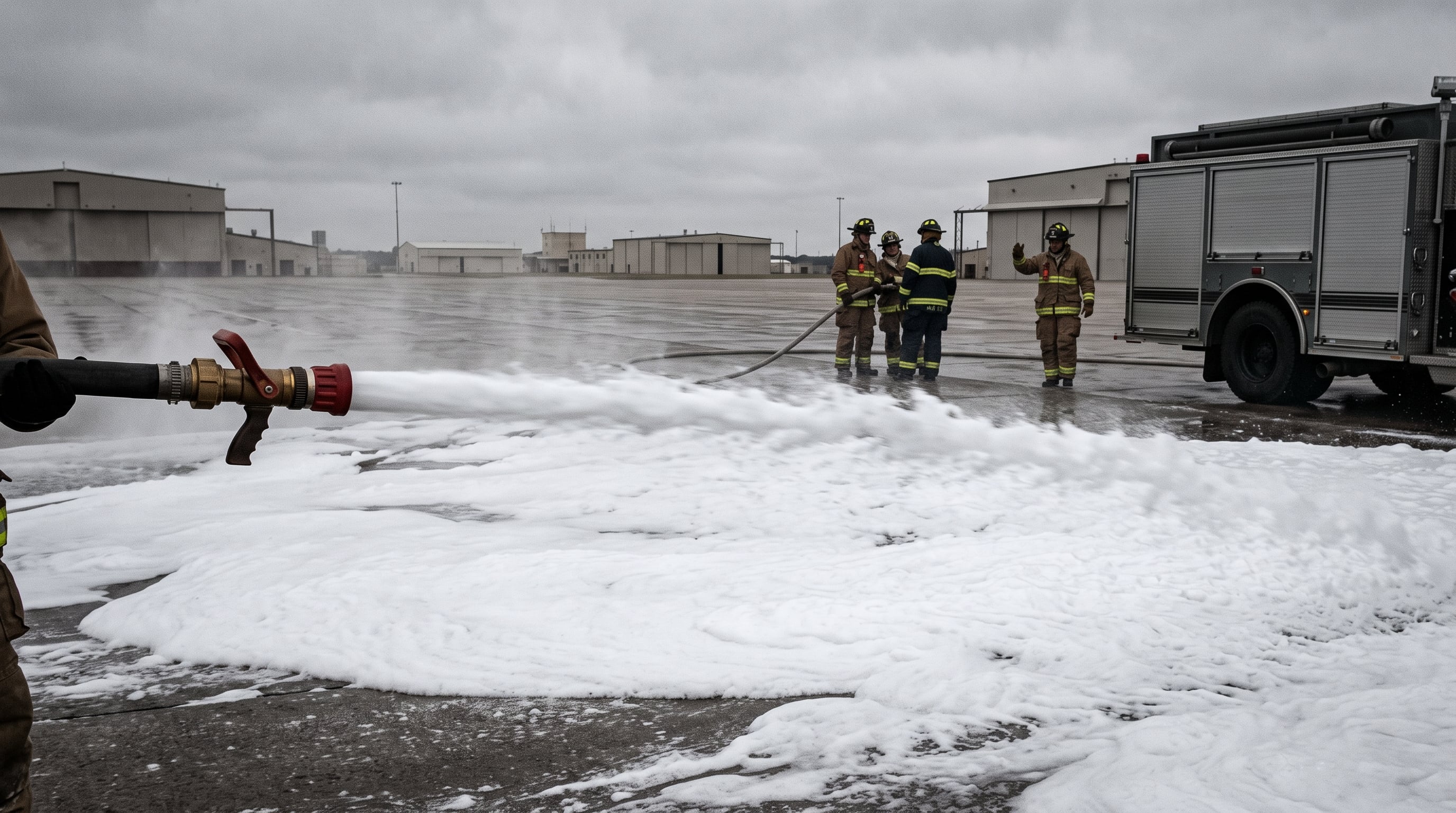
Aqueous film-forming foam — AFFF — was the military standard for fuel fires from the late 1960s onward. It works extremely well. It is also loaded with per- and polyfluoroalkyl substances, the class of compounds now known as forever chemicals because they do not meaningfully break down in the environment or in the human body.
Firefighters trained with it. Crash crews discharged it across flight lines. It ran into base drainage, into soil, and in a great many places into groundwater that fed the drinking water supply on post.
Let me start with the part that gets misrepresented most often.
There is no VA presumption for PFAS
As of now, VA has no presumptive service connection for any condition based on PFAS or AFFF exposure. Anyone telling you PFAS conditions are presumptive is wrong, and following that advice will get your claim denied.
What is true: VA has been formally reviewing PFAS exposure and its potential link to certain cancers, including kidney cancer, under the framework the PACT Act established for evaluating new presumptions. Reviews sometimes lead to presumptions and sometimes do not, and they take years.
The practical consequence is important. Because there is no presumption, an AFFF or PFAS claim must be filed as a direct service connection claim, and it must satisfy all three elements on its own evidence. That is harder. It is also entirely doable, and the veterans who do it properly are getting decisions years before any presumption might arrive.
The three elements you have to prove
- An in-service event, injury, or exposure. Here: exposure to AFFF or PFAS-contaminated water during service.
- A current diagnosed disability.
- A medical nexus linking the two — an opinion that the current condition is at least as likely as not related to the in-service exposure.
Every element needs its own evidence. Most denials I read fail on element one or element three, and almost never on element two.
Element one: proving you were exposed
Exposure evidence comes in two flavors, and the strongest claims use both.
Occupational exposure
If your job put you in contact with the foam, your records may prove it for you:
- Military firefighters — Air Force 3E7X1, Army 12M, Navy Damage Controlman and Aviation Boatswain's Mate (Handling), Marine Corps 7051. Foam was used in live training burns, sometimes repeatedly, sometimes without respiratory protection.
- Flight deck and flight line crews who responded to or trained for aircraft mishaps.
- Crash, fire and rescue personnel at any airfield.
- Maintenance and hangar personnel where fixed foam suppression systems discharged, including accidental system activations.
- Shipboard damage control ratings who conducted foam drills in enclosed spaces.
Pull your training records, your qualification records, your evaluations, and your assignment history. An MOS or rating alone establishes plausibility; documented training in foam application establishes contact.
Environmental exposure
You did not have to touch the foam. If you drank the water, lived in base housing, or attended a school on an installation where PFAS entered the water supply, that is exposure too.
The Defense Department has conducted PFAS assessments at a large number of installations and has published testing results and cleanup status for many of them. Those documents are the backbone of an environmental exposure claim, and they are far more persuasive than a veteran's recollection because they are the government's own findings.
What to assemble:
- Orders and assignment history establishing which installation and which years.
- Housing records, if you lived on post — barracks assignment or family housing.
- The installation-specific PFAS testing and assessment documentation for those years, if it exists.
- Any state or local environmental findings for the water system serving the base.
Be precise about dates. "I was at that base sometime in the nineties" is not an exposure case. "I was assigned there from June 1993 to September 1996 and lived in family housing served by the affected wells" is.
Element two: the diagnosis
The conditions most often raised in PFAS claims include kidney cancer, testicular cancer, thyroid disease, ulcerative colitis, high cholesterol, liver enzyme changes, pregnancy-related hypertension and preeclampsia, and reduced vaccine response in children. The strength of the scientific evidence varies considerably by condition — kidney and testicular cancer and thyroid disease have the most substantial literature behind them.
What matters for your claim is that the diagnosis is current, documented, and made by someone qualified. A suspicion is not a diagnosis. Get the pathology, the labs, the imaging, and the specialist's note into the file.
Element three: the nexus, which is where these claims are won
Without a presumption, the medical opinion carries the whole case. A nexus letter that works here does five things:
- States that the record was reviewed, and identifies specifically what was reviewed — service records, the installation testing documents, the treatment history.
- Describes the exposure factually — route, duration, and intensity. Occupational foam handling for six years, or consumption of contaminated drinking water for thirty-eight months.
- Cites the scientific literature connecting PFAS to the specific diagnosed condition, by name.
- Addresses alternative causes honestly, and explains why exposure remains at least an equal contributor.
- States the conclusion to the legal standard: that it is at least as likely as not — a 50 percent or greater probability — that the condition is related to the in-service exposure.
Under 38 CFR § 3.102, when the positive and negative evidence is in approximate balance, the benefit of the doubt belongs to the veteran. You do not need to prove the exposure caused the illness. You need to get to equipoise. That is a materially lower bar than most veterans think they are facing, and a well-reasoned opinion can reach it.
Two more angles worth knowing
Camp Lejeune is separate
Contaminated water at Camp Lejeune between August 1, 1953 and December 31, 1987 has its own presumptive framework covering a specific list of conditions, and the Camp Lejeune Justice Act created a separate legal claim route entirely. That contamination involved different chemicals — trichloroethylene, perchloroethylene, benzene, vinyl chloride — not PFAS. Do not conflate the two.
Secondary service connection
Under 38 CFR § 3.310, a condition caused or aggravated by an already service-connected condition is itself service-connected. If PFAS-linked thyroid disease is already service-connected, the downstream conditions it causes are claimable as secondaries. Veterans consistently underuse this.
Do this now, not after a presumption
- File an Intent to File. It locks your effective date for up to a year. If a presumption ever arrives, your date is already protected.
- Pin down your installations and dates. Every one, with the years.
- Get the installation testing documentation for those bases and years.
- Get diagnosed properly. If your labs have been drifting for years, get them looked at by a specialist and written down.
- Commission a real nexus opinion. Not a form letter — a reasoned analysis that cites the literature and reaches the 50 percent standard.
The honest position
These are harder claims than burn pit claims, and I will not pretend otherwise. There is no presumption to lean on, the science is still consolidating, and the exposure evidence takes real work to assemble.
But "harder" is not "hopeless," and waiting for a presumption that may never come is a decision with a real cost. An Intent to File takes ten minutes and protects your effective date today. Do that part regardless of how the rest of it goes.
Albert Thombs
VA-Accredited Claims Agent #45147 · 702-992-4883
No claims advice or representation without a signed VA Form 21-22a on file. This article is educational — not legal, medical, or claims advice. Accreditation is governed by 38 CFR § 14.629.